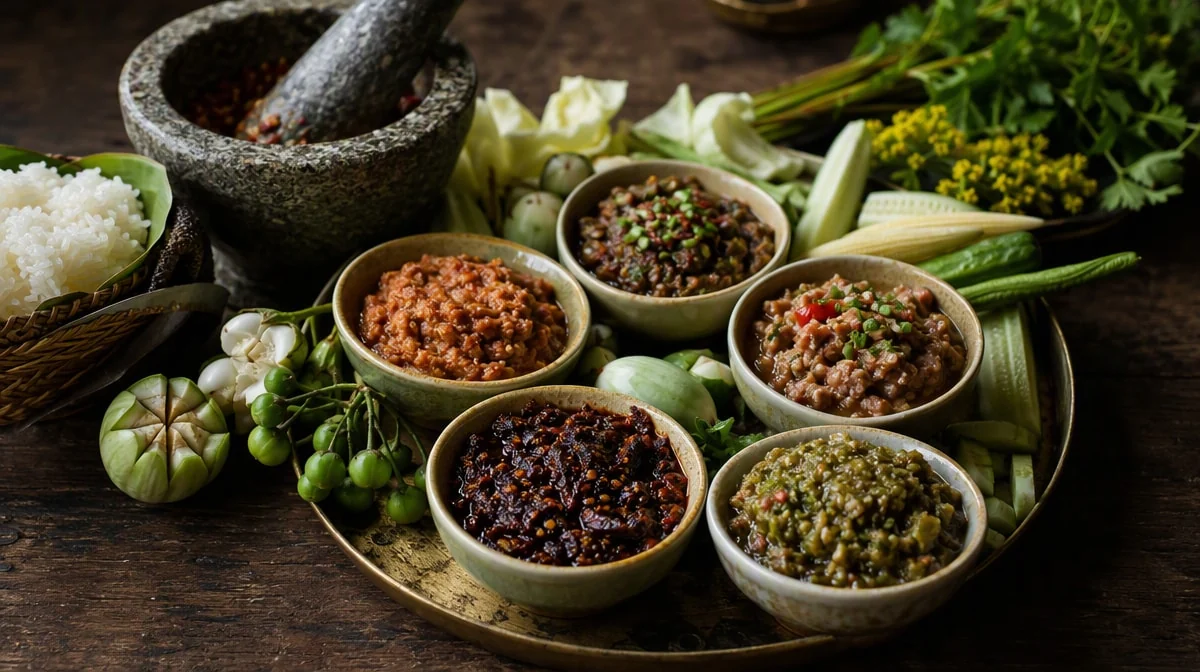
Nam prik is a category, not a sauce. Chillies and aromatics pounded or roasted to a paste, seasoned to be sour, salty and sweet at once, eaten in small amounts. It does two jobs. It is a dip, spooned out with rice and a plate of raw or cooked vegetables, and it is a seasoning, fried by the spoonful into stir-fries and soups. The name is the grammar: nam phrik (น้ำพริก, written nam prik or nam phrik in the cookbooks) is chilli plus the word for its liquid, and one more word says which paste you are holding.
Most English pages describe one member, nam prik pao, as if "Thai chilli paste" were the whole family. It is not. A raw pounded dip of garlic, shrimp paste and eggplant belongs to the same set, and so does a tomato-and-pork dip from the north.
What Is Nam Prik?
A Thai royal-cuisine course book states the family's seasoning target as plainly as English allows: taste for "a balanced salty, sour, and sweet flavour", all three prominent, a strong and bold profile. Heat is not on that list. Heat is available and adjustable, and it is not what the dish is judged on.
The half British cooks miss is the second job. A collection of Thai recipes written for Australian pantries says the family is "what Thais use to season almost everything they eat", and gives the simplest advice in the whole subject: "use white rice to provide a neutral background to the pungency of the sauce." A 2016 guidebook calls them "more home than restaurant food", eaten with rice and steamed or fresh vegetables and herbs.
| Name | What is in it | Eaten how |
|---|---|---|
| nam prik pao ("chilli jam") | dried chilli, shallot, garlic, dried shrimp, shrimp paste, tamarind, palm sugar, oil; roasted then fried | into cooking; a dip too |
| nam prik noom / num | green chillies, shallot, garlic | dip, with sticky rice and boiled veg |
| nam prik ong | tomato, minced pork, shallot, dried chilli, lemongrass, shrimp paste, fermented fish | dip, or steamed with fish |
| nam prik kapi | shrimp paste, garlic, chilli; sometimes pork, peanuts, tamarind | the sharpest; dip and larder item |
| nam prik makham thot | ripe tomato, minced pork, peanuts | lettuce cups, fried rice crackers |
| nam prik jaew | chilli, lime, fish sauce, toasted rice | grilled meat; a different family, different page |
Nam Prik vs Curry Paste: Two Meanings, One Word

Search for nam prik and curry paste comes back, because of a naming pattern no English article explains. In Thai, a curry paste is printed as nam phrik gaeng plus the name of the curry. A Thai-English collection published in Britain labels five of them that way: nam-phrik gaeng khiaw-waan for green, nam-phrik gaeng phet for red. A professional cooking school's Thai book does the same thing, labelling the nam prik ong paste in one of its own dishes a curry paste.
Nam phrik does two jobs, exactly as "paste" does in English. Read it this way: nam phrik on its own, or with
a dip name after it, is what this page is about. Nam phrik gaeng plus a curry name, or khrueang gaeng, is
curry paste, and our red Thai curry paste guide covers what those contain and what
prik gaeng phet means.
What actually differs is where the cooking finishes. Curry paste leaves the mortar raw or barely cooked, is fried in the pot and dissolved into coconut milk or stock. A nam prik is finished in the bowl: already seasoned to eat, with anything fried fried before the paste was made, not after. That is why swapping them fails: chilli jam in a curry makes a thin, sweet, sour curry, and curry paste used where a dip is wanted gives the one-dimensional result our sriracha-substitute page warns about.
How Nam Prik Is Made: Three Routes
Almost every name in the family is one of three methods, and the method tells you how the paste keeps.
Route one: pounded raw. Garlic pounded to a paste, shrimp paste ground into it, chillies bruised gently "so the liquid won't splash", then sugar, fish sauce and lime beaten in. Nothing is heated, and the seasoning is settled by tasting as you go.
Route two: charred, then mashed. Chillies, shallots and garlic grilled until the skins blacken, then mashed with lime and salt. No oil, no frying, and it does not keep: this is the northern noom group, and at home it is a gas flame, a grill rack or a dry wok, then a blender. If you want chilli powder rather than paste, that same dry wok and a spice grinder will do it faster than the dry-roasting method our curry-paste pages use.
Route three: roasted, then fried down in oil. Dried chillies charred, aromatics fried properly brown, everything ground to a paste and cooked low in its own oil until it thickens. This is the only member that keeps for months. Two cautions belong at this stage. Fry it too far and you get what one book calls "a caramelized lump", not a jam. And if the paste is meant to be sour, the lime goes in after the heat is off, because palace recipes say lime juice loses its sharpness when heated.
Nam Prik Pao: the Chilli Jam to Keep in the Fridge
This is the roasted, oil-fried type: dried chilli, shallots, garlic, dried shrimp, a little shrimp paste, tamarind, palm sugar and fish sauce, cooked down thick, glossy and sweet-savoury. One Thai cookbook says chilli jam "doubles as a stir-fry seasoning for greens"; another's index files a prawn fried rice under "khao phat kung naam phrik phao". The thing to understand about nam prik pao is that it is a cooking ingredient that happens to be a dip, not a dip that happens to be used in cooking.
The recipe below is from a Culinary Institute of America book, credited to a Bangkok restaurant. It makes about 375 ml and keeps for months.
- garlic, finely sliced: 80 g
- shallots, finely sliced: 150 g
- dried red chillies, 5-7 cm long: 12
- vegetable oil: 240 ml
- ground dried shrimp: 40 g
- palm sugar: 100 g
- tamarind juice: 2½ tbsp
- fish sauce: 1 tbsp
- salt: ½ tsp
Fry the garlic, shallots and chillies separately in the oil until golden, lift them out, drain. Blend them to a paste with half the oil to loosen. Return everything with the rest of the ingredients and stir over low heat for a few minutes, until the flavours have married. Cool, jar, refrigerate.
What it does in a dish. A guidebook's tom yum paragraph says that where a soup asks for fresh bird's chillies, "half a teaspoonful of nám prík pŏw" is the alternative, which is why our tom yum nam sai vs nam khon page keeps meeting it in the creamy style, and why a teaspoon of it colours restaurant pad thai without tasting of tomato.
Substitutes and the sriracha comparison belong on our can sriracha replace Thai chilli paste page, not here.
Nam Prik Noom and Nam Prik Ong: Two Northern Dips
Nam prik noom (noom in search, num in the books and in our own northern Thai food guide): green chillies, shallots and garlic grilled until charred, mashed with the char still on, seasoned with lime, salt and a little shrimp paste. The guidebook's description is the best printed in English: "grilled then mashed into a stringy and spicy paste", served with sticky rice, parboiled vegetables and deep-fried pork crackling, at "just about every evening market" in the north. The accompaniments are the tell: parboiled rather than raw, and crackling, which the palace book's northern dip also uses for texture. Serve it with sticky rice you cooked properly rather than jasmine.
Nam prik ong is the tomato-and-pork one. The guidebook calls it a Shan-origin chilli dip of tomatoes and minced pork, and reaches for a simile no food writer should get away with, "a northern Thai bolognese of sorts". The Chiang Mai chefs' version in the cooking-school book pounds lemongrass, coriander root, shrimp paste, two kinds of tomato, dried chilli, fermented fish and chicken stock; half of it is steamed into a whole sturgeon, the rest spooned over. Fermented fish in a tomato-and-pork dip is the detail that says where this dish lives: the north-and-Isaan boundary, and our Isaan food page explains what pla ra does to a plate.
Nam Prik Kapi: the Sharpest of the Family
Kapi is shrimp paste, and this one announces itself before you see it. One Thai recipe book's warning is fair: it is "about as pungent as an accompaniment can get". If you want Thai home cooking at its most uncompromising, make this. There are two versions and they are not the same dish.
The fresh one is route one with Thai eggplant pounded through it. Shrimp paste gives the dish its name. The quantities in the copy we read are lost to a damaged scan, but the method survives, and it is forgiving.
The palace version is cooked and much more interesting: chillies, garlic and galangal toasted crisp and pounded, then worked into shrimp paste that has been roasted first, with fried dried shrimp, peanuts and shredded pork folded in, and tamarind boiled with fish sauce and sugar stirred through. Its finishing instruction is the family's target stated outright: taste for "all three flavours, sour, salty, and sweet", strong and bold, add basil off the heat, serve hot.
The same book then does something no English source on this subject mentions. It lists a prepared nam prik kapi as an ingredient in another recipe, 10 g of it, the way a Western recipe uses a spoon of mustard. It also builds a palace rice dish around a different paste in that list, nam prik makham pieak: tamarind pulp, dried shrimp, dried chillies, shallots, garlic, shrimp paste, fish sauce and palm sugar, mixed through cooked rice and packed into a banana-leaf cone. Some of these pastes are not plates. They are larder.
How to Eat Nam Prik

A small bowl of paste, a lot of vegetables, and rice. Three books describe that plate and agree on its shape: fresh cucumber, cabbage, green beans, lettuce and herbs, plus steamed or boiled aubergine, chayote and long beans. One palace list adds grilled catfish, pickled garlic and salted eggs. The Thai cookbook puts fruit on the same plate as its kapi dip, including pomelo and rose apple, which its own glossary lists among the fruits usually served with dips. That is not a mistake; it is the same balance logic the paste is built on. Crunch comes from pork cracklings or roasted peanuts.
Portion sense is the part that goes wrong in Britain. A tablespoon of paste serves two or three people with a plate of vegetables around it; the paste is seasoning, not the main course. Put out more vegetables than you think you need, add boiled eggs and grilled fish, and keep the jar on the table rather than on the plate. The rest of the etiquette belongs to a page about table manners.
How Long Nam Prik Keeps
The numbers come from the books. A pounded fresh dip is made to be eaten and keeps a few days. A cooked shrimp-and-dried-shrimp nam prik lasts up to two weeks in an airtight jar. Home chilli jam gets six weeks in one book, "several months" in another, "months in a glass jar" in a third. A shop jar is ambient until opened, then refrigerated and lidded. Oil and sugar are what make the difference, and both are in the recipe: a paste fried down in a cup of oil and jarred hot has an oil layer over the top, and that layer is the seal. The rules after that are dull: a clean dry spoon, a lidded jar rather than an open bowl, a date on the lid.
Judge a nam prik the way you judge anything fermented and pungent. It is meant to smell strong, and a month-old paste usually tastes better than the day it was made. Look for change rather than intensity: a fizzy fermentation, mould at the rim, a sourness gone from deliberate to aggressive. Our page on whether fish sauce goes off is the nearest analogue on this site for making that call, and the curry-paste storage guide covers the same reasoning for a paste that gets cooked instead of eaten.
Buying Nam Prik in the UK
You can buy nam prik in Britain; the labels are the hard part. Here is what UK Thai grocers listed when this was written, with no prices, because prices date a page.
"Chilli paste in oil" is the phrase to look for. That is how the biggest Thai export brand labels nam prik pao, and a UK Thai online supermarket says so in plain words: "In Thai this is known as 'nam prik pao'." It comes as a 250 g jar and a 400 g tub. Another brand's jar is labelled helpfully as "Chilli Paste in Soy Bean Oil (Nam Prik Pao)". The same grocer has listed a 100 g jar of nam prik ong chilli paste, a jar of nam prik jaew, one labelled nam prik pla-ra with preserved fish, lemongrass and tamarind in the ingredients, and a tub its label calls narok. Two of those were out of stock when I checked. Either way, the whole family is importable.
Expect a sweet jar. Here is the declared composition of one 400 g tub, as the retailer prints it: oil 27%, sugar 24%, water 16.5%, shallot 11%, garlic 6.5%, tamarind 5%, dried chilli 4.5%, shrimp paste and dried shrimp 2% each. That is why a jar makes home cooking taste different from restaurant cooking: sugar outweighs chilli five to one and chilli comes in under 5%. Every recipe in the books above puts chilli first and sugar second or third. This is not a fake product, it is a version built for a market that does not want much heat.
Fix it rather than shop harder. Fry the paste: a little oil, a spoonful from the jar, cooked until it darkens and smells roasted, then your ingredients. That is step one of every proper recipe, and it does more for a mild, sweet jar than any amount of brand research. For which shops carry any of this, our guide to buying Thai ingredients in the UK covers the retail geography.
A Note on the Sources
This page was written from a shelf, and you are entitled to know which one. The two books with the most recipes in it are a professional cooking-school book whose dishes are credited to named Bangkok and Chiang Mai restaurants, and a Thai royal-cuisine course book compiled in Thai and translated. Around them: a 2016 travel guide, used for description rather than method; two cookbooks written for Australian kitchens; and a small Thai recipe book that supplies the curry-paste naming evidence. None of it is Thai-language scholarship, and nothing here describes Thailand after 2016. What is in British shops was checked against retailers' own listings in October 2026.
Three things that shelf could not settle, still open:
- Three chilli-paste recipes on one spread of the Thai-English cookbook printed in columns that interleaved on extraction, so lists cannot be matched to names; nothing from it is quoted with quantities.
- The royal course book lists nam prik petai in its contents and in its survey of another Thai cookbook, and no method for it is anywhere in our text, so it is not here.
- nam prik pla is not in the corpus at all. The only recipes under that name and under prik nam pla come from two Los Angeles restaurants, and they describe different things.
Frequently asked questions
What does nam prik taste like?
Salty, sour and a little sweet, with the fermented taste of shrimp paste and fish sauce behind it. Roasted types bring smoke and caramel; charred ones bring a green, bitter char; pounded raw ones taste sharp and garlic-forward. Heat sits on top of all of that, and none of it is meant to taste of tomato.
Do I need a mortar and pestle?
Not for the roasted type: the professional recipes here use a blender and a wok. For the pounded raw dips a stone or ceramic mortar is worth having, and the workaround one Thai cookbook gives is a bowl, the back of a spoon, a fork and the side of the bowl.
Is nam prik num the same as nam prik noom?
Yes, and it is not the same as nam prik num liab. Noom and num are spellings of one northern dip, which is why our own northern Thai food guide uses num. In num liab the second words are a wild berry, and that is a palace recipe with pork cracklings in it, not a market dip.
Does nam prik noom contain eggplant?
No, and the eggplant belongs to another member of the family. None of the sources read here puts eggplant in a noom or num dip. It goes in the raw pounded dips of the kapi type, where it is pounded through raw, or roasted first until the flesh collapses.
Is nam prik vegetarian or vegan?
Usually not. Dried shrimp, shrimp paste and fish sauce are near-universal, and British jars declare crustacean and fish allergens for exactly that reason. Read the allergen line rather than the marketing. What to use instead, including mushroom and miso routes, is answered on our can sriracha replace Thai chilli paste page.
Which nam prik should I buy first?
Nam prik pao, sold here as chilli paste in oil. It is the only member that keeps, it is the one that turns up in recipes, and if you can store one jar, store that. Nam prik ong paste is worth buying when you see it.
What do the directions on a jar of Thai chilli paste mean?
One UK wholesaler's sheet tells you to mix it into cooked rice, stir it through fried rice, use it as a dip for crackers, spread it on a sandwich or season a Tom Yum with it. That is a fair description of how this paste is used.
Why does my nam prik taste bitter?
Two causes. The aromatics and the shrimp paste have scorched, and every proper recipe here says golden rather than brown-black. Or the chilli seeds have been ground in, and the modern methods tell you to shake most of them out before grinding.
What is nam prik narok?
A jar of chilli paste labelled narok is sold by a UK Thai grocer, and American Thai shops have long sold it under the nickname "dipping sauce from hell", which means very hot rather than being a translation. None of the books in the collection carries it, so this page does not guess at it.
Is sriracha a Thai chilli paste?
It is named after Si Racha, a town in Chonburi, and one travel guide writes the town's signature sauce as nam prik si racha. Our own sriracha page calls the bottled product Thai-adjacent rather than Thai: the vinegar and the factory process are not Thai. Geography and manufacturing are separate claims.



Comments