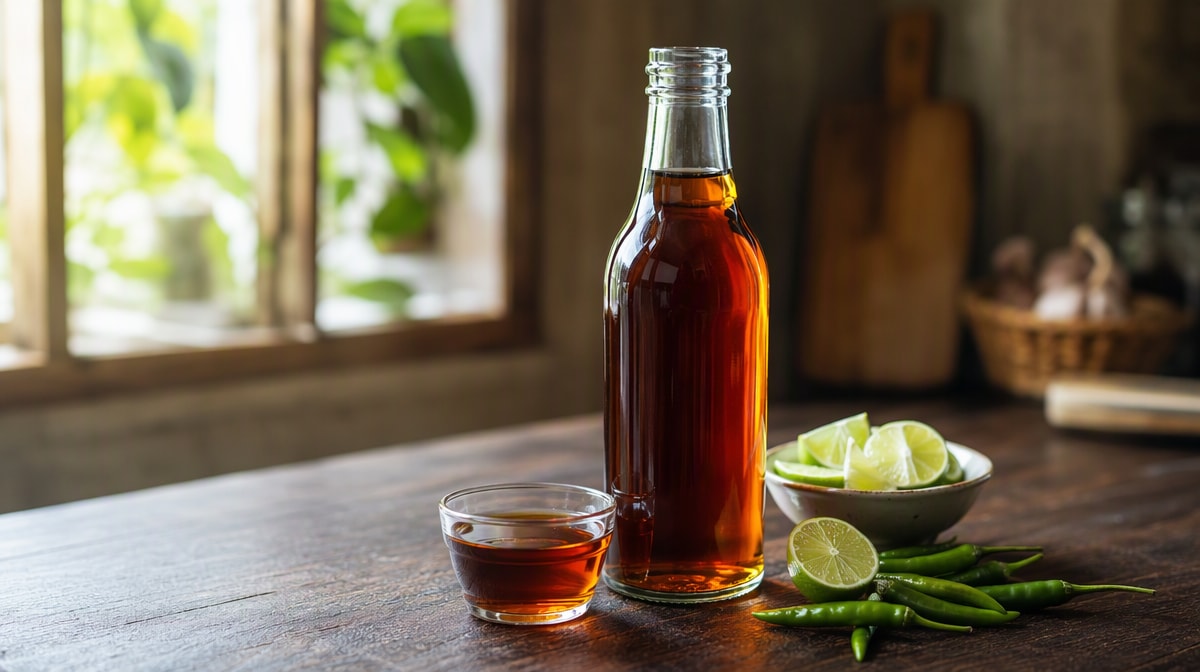
Smell a bottle of fish sauce that's been open for a year and you'll think it's gone off. It isn't. That's what fish sauce smells like. The pungency is the product, and it is exactly the same pungency you are paying for in a fresh bottle.
What changes with age is the aroma, not the safety. Fish sauce keeps for years. What it loses is its edge, and you will notice that in a som tam dressing long before you notice it in a curry that's been simmering.
So the short answer: opened fish sauce keeps six to twelve months in the fridge for best flavour, and stays perfectly safe well past that. In a cool, dark cupboard expect three to six months before it starts tasting flat. Unopened, two to three years is normal.
Why it lasts as long as it does
Three things are working in your favour here, and together they make fish sauce about as close to indestructible as a condiment gets.
The salt is the big one. Commercially bottled fish sauce sits somewhere around 20 to 30 per cent salt by weight, which is far past what any bacterium can tolerate. It pulls water out of anything that lands in it by osmosis, and even the salt-tolerant bugs that survive still can't reproduce.
Then there's the water activity, which is the formal way of saying the same thing. Below 0.85, almost nothing grows. Fish sauce sits well under that.
And the fish were fermented in brine for 12 to 18 months before the sauce was drawn off and bottled, up to two years for the better grades. Lactic and acetic acids build up as the fish break down. What you're buying is a product that has already been through a controlled spoilage. The same process carried out on other seafood is what produces squid fish sauce, which behaves this way for the same reasons.
Which brings me to why the bottle exists at all. In Thai Sensations, the coastal supply chain gets described plainly: fresh seafood reaches Bangkok's main wholesale fish market at Bangrak still wriggling on their beds of ice, landed before dawn, and most of the fish eaten in Bangkok and other towns near the sea is fresh-caught that day. What can't be eaten that day is dried in the tropical sun.
A catch that arrives all at once, in bulk, in tropical heat, needs a way to be kept. That's the whole point of the bottle in your cupboard, and it belongs on the list of twenty Thai ingredients worth keeping stocked.
The honest answer, including where sources disagree
Published figures for opened fish sauce range from three months to five years. That spread isn't carelessness. It's almost entirely two different questions being answered at the same time.
How long until it's safe? A long time. Effectively the whole time.
How long until it tastes its best? Much shorter. This is where the numbers move.
Once you open the bottle, oxygen gets in and the umami compounds start to oxidising. The sauce stays fine to eat. It just goes quiet, and quiet in this context means less pungent, less sweet-savoury, more like salty water than nam pla.
| Storage | Safe for | Best flavour |
|---|---|---|
| Opened, fridge | 12 months or more | 6 to 12 months |
| Opened, cool dark cupboard | 12 months or more | 3 to 6 months |
| Unopened, pantry | 2 to 3 years | 2 to 3 years |
The extremes come from specific framings, and knowing which is which saves you arguing with a source. Some of the generous numbers are lifted from USDA FoodKeeper data, which gives 730 to 1,095 days refrigerated and 365 to 730 days in a pantry. That table is about safety, not taste. The tightest figures, three to six months at room temperature, come from Chin-Su, a Vietnamese fish sauce manufacturer, and they're a quality recommendation.
The manufacturer's number is the one to plan your kitchen around. It's conservative, it's specific, and it's the only figure here that comes from someone who makes the thing.
Does it need a fridge

Not for safety. Yes for flavour.
Nearly every manufacturer and food writer agrees on this. Thai and Vietnamese households routinely keep the bottle in a cupboard indefinitely, and it doesn't make anyone ill. The salt and the fermentation have already done their work.
The fridge does slow the oxidation though, and that matters more than people expect. It's a small difference in a curry, where the fish sauce is one of several flavours cooking away together. It's a very large difference in anything you eat raw: a som tam dressing, a dipping sauce for pork, a spoon stirred through a green curry at the end rather than the start.
My rule is simple. If the bottle lives on your worktop and you use it daily, leave it there. If it lives in the cupboard and comes out for a som tam, put it in the fridge when you open it.
Signs it's genuinely gone off

These are rare, but they're real, and they're worth knowing before you need them.
Mould or a film on the surface or around the neck. That's the clearest signal and the one thing every source agrees means discard.
A sour, rotten or ammonia-like smell. Fresh fish sauce is pungent and briny. Sour or chemical is a different kind of smell, not just more of the same.
Cloudiness, foam, or a slime. Sediment at the bottom is normal. Slime is not.
A bitter, metallic or vinegary taste.
One thing to watch for, because it catches people: the sniff test is not much use here. Fish sauce always smells strong. What you're listening for is a change of kind, something sour or ammoniac, rather than an increase in intensity. A pad thai that tastes of fish is usually a balance problem rather than a bottle problem, and why your pad thai tastes too fishy works through that.
Changes that are completely normal

Before you bin a perfectly good bottle, some things that look wrong aren't.
It has darkened. Light amber going to deep brown is ordinary oxidation. It's also, to a lot of cooks, a sign of a well-aged sauce. Very dark, cloudy, or with a white film is a different matter.
Salt crystals have formed at the bottom or stuck to the cap. Tyrosine and salt precipitates, entirely harmless, and they increase with age. They will dissolve in hot water.
There's sediment in the bottom. Normal.
The smell is intense. See above.
Chin-Su puts the principle neatly: best-by dates mark peak flavour, not safety. That distinction runs through everything on this page, and once you've got it you can date-check anything in the cupboard with your eyes shut.
If there's no date on the bottle
Common with imported bottles, and with anything bought loose or from a restaurant supply shop. The label isn't doing the work, so use the bottle.
Smell it, open it, and taste a little on a spoon. Judge the sharpness. A sauce that still makes your mouth water is working. A sauce that tastes only of salt is finished. A sauce that tastes sour, or fizzy on the tongue, gets binned.
Then look. Darkening is fine. Crystals are fine. Mould, cloud, film or slime is not.
One more thing worth doing if you decant. If you pour the sauce into a smaller bottle, which you should, because it keeps the moisture and the air out of the way, that bottle needs to be airtight and ideally glass. Moving it into a squeezy bottle with a narrow spout introduces exactly the water and contamination that cause the mould you were trying to avoid.
Premium sauces are a different case
The expensive bottles are the exception worth understanding.
High-grade, high-nitrogen sauces, Red Boat and Son among them, are made to a different standard. Less added sugar and caramel, fewer or no preservatives, and in Andrea Nguyen's account they will sometimes release gas at room temperature, which is why she keeps them in the fridge. They're also the sauces most likely to be near their best quickly, because that's what you're paying for.
Budget brands with preservatives, Megachef and Three Crabs, are the opposite. They're formulated to sit on a shelf and they're fine in a cupboard. Squid Brand, a Thai producer, prints one to two years on the bottle and advises using it within six to twelve months of opening for peak quality.
Read your own bottle. Brand guidance is more specific than any general article, this one included.
Practical habits that make the difference
Cap it tightly every single time. More than anything else, that's what matters. The seal is what keeps air out between uses, and if you don't, the smell will perfume your entire cupboard.
Wipe the neck after each pour. The crust that builds up around the cap and threads is where mould starts.
Keep it cool and out of sunlight, away from the hob. Heat and direct sun both accelerate the flavour loss that the fridge exists to prevent.
And decant into glass if you use it slowly. Less headspace, less air, and you can see what you're working with.
Freezing is possible and barely covered anywhere. Small portions in ice cube trays, or a bag of cubes moved into a sealed box, keep up to six months. I'd skip it. The salt lowers the freezing point and changes the texture on thawing, and you've paid full price for the same product. A bottle in the fridge will outlast any realistic gap between shops. How long Thai curry paste keeps in the fridge is the shorter question, and it is worth answering at the same moment.
A caveat on the sources
This page is built on food writers, manufacturer guidance and condiment databases rather than a national food authority. That's a reflection of what's publicly available on the subject rather than a criticism, but it's worth knowing if you're looking for a figure to argue from.
The water activity and salt percentages are well established and consistent across everything that mentions them. The shelf life windows are not, and you will find figures five times apart on sites that sound equally authoritative. Treat the manufacturer on your bottle as the most reliable guidance going, and your own palate as the final word.
Frequently asked questions
Can expired fish sauce make you sick?
Rarely, and that's rather the point of how it's made. At 20 to 30 per cent salt and a water activity below 0.85, the conditions that cause food poisoning don't exist in the bottle. In practice a bad bottle is nearly always a bottle that has lost its flavour rather than one that will harm you. Mould means discard, dullness means use it anyway.
How long does fish sauce last once opened?
About six to twelve months in the fridge for best flavour, and three to six months in a cool dark cupboard. It stays safe considerably longer than that. Chin-Su, the manufacturer, advises using an opened bottle within three to six months at room temperature or up to twelve months refrigerated.
Should I refrigerate fish sauce after opening?
Only if you care about flavour, and especially if you use it raw. Safety doesn't require it. It matters for colour, aroma and umami, and the difference is obvious in a som tam dressing or a dipping sauce. If it goes straight into a curry, the cupboard is fine.
Why has my fish sauce gone dark?
Oxidation, which is normal and not a sign of spoilage. Light amber deepening to dark brown over a year or two is ordinary. The exceptions are extreme blackening, cloudiness, or a white film on the surface. Those mean discard.
What are the white crystals at the bottom of my fish sauce?
Salt and tyrosine precipitates, and completely harmless. They form as a concentrated solution cools and they grow more common with age. If they bother you, stand the bottle in warm water and they dissolve. Don't discard a sauce over them.
Can I use fish sauce that's past its best-before date?
Yes, if it looks and smells normal. A best-before date marks peak flavour, not an expiry. The date on your bottle is a quality estimate from the manufacturer, not a safety cut-off.
Does the brand of fish sauce change how long it keeps?
Yes, meaningfully. Premium high-nitrogen sauces such as Red Boat and Son have few or no preservatives and are recommended for the fridge by their producers. Budget brands with added preservatives sit happily on a shelf. Squid Brand prints one to two years and advises using it within six to twelve months of opening.
Can I freeze fish sauce?
You can, in small portions, for up to six months. I'd not bother. The salt changes the texture on thawing, and a refrigerated bottle keeps longer than any realistic gap between shops.



Comments