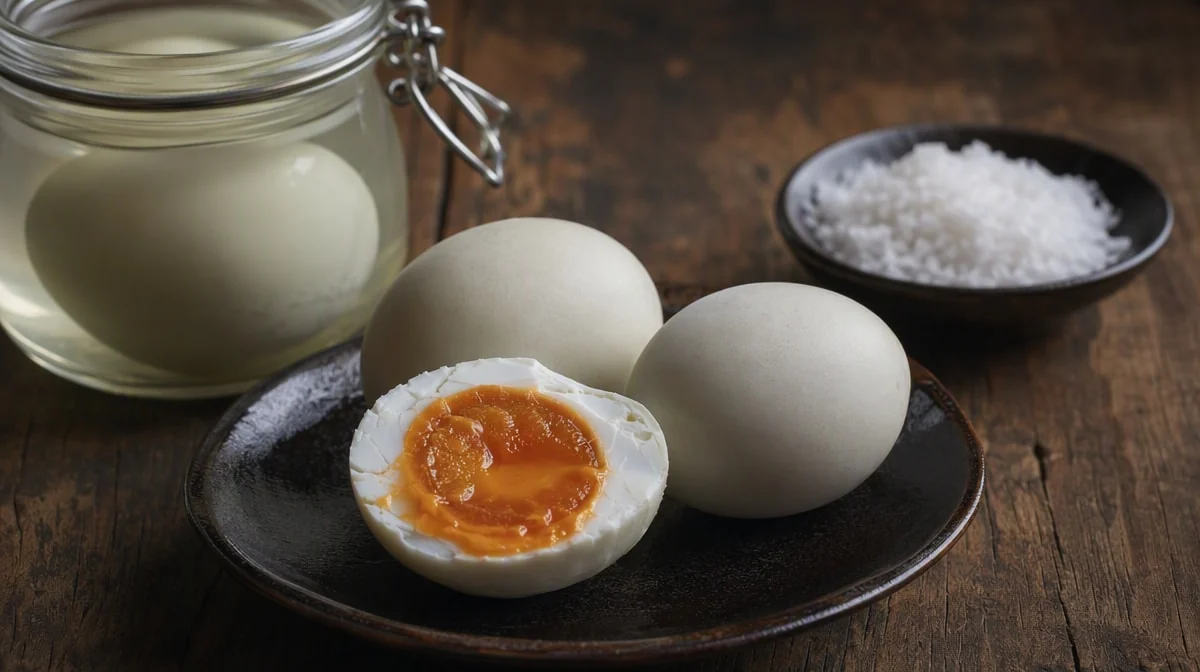
Salted eggs, khai kem in Thai, are duck eggs cured in salt water until the yolks turn rich, oily and deeply savoury. They are an ingredient rather than a dish on their own: a salted egg yolk can finish a plate of fried rice, a squid stir-fry or a salad, and the white is a very salty seasoning that most recipes throw away. The cure is simple, the waiting is the hard part, and the result is one of the best cheap luxuries in Thai cooking.
You can make them at home with duck eggs, salt and water in about three weeks, or buy them ready-cured from a Thai or Chinese grocer. Duck eggs are the traditional choice because the yolks are larger and oilier; chicken eggs work if you cannot find duck eggs, but the yolk will be smaller and less rich.
What Are Thai Salted Eggs?
Salted eggs are whole eggs, usually duck eggs, cured in a salt solution until the yolk firms up and the white becomes very salty. The Thai name is khai kem, sometimes written kai kem or khai khem. They are the same family as Chinese salted duck eggs, which are used in mooncakes and steamed buns, and they turn up across Southeast Asia under different names.
The book's recipe is short: 10 fresh duck eggs, 175g salt and 625ml water, a jar big enough to hold them, and three weeks. The eggs go into cooled salt water, the jar is sealed, and the waiting begins. The book warns that three weeks is the limit: "If you leave them any longer they will get too salty."
The flavour is rich, savoury and salty, with a yolk that is creamy and slightly grainy. The white is very salty and firmer than a fresh egg white; the book says to boil the eggs, scoop out the yolks and discard the whites. That is the traditional use in some kitchens, but it is not the only one. The white can be used sparingly, and this page explains how.
How to Make Salted Eggs at Home
The brine is the whole method. Heat 625ml water with 175g salt until the salt dissolves, then let it cool completely. Put 10 clean duck eggs into a large jar, pour the cool brine over them, and make sure they are submerged. Seal the jar and leave it for three weeks.
Use a jar that is big enough for the eggs to sit in a single layer, or at least not tightly packed. A cracked egg will let the salt in too fast and turn rubbery, so handle them gently and discard any that crack. Keep the jar in a cool, dark place, not a warm cupboard.
After three weeks, drain the eggs and use them as needed. The book says they will last for up to two months in their jar, so you do not have to use them all at once. If you want a milder cure, taste one at three weeks before leaving the rest longer; the saltiness increases with time.
The book's ratio is a good starting point, but it is not the only brine strength. Some Chinese recipes use a stronger salt solution and a shorter cure; some use a salt-and-charcoal pack instead of brine. The principle is the same: salt draws water out of the egg, firms the yolk and preserves the egg. The exact days depend on the strength of the brine and the size of the egg.
How Long Do Salted Eggs Last?
The book gives two numbers: three weeks to cure, and up to two months in the jar after that. That is the simplest answer. Keep the eggs submerged in the brine, in a cool place, and use them within the book's window.
If you boil the eggs, they will keep for less time than the raw cured eggs. Treat a boiled salted egg like a boiled egg: keep it in the fridge and eat it within a few days. If you crack a raw cured egg and only use the yolk, use it the same day.
The salt is a preservative, but it is not indestructible. If the brine looks cloudy, smells wrong or has mould, throw the batch out. If an egg floats, it is a bad sign; discard it. The same rules you would use for any preserved food apply here.
What to Do with Salted Duck Eggs

The yolk is the prize. It is salty, creamy and slightly grainy, and it can be used in several ways:
- Fried rice: crumble a cooked yolk into fried rice at the end, or use it as the fat and seasoning for a salted-egg fried rice. The rice should be cold and dry; the jasmine rice guide covers the cooking.
- Stir-fries: mash the yolk into a paste and toss it with squid, prawns, pumpkin or green beans. It coats the ingredient and gives it a rich, savoury edge.
- Salads: crumble the yolk over a Thai salad, or use it in a dressing. The salt and fat replace some of the fish sauce and oil.
- Mooncakes and pastries: the Chinese use is the sweet one; the yolk sits inside a lotus-paste mooncake. That is a different tradition, but it is the same ingredient.
- On rice: a hot bowl of rice with a salted egg yolk and a little chilli is a complete meal. It is not fancy, but it is very good.
The white is salty and firm. The book says discard it, and many Thai recipes do. If you want a Thai egg dish that uses fresh eggs rather than salted ones, the son-in-law eggs recipe is the sibling page. If you want to use it, treat it as a seasoning: chop it and add it to fried rice, an omelette or a soup, and cut back on the fish sauce or salt. Do not use it as a direct substitute for a fresh egg white in baking; the salt will ruin the recipe.
What to Do with Salted Egg Whites
This is the question the book answers with "discard", and it is worth pushing back gently. The white is edible, very salty and slightly rubbery. It is not a delicacy, but it is not rubbish either.
Use it in a small amount as a seasoning. Chop it finely and add it to fried rice, a stir-fry or a soup, then taste before adding any fish sauce. It can also be steamed and eaten with rice, the way a salted egg is eaten in some Chinese households, but the texture is firm and the salt is strong.
Do not use it in place of a fresh egg white in a cake or a meringue. The salt content is far too high, and the protein has changed. If you are not going to use it within a few days, freeze it in small portions and add it to cooked dishes later.
The practical rule: use the yolk for the dish, and use the white as salt. If you have no plan for it, the book's advice to discard it is not unreasonable, but it is not the only option.
Salted Eggs vs Cured Egg Yolks
They look similar and they are not the same. A salted egg is a whole egg cured in brine or packed in salt, usually a duck egg, with the shell on. A cured egg yolk is a raw yolk separated from the white and packed in a salt-sugar mixture until it firms up, then often dried and grated. The first is a Southeast Asian ingredient; the second is a modern European technique with a much saltier, more concentrated yolk.
The flavour is different too. A salted egg yolk is rich and mildly salty, with a creamy, slightly grainy texture. A cured egg yolk is denser, saltier and often used as a garnish, grated over pasta or vegetables. You can use one in place of the other in some dishes, but the amount and the texture will change.
If a recipe asks for salted egg yolk, use the brined kind. If it asks for cured egg yolk, do not use a salted egg and assume it is the same; the salt level is different and the texture is softer. The names are close, the preparations are not.
Thai Salted Egg Salad and Salted Egg Squid
Two Thai dishes show the ingredient at its best. Yam khai kem is a salted egg salad: the cooked yolk is crumbled or mashed into a dressing with lime, fish sauce, chilli and herbs, and the salad is built around it. It is salty, sour, hot and rich, and it is a good use for a yolk that would otherwise be too much on its own.
Pla meuk pad khai kem is squid stir-fried with salted egg yolk. The yolk is mashed and tossed with the squid in a hot wok, where it coats the seafood and turns into a rich, savoury sauce. It is a restaurant dish in Thailand and a home dish in Chinese-Thai kitchens, and it is one of the best arguments for keeping a jar of salted eggs.
Other uses are less formal: salted egg fried rice, salted egg with pumpkin, salted egg on congee. The yolk is a seasoning as much as an ingredient, so it works anywhere you want salt, fat and a savoury edge.
Buying Duck Eggs in the UK

Duck eggs are the real blocker for a UK reader. They are not in every supermarket, and they are seasonal. Waitrose sells free-range duck eggs, Riverford sells organic duck eggs by delivery, and farm shops often have them in season. A good Asian grocer may also stock them, especially around Chinese festivals.
If you cannot find duck eggs, use large chicken eggs. The cure works, the yolk is smaller and less oily, and the result is still recognisably a salted egg. Do not use quail eggs for this recipe; they are too small to cure in the same time and the yolk-to-white ratio is different.
Ready-cured salted duck eggs are sold in Asian grocers and online, usually vacuum-packed or in a jar. They are a shortcut, and they are fine for cooking. Check the label for the cure date and the salt level, and taste before you use the whole yolk; brands vary.
The guide to buying Thai ingredients in England covers the shop types if you are starting from scratch.
Thai Salted Eggs (Khai Kem)
Ingredients
- 10 fresh duck eggs (or large chicken eggs), cleaned
- 175 g salt
- 625 ml water
- A preserving jar big enough to hold all the eggs
Instructions
- Heat the water and salt until the salt dissolves. Allow to cool completely.
- Carefully place the eggs in a large jar without cracking them.
- Pour in the cool salt water and seal the jar. Leave for three weeks.
- Drain and use as required. Boil the eggs, then scoop out the yolks. The whites can be used sparingly as a salty seasoning.
Frequently asked questions
What do salted duck eggs taste like?
The yolk is rich, creamy, savoury and mildly salty, with a slightly grainy texture. The white is very salty and firm. The overall effect is like a concentrated egg with a savoury, almost cheesy depth. It is not a subtle ingredient, and a little goes a long way.
Why are my salted eggs not oily?
Duck eggs are oilier than chicken eggs, and the oil comes out when the yolk is cured and cooked. A short cure, a weak brine or a chicken egg will give a drier yolk. Leave the eggs for the full three weeks and use duck eggs if you can; the oil comes from the yolk's fat.
Can I use chicken eggs instead of duck eggs?
Yes. Large chicken eggs work, and the book allows them. The yolk will be smaller and less rich, and the cure may take slightly less time because the egg is smaller. Taste one at three weeks before leaving the rest longer.
Are salted eggs healthy?
They are high in salt and cholesterol, and they are not a health food. A yolk is a rich treat, not an everyday staple. If you are watching your salt, use half a yolk and adjust the rest of the dish. The page does not make a medical claim beyond that.
How do I store salted eggs?
Keep the raw cured eggs submerged in the brine in a cool, dark place, and use them within the book's two-month window. Once boiled, keep them in the fridge and eat them within a few days. Discard the batch if the brine smells wrong or has mould.
Can I freeze salted eggs?
You can freeze the cooked yolks, but the texture suffers; they become crumbly rather than creamy. The raw cured eggs do not freeze well because the whites become watery. If you have too many, use them in a cooked dish and freeze that instead.
What is the difference between salted eggs and century eggs?
They are different preserves. Salted eggs are cured in salt water and remain recognisably eggs, with a firm yolk and a salty white. Century eggs are preserved in an alkaline mixture and turn dark and jelly-like. They are not interchangeable.
Can I make salted eggs without a jar?
You need a container that will hold the eggs and the brine without leaking, and that can be sealed. A large glass jar or a food-grade plastic container works. Do not use a metal container; the salt will corrode it. Keep the eggs submerged with a small plate if they float.
How long do salted eggs take?
About three weeks in the book's brine. Some recipes use 20 to 30 days, depending on the strength of the brine and the size of the egg. Taste one at three weeks; if it is not salty enough, leave the rest a few days longer, but do not leave them for months.
What can I do with the salted egg white?
Use it as a salty seasoning in fried rice, an omelette or a soup, or discard it as the book suggests. Do not use it in baking as a fresh egg white. It is very salty, so add a little at a time and taste before adding more fish sauce.




Comments