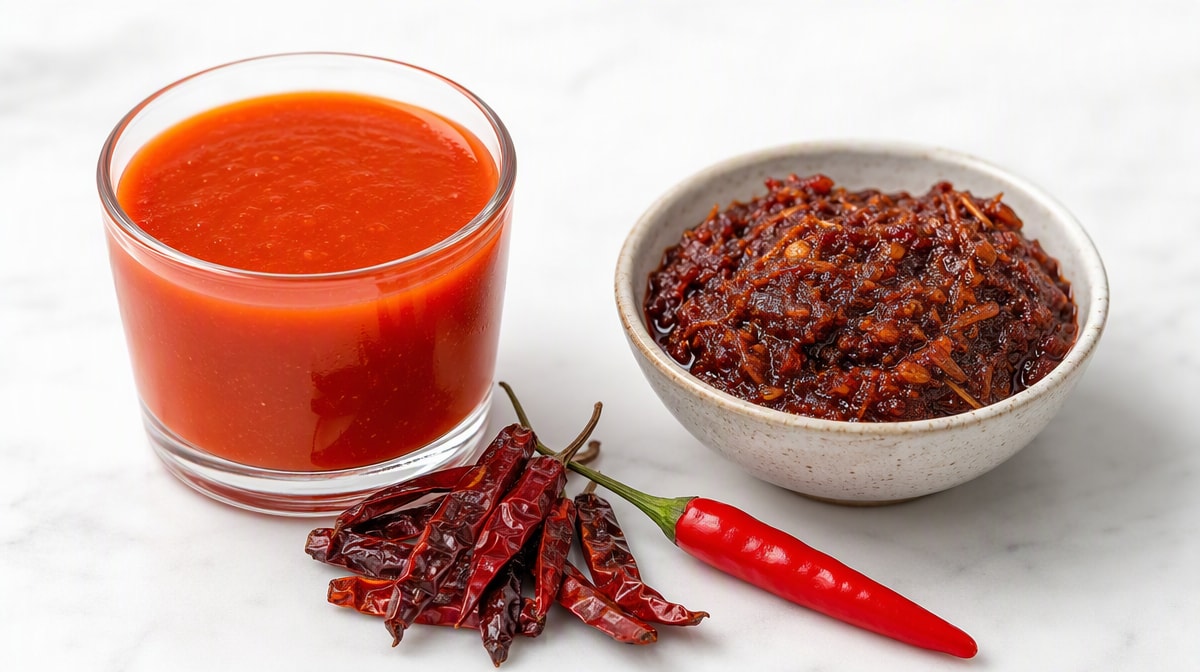
Sriracha will work, in most Thai dishes, one for one. It isn't the same ingredient and a soup or a stir-fry will taste flatter than it should.
The gap is umami and roast, not heat. Sriracha has vinegar, sugar and garlic. Thai chilli paste, specifically nam prik pao, has dried shrimp, tamarind, palm sugar and hours of slow cooking. The heat is the only thing they genuinely share.
A tablespoon of sriracha plus a teaspoon of fish sauce closes most of that gap, and that's the shortcut worth knowing.
First, which paste
Almost every disappointing Thai dish made with the wrong paste comes from this, so it's worth sorting out.
Nam prik pao is a roasted chilli paste, made from dried chillies, shallots, garlic, dried shrimp, tamarind, fish sauce and palm sugar, slow-cooked until thick and jammy. It's smoky and savoury, with depth from roasting and fermentation. This is the paste people mean most often when they say "Thai chilli paste", and it's the subject of this page.
Red curry paste is a different thing entirely. Wet, fresh-aromatic, dominated by green aromatics and shrimp paste rather than dried chilli. It goes into curry, not into stir-fries or dipping sauces.
Sambal oelek is a raw, uncooked chilli paste from Indonesia. Bright, hot, no roast at all. Closer to sriracha in spirit than to nam prik pao, and a better substitute for it than sriracha is.
And sriracha itself is a sauce rather than a paste. Vinegar, chilli, sugar, garlic. It's a Thai-adjacent condiment rather than a Thai one.
If you've been using red curry paste where a stir-fry wanted nam prik pao, that's why the dish came out one-dimensional, and no amount of sriracha will fix it.
What nam prik pao actually is, in detail

Because this paste is the real subject here, and most people buying a jar have never been told what's in it.
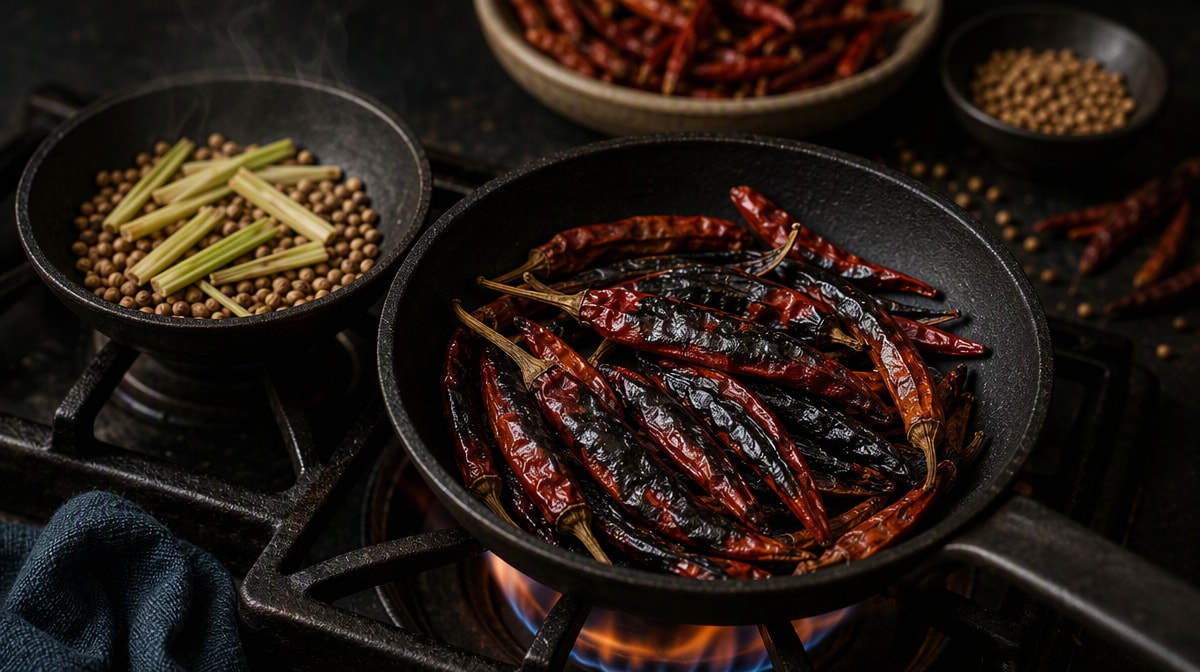
Dried chillies, soaked and then roasted, which is what gives the smokiness. Our dry-roasting guide covers the technique, and it's the step that makes a home version taste like the jar.
Dried shrimp, conhecida asbaiki. This is the umami, and it's also the reason nam prik pao isn't vegetarian. A small quantity, carrying an enormous amount of the savoury depth.
Tamarind, for sourness, the same tamarind from our tamarind guide, and the reason the paste has a rounded sourness rather than just heat.
Palm sugar, which balances the sour and the salt and rounds everything off.
Shallots and garlic, roasted alongside the chilli until they're properly soft and browning.
Fish sauce, for salt and more depth.
Then the whole thing is slow-cooked until the moisture reduces and it becomes thick, dark and jammy. That reduction is what makes it a paste rather than a sauce, and it's why the flavour is concentrated rather than fresh.
None of that is in a bottle of sriracha. The gap between the two isn't a matter of degree. It's a completely different cooking process.
Where sriracha falls short
The vinegar. Sriracha is built on vinegar tang and nam prik pao has none. It's roasted and fermented, not acidified. This is the most noticeable difference and the hardest to correct, because you cannot add roast to a sauce.
The missing umami. No shrimp paste, no dried shrimp, no tamarind, no fermentation. This is the second biggest gap and the easiest to close.
The texture. Sriracha is thin and liquid, nam prik pao is thick and jammy. The body matters more than people expect. A thick paste coats noodles and ingredients, carries through a stir-fry, and gives a sauce something to cling to. A thin sauce pools at the bottom of a pan.
The heat profile. Sriracha is around 1,000 to 2,500 SHU for Huy Fong, which is genuinely mild. Thai chilli paste is typically hotter, and its heat builds and stays rather than arriving and fading.
The swaps, best to worst

Nam prik pao itself is the correct answer. It's widely available online and in most Asian shops, and it keeps for weeks in the fridge. If you're going to cook Thai regularly, buy a jar and the question disappears.
Sambal oelek is a genuinely better substitute than sriracha, because it's a chilli paste rather than a chilli sauce. It has body, it isn't vinegared, and it's unripe and bright rather than cooked. Closest available in texture and heat.
Sriracha plus fish sauce is the practical emergency swap. Equal parts sriracha and fish sauce, then taste. The fish sauce supplies the missing umami and salt, which is the biggest single gap. A tablespoon of sriracha with a teaspoon of fish sauce is a better approximation than two tablespoons of sriracha.
Sriracha, brown sugar and soy is the other standard upgrade. A little sugar for the sweetness nam prik pao actually has, and soy for depth and body. This is the closest you can get with things in a British cupboard.
Sriracha alone works. Fine in a stir-fry or a marinade, one for one, where the other flavours in the dish are carrying the flavour and sriracha is supplying heat. It falls down in anything where the paste is the main seasoning.
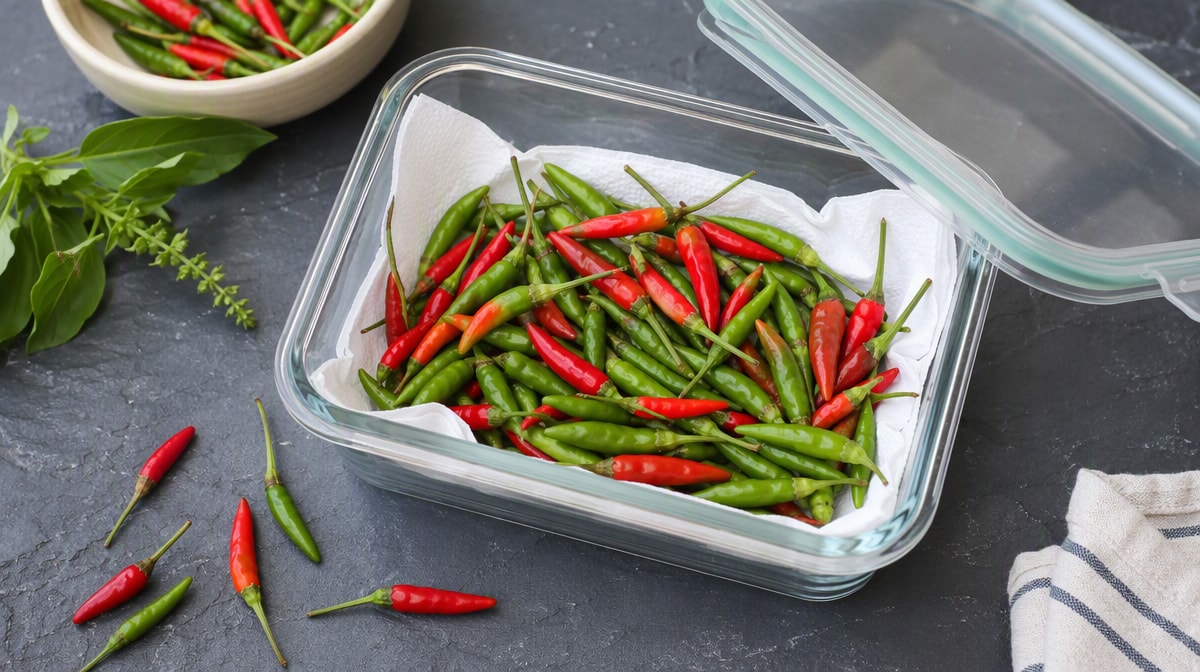
Fresh bird's eye chillies aren't a paste, so not a like-for-like swap, but a spoonful of pounded fresh chilli with a pinch of salt is closer to a nam prik pao than sriracha is, because at least it isn't vinegared. We have covered the varieties in our chilli guide.
Where it works and where it doesn't
Sriracha is fine in stir-fries, particularly chicken or pork, where it's one of several seasonings. In marinades. In dipping sauces mixed with other things. In fried rice. And in a sauce for something like pad krapow where the basil and chilli carry the dish.
It's a poor choice in a soup like tom yum, where the broth is delicate and vinegar sits badly in it. In a som tam dressing, where the vinegar throws out the balance. In a curry, where you want curry paste. And anything where the paste is the main flavour rather than an accent.
The rule is roughly this: the more the paste is doing, the less sriracha can do instead.
Making a substitute that actually works, step by step
Because "add a bit of fish sauce" is easy to say and vague in practice, here's a method.
Start with a tablespoon of your best available paste. Nam prik pao, sambal oelek, or sriracha, in that order of preference.
Add a teaspoon of fish sauce for umami and salt. Stir it in. It'll look slightly thinner and taste markedly deeper. This single step fixes most of what's wrong with a sriracha-based substitute.
If you're using sriracha and it still tastes flat, add a small pinch of brown sugar. Not to sweeten it, but to supply the roundness that nam prik pao gets from palm sugar, and to take the sharp edge off the vinegar.
If it needs more body, add a teaspoon of soy sauce or a spoonful of miso. This thickens it and adds the savoury weight that separates a sauce from a paste.
Taste it on something. A spoonful of the mix on a slice of cucumber or a piece of cold chicken tells you more in three seconds than any amount of thinking about it.
And if you have five more minutes, toast the paste in a little oil first. This is the single biggest improvement available and it costs almost nothing. Heat a little oil, fry the paste until it darkens and smells roasted, then add the rest. Nam prik pao is a fried paste, and frying restores a surprising amount of what sriracha is missing.
Making it yourself
If you can get dried chillies and a jar of dried shrimp, this is thirty minutes of work and it's the real thing.
Soak the dried chillies in warm water for 15 minutes, then dry them thoroughly and dry-roast in a dry pan for three to five minutes until they darken and smell smoky. That's the roaster in our dry-roasting guide doing its work, and it's where the flavour in the jar comes from.
Soak dried shrimp in warm water for 10 minutes. Add the softened shallots and garlic to a dry pan with the chillies and char them, which takes another five minutes and is where a good chunk of the sweetness comes from.
Pound everything together with a little fish sauce and a little palm sugar, then reduce in a pan until it's thick. The reduction is the step people skip, and it's what makes it a paste rather than a salsa.
You end up with roughly a cup of paste from a small handful of dried ingredients, and it keeps for weeks in the fridge.
The dried shrimp is the one non-negotiable part, and it's the reason this doesn't work as a vegetarian dish without substituting it. Dried mushroom is the swap that works best, soaked in warm water until soft, and it brings a savoury depth that holds up in a paste.
The fermentation point, which is the real difference
If you take one thing from this page, take this.
Nam prik pao is fermented and roasted. Sriracha is acidified and sugar-preserved. Those are different preservation methods producing different flavours, and no quantity adjustment closes the distance between them.
The dried shrimp in nam prik pao has been sitting in a salt and sugar mixture for a long time, developing amino acids and peptides that are the definition of umami. The garlic has been roasted until it's sweet and almost caramelised. The tamarind has contributed a long, slow fermented sourness. The palm sugar has rounded it.
Sriracha achieves preservation with vinegar and sugar within weeks. That gives a bright, sharp, clean flavour, genuinely pleasant, and a completely different thing. Its garlic is raw, its chilli is fresh, and there's no fermentation stage at all.
It's also why nam prik pao improves with age. A jar that's been open for a month tastes better than a fresh one, because the flavours continue to marry. Sriracha doesn't do this. It's at its best in the first year and then it's simply old.
Which means that if you want a Thai-adjacent condiment that gets better in the cupboard, you want the nam prik pao, not the sriracha. That's the whole argument in one sentence.
A caution about a related mistake
Red curry paste and sriracha are both red and both arrive in a tub, and swapping one for the other changes a curry completely. Curry paste is wet, fresh, aromatic and dominated by lemongrass, galangal and shrimp paste. Sriracha is thin, vinegared and sweet. If a curry tastes overwhelmingly sweet and lacks body, red curry paste is the likelier culprit than sriracha.
If you are vegetarian or vegan
Nam prik pao is out, because it contains dried shrimp and fish sauce. Worth stating plainly rather than leaving people to work it out from an ingredient list.
Your best options, in order.
A good chilli paste plus a spoonful of miso. Miso is not Thai and won't fool anyone, but it does exactly the same job: fermented, salty, savoury umami. A teaspoon into a tablespoon of chilli paste narrows the gap considerably.
A nam prik pao made without shrimp. Some brands and Thai vegetarian products now omit it. Read the label, because "vegetarian" and "nam prik pao" rarely appeared together until fairly recently.
Sambal oelek plus miso or soy. A thick, unvinegared paste plus umami, which are the two things sriracha lacks.
Your own roasted chilli paste, with dried mushroom in place of the dried shrimp. Mushroom supplies the savoury depth and nobody will identify it in a stir-fry.
What not to do is simply use more sriracha and hope. That produces a vinegary dish, not a deep one.
Getting the most out of a jar
The most common mistake with a jar of nam prik pao is treating it as a finished condiment, a tableside dip, used occasionally, and reaching for sriracha out of habit the rest of the time.
It's a cooking ingredient first. A spoonful stirred into fried rice in the last minute, mixed into a pad thai sauce, folded into an omelette, or thinned with a little water and lime into a dipping sauce for grilled chicken. All work well.
A good jar keeps for weeks in the fridge and is genuinely one of the highest-value purchases for a home Thai kitchen, precisely because it solves a problem you'd otherwise solve badly with sriracha several times a month.
And it's not exclusively savoury. A little thinned with lime and a touch of sugar makes a proper nam jim, and it's excellent on boiled eggs and grilled pork.
Which sriracha, briefly
Huy Fong is the Thai-origin sriracha most people mean, and it's the one to buy. Made in Thailand, properly hot, with a straightforward chilli-vinegar-sugar profile.
The cheaper supermarket srirachas are frequently sweeter, thicker, and sometimes quite mild. They work, but they lean further towards the sweet sauce end, which takes you further from nam prik pao rather than closer.
And rooster brand sriracha is a different product. Sweeter, with a fruity chilli profile, used more as a dipping sauce than as a cooking ingredient. It's fine in a stir-fry but it's not the sharp, hot vinegar heat you want for a Thai dish.
A note on sources
The ingredient breakdown of nam prik pao is consistent across the sources and the process is well documented. The brand comparisons are cook experience rather than testing, and heat varies with the chillies you can get hold of. What is not in question is the fermentation point, which is a difference in method rather than an opinion, and which is the thing worth remembering.
Frequently asked questions
Can I use sriracha instead of Thai chilli paste in a stir-fry?
Yes, one for one, and it will be acceptable. It'll taste flatter than a nam prik pao because sriracha has vinegar and no roasted or fermented depth, and it's thinner so it doesn't coat as well. For a better result use equal parts sriracha and fish sauce, or sriracha with a little brown sugar and soy sauce.
What is the difference between nam prik pao and sriracha?
Nam prik pao is a slow-cooked roasted chilli paste made with dried chillies, dried shrimp, tamarind, shallots, garlic, fish sauce and palm sugar, so it's smoky, jammy and savoury. Sriracha is a thin vinegar-based sauce with chilli, sugar and garlic. They share heat and nothing else, and the vinegar in sriracha is the biggest single difference.
What is the best substitute for Thai chilli paste?
Nam prik pao itself, if you can get it. Failing that, sambal oelek is a better substitute than sriracha because it's an actual paste with body and no vinegar. If you have only sriracha, add a little fish sauce, miso or soy to supply the umami that's the main thing missing.
Why does my Thai food taste flat when I use sriracha?
Because sriracha supplies heat but almost no umami, and its vinegar tang is a flavour Thai chilli paste doesn't have. The fix is umami rather than more chilli sauce: a teaspoon of fish sauce, a spoonful of miso, a dash of soy, or a spoonful of dried mushroom. Adding more sriracha makes it more vinegary, not deeper.
Can I use red curry paste instead of sriracha?
Yes, and it will be closer in some respects, because curry paste is a wet paste with real body and shrimp paste for umami. It's fresher and more aromatic than nam prik pao rather than roasted, so it suits a fresh dish better than a slow-cooked one. It also brings its own flavour, so use it in a dish where curry paste is a reasonable seasoning.
Is sambal oelek or sriracha a better stand-in for nam prik pao?
Sambal oelek, clearly. It's a thick chilli paste rather than a liquid sauce, it isn't vinegar-based, and it has the body to coat. Sriracha works in a pinch but its thinness and its vinegar both work against it. Sambal is bright rather than roasted, so it's still not the same thing, but it's much closer.
Does sriracha work in a curry or a soup?
Less well than in a stir-fry. In a curry you want curry paste, which is built from fresh aromatics. In a soup like tom yum the vinegar in sriracha sits badly against a delicate broth. In a stir-fry, a marinade or fried rice, where several other seasonings are present, sriracha is at its most acceptable.
How do I make a quick substitute that tastes more like Thai chilli paste?
Mix equal parts sriracha and fish sauce, then add a small pinch of brown sugar and a touch of soy sauce. That supplies the umami from the fish sauce, the sweetness and body from the sugar, and the salt and depth from the soy. It won't be nam prik pao, but it's much closer than sriracha alone and takes about ten seconds.

Comments