An introduction to Isaan food
Isaan-style Thai food, also known as Isaan food, hails from the northeastern part of Thailand, specifically the region known as Isaan. The region and its food are also spelled Isan, Esan or easan, and you will see all of them on menus and shop fronts. It stands out as a distinct regional cuisine, separate from the more familiar central Thai cuisine, offering a unique culinary experience shaped by the region’s culture, climate, and agricultural practices. For a broader look at all of Thailand’s regional cuisines, see our introduction to Thai food.
What is Isaan food?
Isaan food is hot. Chilli goes into nearly everything, and the fermented fish and the fresh herbs keep it from being simply hot. If you like heat, you will like this food.
Sticky rice, locally known as “Khao Niew,” plays a central role in Isaan cuisine. It’s often served in small bamboo baskets and serves as both a staple and an essential utensil. Diners use sticky rice to pinch and scoop up the various dishes, and it is very good for that.
Grilled meats, particularly marinated and skewered chicken, pork, or beef, are a common sight in Isaan cuisine. They usually come with a small pile of dipping sauces, and the whole thing is eaten standing up.
Fermented ingredients are a significant component of Isaan food, with “pla ra” or fermented fish sauce being a notable example. This fermented sauce is used to season dishes and contributes a unique Isaan flavour.
The use of local herbs and vegetables, some of which are foraged from the region’s forests and fields, also adds to the unique flavour. These fresh and indigenous ingredients are what make Isaan food taste different from central Thai food.
The cuisine of Isaan has been influenced by its proximity to neighbouring countries, particularly Laos and Cambodia. These influences are evident in dishes like sticky rice, variations of larb, and the use of local herbs and spices, which are popular in both neighbouring countries.

Where is Isaan?
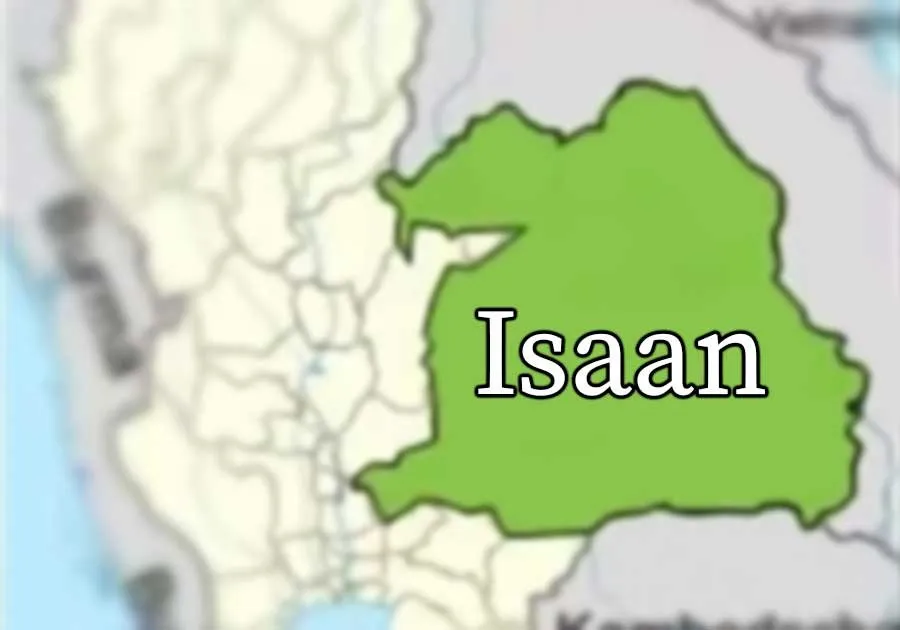
The north-eastern region of Thailand is known as Isaan and as you would expect, the food of the region is known as Isaan food. Most of Isaan is situated on a high plateau divided by the Phu Phan mountains with Laos and Cambodia also bordering it. These two countries have had a strong culinary influence on Isaan food. Laos in particular as many Isaan people fled Laos in the 1970s after the communist uprising.
It’s often said there are more Lao people in Issan than there are in Laos! How true this is though, I don’t know.
Isaan was one of the first areas in Thailand and Asia to grow rice. Jasmine rice is cultivated over much of Issan but in recent years rainfall has become unreliable, making life hard for the local farmers.
Why fermentation defines Isaan: survival and climate strategy
Fermented ingredients like pla ra (fermented fish) and sai krok isaan aren't just flavour choices; they're survival adaptations. Isaan's climate is characterised by unreliable rainfall and a long dry season, making food preservation critical for sustaining communities between harvests.
Fermentation solved this problem. Fish caught during the rainy season were preserved in salt, allowing communities to eat protein year-round. The process also creates umami depth: fermented fish provides glutamates that make other dishes taste richer without added salt, stretching limited resources further. Sticky rice, fermented sausages, and preserved vegetables all reflect this "preserve through fermentation" philosophy.
Understanding fermentation as survival strategy, not just taste preference, reveals why Isaan food tastes the way it does. The sourness, saltiness, and funk of fermented ingredients aren't accidental; they're the result of centuries of adaptation to geography. This is what makes Isaan food fundamentally different from Central Thai cuisine, which relies more on fresh herbs and coconut milk.
Sourcing Isaan ingredients: finding authenticity outside Thailand
One barrier to authentic home cooking is sourcing. A lot of recipes list "pla ra" and "toasted rice powder" without explaining where Western cooks actually find them.
Sticky rice (khao niew) is the easiest to track down. Asian markets and online retailers stock it under the name "glutinous rice" or "sweet rice." Avoid short-grain sushi rice; the starch structure is completely different. A 5-lb bag costs around $8–12 and keeps for years.
Fermented fish sauce (pla ra) is available from Asian markets or online suppliers. It's pungent and smelly, and that's exactly how it should be. Brands like Megachef are affordable and authentic. If you can't find it, regular fish sauce will work in a pinch, though the flavour is weaker. Don't skip fish sauce entirely; it's the backbone of Isaan taste.
Toasted rice powder (khao khua) is simpler to make than to buy. Most Isaan cooks toast uncooked sticky rice in a dry pan until golden, then pound it. The whole process takes about five minutes, and the homemade version is better and cheaper than anything pre-made. Store it in an airtight container and it keeps for months.
Fresh herbs such as mint, coriander, and Thai basil are available at most supermarkets and farmers' markets. If fresh isn't available, freeze coriander and mint in ice-cube trays with water; they're fine for cooking, though not for garnish.
Bird's eye chillies can be found fresh or frozen at Asian markets. Thai chilli flakes work as a substitute (use roughly half the quantity), but regular red chillies don't have the heat, so avoid those.
For a steamer, the traditional bamboo cone (kratip) costs $10–20 and lasts for decades. A metal steamer basket is a workable alternative, though bamboo keeps the rice warmer during serving.
Authentic Isaan vs. restaurant versions: what you should know
Not all larb is the same. There's a real difference between home-cooked Isaan food and what restaurants serve, especially outside Thailand.
At home, locals eat raw or lightly cooked minced meat (larb sod), heavy on herbs and toasted rice powder, with minimal oil and moderate heat. It's eaten with sticky rice and raw vegetables such as cabbage and long beans. The flavour is herbal, complex, and sour from lime and fish sauce rather than sweet. Texture matters too: toasted rice powder should be visible and crunchy, not dissolved into the dressing.
Restaurant versions, particularly those adapted for tourists, tend to use fully cooked minced meat (safer from a food-safety standpoint), less toasted rice powder (often omitted entirely), and a sweeter dressing with more palm sugar to suit Western palates. They arrive on a plate with a garnish rather than in a communal sticky rice basket. Easier to eat, but less authentic.
When ordering, it's worth asking whether the larb uses raw meat (sod) and whether toasted rice powder (khao khua) is included. A kitchen that can answer those questions clearly is one that takes Isaan food seriously. If the staff look puzzled, the dish probably wasn't made the way Isaan people make it.
Dining customs: how Isaan meals work
Isaan food isn't designed to be eaten individually. Understanding the meal structure reveals why these dishes taste the way they do.
Sticky rice is the centrepiece. A large basket sits in the middle of the table and diners tear off a piece with their right hand to use as a scoop for curries, salads, and grilled meats. The rice absorbs flavours and textures while providing a neutral base for intense dishes. Eating without it fundamentally changes the experience; it's not a side dish, it's the meal's foundation.
Dishes are shared rather than portioned. A family of four might have four or five dishes in the centre: larb, som tam, grilled chicken, stir-fried vegetables, and soup. Everyone eats from everything throughout the meal. This is why Isaan dishes are so intense and complex. You're not meant to eat a full bowl of som tam; you'll eat a spoonful with rice, move to larb, then come back to the som tam.
Heat tolerance is respected but not accommodated. Dishes arrive as cooked, which is spicy by Western standards. Fresh chillies, fish sauce, and lime juice sit on the table for those who want more. Asking for less spice is uncommon; the usual approach is to eat more sticky rice and vegetables to temper the heat.
Can't decide what to eat tonight?
Take our 60-second quiz and we'll pick for you
Raw vegetables are always served alongside: cabbage, long beans, cucumber, and fresh herbs. These aren't garnish. They're eaten between bites of spicy dishes, providing textural contrast and cooling relief. This is why Isaan meals feel balanced despite their apparent intensity.
Popular Isaan food
Som Tum (green papaya salad)

Som Tum is the dish everyone orders. It is shredded green papaya with lime, fish sauce, palm sugar and chilli. The sweet, sour, spicy and salty all arrive at once, which is the point of the dish. Som Tum often includes additional ingredients like tomatoes, green beans, and peanuts, adding layers of crunch and complexity to the dish.
Larb (Laap)

Larb is a flavourful Isaan minced meat salad that captures the essence of the region’s cuisine. Ground meat, whether chicken, pork, or beef, is cooked with a medley of aromatic herbs and spices, and then dressed with lime juice and fish sauce. A key element is the toasted rice powder, which imparts a nutty flavour and a pleasing crunch. Fresh mint and coriander lift the dish, while toasted ground rice (khao khua) gives it a subtle crunch and nutty depth: the detail that separates real larb from imitations.
Sticky rice (Khao Niew)

Sticky rice, known as “Khao Niew,” is the cornerstone of Isaan meals. This glutinous rice is steamed to perfection and served in small bamboo baskets. Its unique texture and slightly sweet flavour make it the ideal accompaniment to the region’s bold and spicy dishes. Sticky rice is not just a side dish but also an essential utensil, as diners use it to scoop up and savour the other elements of their meal.
Kai Yang (grilled chicken)

Kai Yang is grilled chicken, the Isaan answer to barbecue. The chicken is typically seasoned with a mixture of herbs, garlic, and spices, then grilled over charcoal, imparting a smoky and aromatic flavour. It’s often served with a selection of dipping sauces that elevate the dish to a culinary masterpiece.
Sai Krok Isaan (Isaan sausage)

Sai Krok Isaan is a uniquely flavourful fermented sausage made from ground pork, garlic, and sticky rice. The mixture is packed into casings and left to ferment, resulting in a distinct sour and slightly spicy taste. It’s a beloved Isaan snack and is often enjoyed with fresh herbs and vegetables.
Isaan food is a table rather than a dish, and the order you meet it matters. The plateau, the border with Laos and Cambodia, and fermentation as a way of keeping food through a long dry season explain most of what the region cooks. What follows is the trail through that table: the holy trinity, the grill, the fermented fish, the river, the curry without coconut, the market and the drink.
What to Eat in Isaan
Isaan food is a table, not a dish. At the centre is sticky rice, a pounded salad, a grilled meat, a fermented fish seasoning, a chilli dip and a heap of raw vegetables and herbs. The cuisine is a blend of Lao and Thai cooking that uses local ingredients, with three things at its heart: grilled chicken, spicy papaya salad and sticky rice. The chillies are not a garnish; a fistful goes into most dishes.
The Tourism Authority of Thailand describes Isaan cooking as simple methods with complex results, and singles out food preservation as the region's culinary highlight. That is the useful frame. The trail is not a list of courses. It is the set of jobs the table has to do: something grilled, something pounded, something fermented, something sour, something hot, and rice to carry it.
The Isaan Holy Trinity

The holy trinity is gai yang (kai yang, grilled chicken), sôm·đam (som tam, spicy papaya salad) and kôw nĕe·o (sticky rice). It calls the three integral to the culture rather than merely common. The TAT adds the wider table: grilled meats, sticky rice, strong fermented salads, and heaped plates of fresh vegetables and herbs, with spicy, sweet, sour and salty all represented.
The trinity works because each part does a different job. The grill gives smoke and fat, the mortar gives sourness and heat, and the sticky rice gives neutral bulk and a utensil. None of them needs coconut milk. Put them together and you have a complete meal; the other dishes on this page are variations and additions, not missing pieces.
The Dishes This Page Already Covers
Som tum, larb, sticky rice, kai yang and sai krok Isaan are described above. What follows is how they fit together and where to find them.
For the methods, use the som tam recipe and the larb recipe.
For the rice, how to cook sticky rice and the best rice for sticky rice cover the practical side. If your larb has come out flat, why does my larb taste bland is the troubleshooting page, not this one.
Nam Tok and the Grilled Meats
Nam tok is the next step after larb: essentially the same dish, but the meat is sliced and grilled rather than diced and boiled. That changes the texture and adds charcoal. It belongs with gai yang and sai grok on the grill side of the table, and it is the dish to order when you want the grilled flavour without a plain skewer.
Đôm sâap (tom saep) is the Isaan version of tom yam, usually full of innards and tendons: the soft parts of an animal left over after making larb. It is a useful reminder that Isaan cooking uses the whole animal. The grill is not a barbecue add-on; it is one of the region's main ways of turning a small amount of meat into a shared dish.
Pla Ra: The Fermented Fish That Defines the Region
Pla ra is the ingredient that makes the cuisine legible. Outsiders, including most other Thais, are rarely fans of it. It looks like rotten mud, and Isaan people consider it almost essential for good cooking. The rule is blunt: if your som tam does not have pla ra, it is not real som tam. The TAT calls it the region's most famous preserved ingredient, made from local fish fermented with salt and rice, and used in many dishes and sauces.
For a UK kitchen, the practical route is a bottled pla ra from a Thai grocer. RaanThai lists Mae Boonlam preserved fish sauce, and Tuk Tuk Mart lists Zab Mike and Jawirat fermented fish sauce as pla ra. Buy a bottled product, read the label, and expect a strong smell; that is the ingredient working. It is not a direct swap for fish sauce, which gives salt but not the fermented depth. For the wider shopping picture, see Thai ingredients in England.
Mekong Fish and the River Larder
Isaan is landlocked, so its fish come from rivers. Fish dominates the menu: catfish, striped snakehead and sand goby are among the most popular, mostly caught in the Mekong and other large rivers. That river larder is why the region has so much fermented fish and so many grilled fish dishes.
Pla pao is the image to hold: a whole fish coated in salt, its stomach stuffed with pandanus leaves and lemongrass, grilled over charcoal. The TAT's 2026 Nakhon Phanom feature describes the same habit in current terms: grilled Mekong fish seasoned with herbs and lime, eaten with sticky rice.
Gaeng Om and the No-Coconut Curry
Gaeng om is the prototypical Isaan curry: heavy on herbs, only mildly spicy, and made without coconut milk. Gaeng het is another common northeastern curry, soured with tamarind, and its mushrooms depend on what has just been picked in the forest. Both are a long way from the coconut-rich curries most visitors know.
Central Thai curries build richness with coconut; Isaan curries build flavour with herbs and sourness. The absence is not a lesser version. It is a different technique, and it is why an Isaan curry tastes clean rather than sweet. The central style is covered on exploring central Thai food.
Isaan Food Markets

The market is where the trail becomes visible. Insects traditionally made up a large part of the family diet and are still common as snacks and chilli-sauce ingredients. The purple lights in the countryside are for catching giant water bugs, which make a fragrant chilli paste. The TAT's four-regions piece adds the heaped plates of fresh vegetables and herbs that sit alongside the meat and rice.
In practice, look for a morning market with grilled chicken, baskets of sticky rice, bags of pla ra and trays of insects. Buy small amounts and eat them the same day. The market is not a restaurant with a menu; it is the region's pantry laid out for choosing.
What to Drink with Isaan Food
The drinking notes are plain: beer comes in several domestic and licensed brands it finds largely indistinguishable, and rice whisky and rum are cheaper and common at family gatherings, usually with ice, soda and a splash of cola. It also notes the cool-season beer halls that serve spicy drinking snacks. Isaan food fits that setting: salty, sour and hot, built to keep you drinking.
For the table, cold beer, ice and soda, or rice whisky if you want the local register. Water alongside, because the heat and the salt are the point and dehydration is not. The food is not designed to be eaten quietly with a cup of tea.
Isaan Food vs Central Thai Food
The comparison is a set of swaps. Isaan eats sticky rice; the central plains eat jasmine rice. Isaan seasons with pla ra; the centre seasons with fish sauce. Isaan grills and pounds; the centre curries and stir-fries. Isaan uses little coconut; central curries use a lot. Isaan leans sour, salty and hot; central food leans sweeter and more aromatic.
Neither is the national cuisine. Isaan is a blend of Lao and Thai cooking, and the TAT describes it as one of four distinct regional cuisines. The rice difference is the clearest place to start; the main types of rice in Thailand explains why sticky rice behaves the way it does. The rest is technique and seasoning, not a hierarchy.
Frequently Asked Questions
What is tom saep?
It is the Isaan version of tom yam: a sour and spicy soup, often with offal and the soft parts of the animal left after making larb. The TAT's Nakhon Phanom feature describes it as tom yum with an Isaan kick. It is a soup to eat with sticky rice, not a starter before it.
What is koi pla?
Koi pla is a spicy minced fish salad, associated with the Mekong provinces. The TAT's 2026 Nakhon Phanom feature lists it alongside som tam as a local pairing. Ask whether the fish is raw or cooked before ordering; versions differ, and the answer tells you what kind of kitchen you are in.
What is aeng?
Aeng is a fermented Isaan dish, listed by the TAT among the foods of Nakhon Phanom alongside koi pla and grilled river fish. It belongs to the region's preservation tradition rather than its grill tradition. Ask what is in it before ordering if you are new to fermented food.
Why do Isaan markets have purple lights?
The lights are used in the countryside to catch giant water bugs, which are then pounded into a fragrant chilli paste. They are not decorative. If you see them, you are looking at the supply chain for one of the region's stronger condiments.
What can I use instead of pla ra?
There is no exact substitute. Fish sauce gives salt and umami but not the fermented fish depth, and the dish will taste different. If you cannot buy pla ra, use a bottled fermented fish sauce from a Thai grocer rather than ordinary nam pla. Do not skip the fermented note entirely.
Which sticky rice should I buy in the UK?
Buy a Thai glutinous rice, sold as glutinous, sweet or sticky rice. Oriental Mart lists Thai brands from 1kg to 10kg; Thai Food Online lists a 1kg bag. Do not use sushi rice or ordinary jasmine rice; the starch is different. The site's guide to the best rice for sticky rice covers the choice in more detail.
Is Isaan food the same as Lao food?
No, but they are close relatives. Isaan cooking is a blend of Lao and Thai styles, and the region shares the Mekong, sticky rice and fermented fish with Laos. The differences are in the Thai pantry, the Thai chilli varieties and the way the dishes have evolved inside Thailand.
What is the difference between som tam Thai and som tam Isaan?
Som tam Thai is the milder, sweeter version, usually with palm sugar and fresh chilli. The Isaan version, sometimes called som tam Lao, uses pla ra and dried chilli, with little or no palm sugar. It is saltier, sourer and more pungent. The pla ra is what makes the difference.
What is sup nor mai?
It is a bamboo shoot salad, flavoured with yah nang leaves. It is much less spicy than som tam, which makes it a useful dish for a table that is otherwise hot. It is a good example of the forest side of Isaan cooking.
Isaan food may not be for everyone

Some things in Isaan cuisine may not be for everyone though! Insects and frogs are often eaten in Isaan and red ants are used as a seasoning in some dishes. If you’re travelling around this part of Thailand check the menu carefully before ordering!
The region’s adventurous approach to food includes the consumption of insects, frogs, and even the use of red ants as a seasoning in certain dishes. For those unaccustomed to these unique culinary experiences, it’s advisable to exercise caution when exploring the Isaan food scene.
In Isaan, various types of edible insects are considered delicacies and are often enjoyed as snacks or incorporated into dishes. These insects can range from crispy crickets and grasshoppers to protein-rich mealworms and bamboo worms. While they are a good source of nutrition and add a crunchy texture to dishes, their consumption can be an acquired taste for those unfamiliar with entomophagy, the practice of eating insects.
Frogs are another protein source commonly featured in Isaan cuisine. These amphibians are prepared in various ways, from deep-frying to grilling. The tender meat of frogs has a flavour reminiscent of chicken or fish and is appreciated for its versatility in Isaan dishes. However, some diners may hesitate to try frog meat due to its unconventional nature.
If you’re travelling through the region, order what the locals are eating. Menus rarely do the food justice, and pointing works fine. If you have reservations about trying these unconventional ingredients, don’t hesitate to ask the restaurant staff or locals for recommendations on more familiar dishes that align with your taste preferences.



Comments