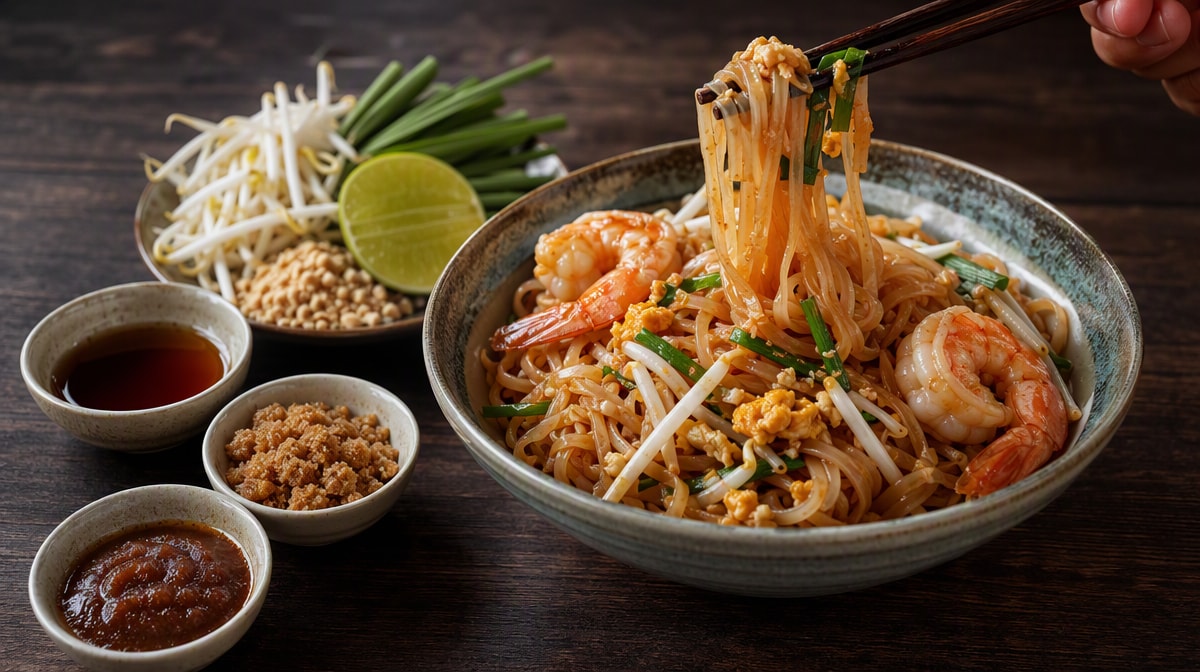
Let me clear up one thing first, because it sends people down the wrong path.
The smell is normal. The taste is not. Authentic pad thai should smell strongly of fish sauce, and if yours doesn't smell fishy something is wrong with it. What you don't want is for it to taste of fish, for the fish sauce to be the loudest thing in the bowl rather than the savoury floor everything else sits on.
Nearly always, this is a balance problem rather than a fish sauce problem. More tamarind, more sugar, or less fish sauce. Changing bottles almost never fixes it. If the bowl reads as salty rather than fishy the correction is different again, and that is how to make pad thai less salty.
Why it smells fishy at all
Fish sauce, nam pla, is made by fermenting anchovies in salt for 12 to 24 months. That fermentation generates trimethylamine, ammonia and hydrogen sulfide. Those are what you smell, and they're chemically bound into the liquid.
Here's the part that matters for your cooking. Those compounds have very low boiling points. The moment fish sauce hits a hot wok they evaporate almost instantly, and what they leave behind is glutamate, plain savoury umami. That's why fish sauce smells fierce in the bottle and tastes mild and deep in a finished dish.
So the smell leaving is correct and desirable. The problem comes when fish sauce is added late, or in too much, or without enough heat behind it. The volatiles never get the chance to cook off and they come through on the tongue as fish.
If your pad thai tastes fishy, I'd put money on the sauce being either too heavy or not hot enough to cook it off.
The three-way balance

Pad thai is built on three seasonings working against each other, and they have to stay in proportion. The prawn pad thai recipe is written around those three.
Sour is tamarind. Sweet is palm sugar. Salty and savoury is fish sauce.
Take away the acid and the sweetness and the fish sauce has nothing to sit against. It takes over, and fish sauce left unchallenged tastes like fish.
A widely used starting point is roughly one part tamarind to one part palm sugar to one part fish sauce. It's a starting point rather than a rule. Dishes differ, and a restaurant may be running well away from it. But it's a useful anchor when you're adjusting by feel.
As Dancing Shrimp puts it, whether more sugar should be added depends on whether the sweet component is an important feature of a particular savoury dish. Its role varies from dish to dish, and on the taste preference of the people at the table. Some dishes are quite plain and simple, using one or two flavour ingredients. Others are in between.
The practical consequence: if it tastes too fishy, it's almost always too light on sour and sweet. Add one of those before you add anything else. The same three seasonings going the other way is pad thai that tastes too sweet or too sour.
Fixing pad thai that's already too fishy
You're adjusting a finished dish, so you need things that work fast and at the end of cooking.
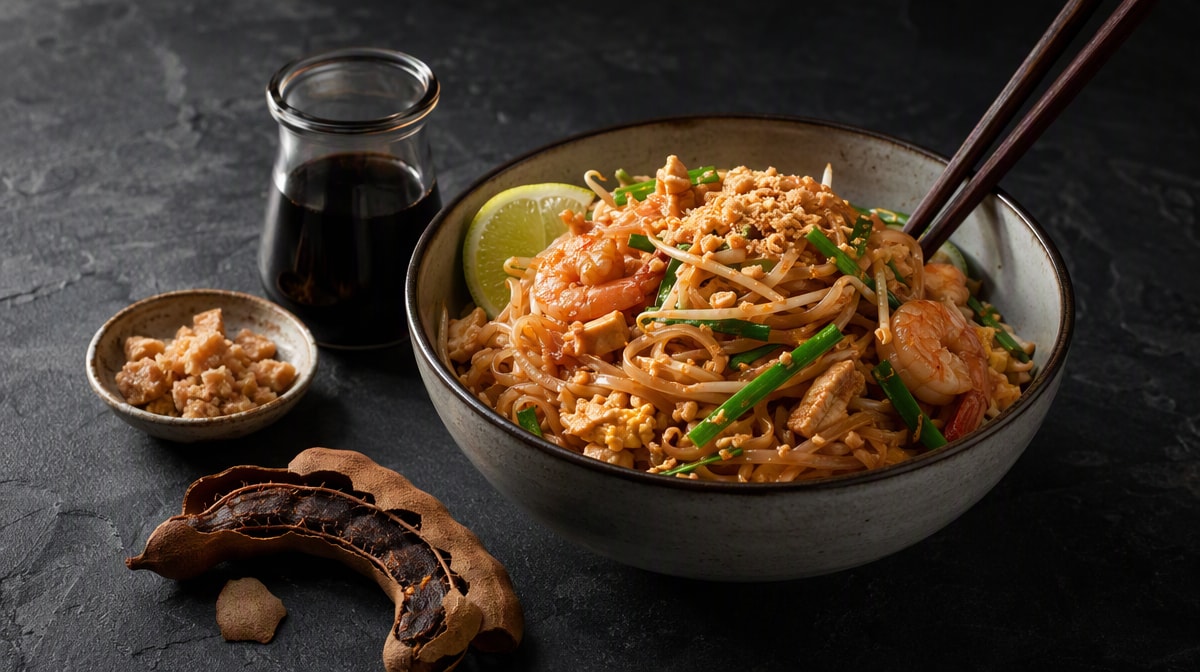
Add tamarind. A small amount, a quarter teaspoon at a time, stirred through off the heat. The acid neutralises the volatile compounds chemically rather than just masking them. This is the single most effective move, and it's why tamarind isn't optional in a properly balanced pad thai.
Add palm sugar, dissolved in a splash of warm water first or it'll sit in grains. It rounds the sharp edge off the fish sauce and gives the tamarind something to work against.
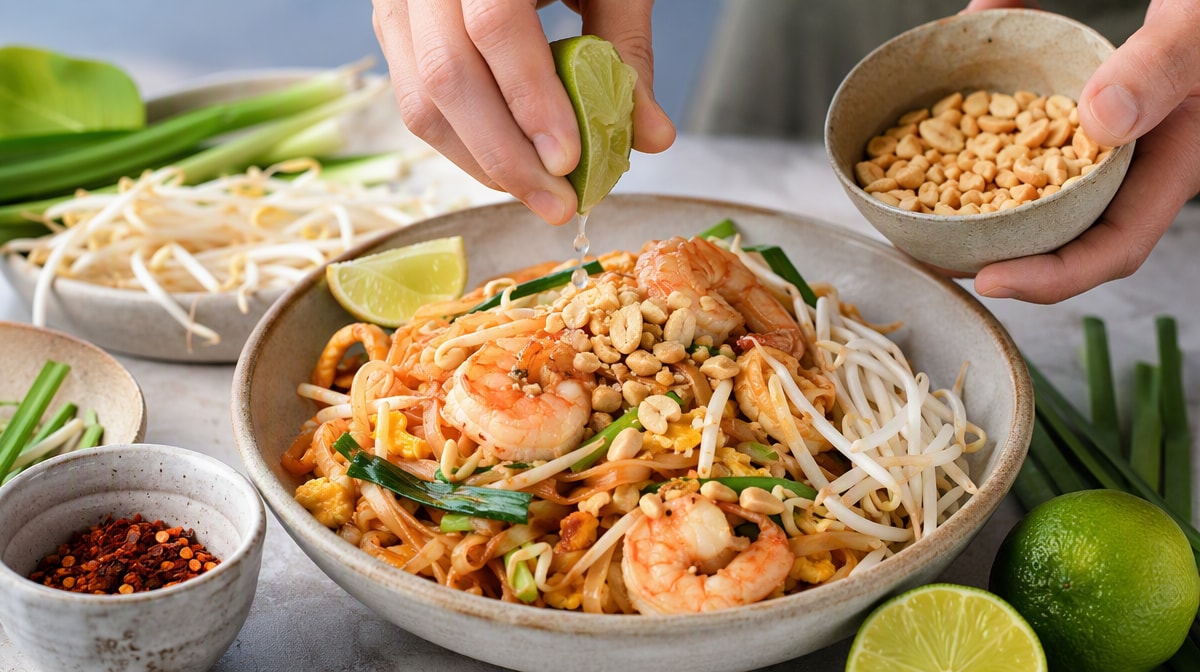
Add lime. A squeeze at the end, and It Rains Fishes recommends exactly this at the table, squeezing lime juice over each serving. It brightens the whole dish and lifts the fish note rather than burying it.
Add a little sugar and vinegar together if you have no tamarind. It's a rougher approximation, but the two together are what tamarind already does.
And never add more fish sauce. Not ever, to fix a fishy dish.
A worked example
Say you've made it and it tastes clearly of fish, but it's not salty and it's not too sour. That combination tells you something specific. You have fish sauce and tamarind in proportion, but not enough sugar to give the tamarind something to work against, so the acid isn't rounding out the fish note.
Add half a teaspoon of palm sugar dissolved in a tablespoon of warm water, off the heat. Stir, wait thirty seconds, taste.
If it's better but still fishy, it was the sugar and the heat. Add a further quarter teaspoon of tamarind, stir again, taste. You're looking for the point where the fish sauce stops being a flavour you notice and becomes the savoury base you can't quite identify, which is where it belongs.
Two adjustments is usually enough. If it's still obviously fishy after that, you put in too much sauce to rescue at the end, and next time means starting with less.
Work in quarter teaspoons rather than tablespoons because tamarind and sugar both accumulate. It's much easier to creep up to the right amount than to back off from over-corrected.
Stopping it happening next time
Use less fish sauce, and add it early. Put it in with the aromatics while the wok is hot, not in the last thirty seconds. You want the volatiles gone and the umami left.
Get the wok properly hot. This is the single biggest lever. The compounds need heat to evaporate. A lukewarm pan leaves them in and the dish tastes of the bottle rather than of what you put in it. High heat and fast cooking isn't a stylistic preference here, it's the mechanism.
Balance as you go rather than at the end. Add fish sauce, taste, then correct with tamarind or sugar. Tasting once the sauce is in and adjusting is the whole technique.
And watch your dried shrimp and shrimp paste. Both are fermented seafood and both add their own pungency. If your pad thai is too fishy and you're also using dried shrimp, the two sources are stacking. Halve one of them.
The fish sauce bottle matters, but less than you'd think

Cheap fish sauce does smell worse, and it's worth knowing why.
Premium sauces, Squid, Megachef, Son and Red Boat among them, use first-press extraction and longer fermentation, which produces a more complex and less aggressive aroma. Budget brands often add caramel, water, MSG or flavouring, and the result can be harsher than the label suggests. If the additive list is the actual worry, does pad thai have MSG covers where it comes from and whether it can be avoided.
But the strongest smell isn't the same as the strongest flavour. A cheap bottle can disappear into a well-balanced dish quite happily. If your pad thai is genuinely too fishy, the ratio is wrong long before the brand is.
One exception worth knowing: if the fishiness smells wrong rather than strong, ammonia or sour or a vomit-like note, that's not a balance problem. That's fish sauce that has gone off, and no amount of tamarind will fix it.
If you want to leave fish sauce out
It's doable and the dish still works, but you'll be losing the backbone of it.
Soy sauce plus rice vinegar plus sugar, roughly a tablespoon of soy to a teaspoon of vinegar to half a teaspoon of sugar per tablespoon of fish sauce you're replacing, is the closest quick approximation. It gives you salt, acid and sweetness, and it lacks the fermented depth that makes pad thai taste like pad thai.
Mushroom-based vegetarian fish sauce is a genuinely better substitute, because it reproduces the umami rather than approximating it with salt and sugar.
Coconut aminos is milder and slightly sweet, closer in spirit to the seasoning in a green curry than to nam pla.
Choosing a fish sauce in the first place
Since we're here, because people ask me this more than anything else about fish sauce.
Premium labels aren't marketing. A first-press sauce made from the liquid that runs first has a rounder, more complex aroma and less of the sharp ammoniac edge. A longer fermentation does the same thing, because more of the protein has broken down into the compounds you want.
The cheap ones aren't bad, and for most home cooking they'd be indistinguishable in a curry. Where you can taste the difference is raw. A dressing or a dipping sauce is where a better bottle earns its price, because there's nothing else on the plate to cover it.
Squid, Three Crabs, Healthy Boy, Megachef, Mae Ploy and Red Boat are all widely available in the UK and all perfectly reasonable. The Squid and Three Crabs bottles you'll find in most Asian supermarkets are what I use at home and I've not found a reason to move on.
If you do want to compare properly, taste two on a spoon. Not mixed into anything. Straight from the spoon, back to back, and you'll hear the difference in your nose within three seconds.
Leftovers smell different, and that's normal
Pad thai left overnight will smell stronger, and it's not a fault. Fermentation continues in the sauce after cooking and the volatiles re-dissolve as everything cools.
It's only a problem if it smells putrid rather than simply fishier. A vomit-like smell points to butyric acid from bacterial breakdown, which is a genuine spoilage signal and shouldn't be eaten. That's different from fish sauce reasserting itself.
Tasting as you go
The technique that prevents all of this is less glamorous than any of the fixes above, and it's the one that works.
Add the fish sauce, then taste the sauce on a spoon before it goes anywhere near the noodles. Not the dish, the sauce, at the concentration you're about to use. A quarter teaspoon is usually right. Once it's in the wok you can't take it out.
Then taste the dish at three points: after the aromatics and sauce, after the noodles go in, and once more off the heat. Adjust at each. The final taste off the heat is the one that counts, because the dish continues to develop as it sits, and something that tastes right straight off the wok can taste fishier two minutes later.
Nobody measures a wok sauce and then walks away from it.
The short version, for when you need it mid-cook
Off the heat, and in this order.
A quarter teaspoon of tamarind, stirred through. Wait thirty seconds, taste.
Still fishy: a quarter teaspoon of palm sugar dissolved in warm water. Wait, taste.
Still fishy: a squeeze of lime, added right at the end rather than during cooking.
If it's still obviously fishy after that, you put in too much sauce to rescue at the table, and next time means starting with less and tasting as you go.
A note on sources
Most of what's published on this is food writing rather than testing. The chemistry, low-boiling volatiles evaporating in a hot wok and leaving glutamate, is the part that's consistent across every source and that explains all the rest. The brand-by-brand flavour profiles are impressions rather than measurements. Trust the ratio.
Frequently asked questions
Is authentic pad thai supposed to smell fishy?
Yes. The smell is fish sauce, and fish sauce isn't optional in the dish. The volatiles should cook off in a hot wok, leaving savoury umami. The smell is normal; a fishy taste is not, and the difference is heat and balance rather than quantity.
Why does my pad thai taste fishy but not taste salty?
Because fishiness and saltiness come from different compounds. The volatile aroma compounds evaporate in a hot wok while the sodium stays, so a dish can lose all its fishy smell and still be very salty. If the fishy taste is strong but the salt isn't, your tamarind and sugar are the things to increase.
Can I fix too-fishy pad thai after cooking it?
Yes, off the heat. Add tamarind a quarter teaspoon at a time; the acid neutralises the volatiles chemically rather than masking them. Then a little dissolved palm sugar and a squeeze of lime. Don't add fish sauce, and don't try to dilute with water, which will make the noodles soggy.
Does dried shrimp make pad thai taste fishy?
Yes, and it stacks with the fish sauce. Dried shrimp and shrimp paste are both fermented seafood and bring their own pungency. If you're using both and the dish is too fishy, halve one of them rather than reducing both. The fish sauce is doing the seasoning work and the dried shrimp is adding depth.
Does the pan temperature actually change the flavour?
It's the biggest lever you have, and not only for fishiness. Fish sauce aroma compounds have very low boiling points and need heat to evaporate; what remains is glutamate. Too cool a pan leaves the fishy volatiles in the dish, which is why the same recipe tastes different from a properly blasted wok.
Will a better fish sauce brand stop this?
It helps at the margin but it isn't the fix. Premium brands such as Squid, Megachef and Red Boat use first-press extraction and longer fermentation, so their aroma is less aggressive, and a cheap bottle is more noticeable. But if your ratio is off, no bottle will rescue it. Fix the balance first.
Is the fishy smell in my kitchen a sign the dish is bad?
No, it's the same volatility carried on steam and oil. If the aroma fills a small kitchen, run a fan or open a window; most of it disperses within ten minutes of the pan coming off the heat. The signal to act on is a change in the kind of smell, sour or ammoniac, rather than how strong it is.
Why does my pad thai smell fishy but other people say it tastes fine?
Adaptation. Fish sauce aroma is much stronger to someone cooking with it daily than to someone eating it occasionally, which is why the same dish can read as perfectly balanced to the cook and too fishy to the guest. Trust the guest, and taste your own cooking at the point of eating rather than at the stove.

Comments