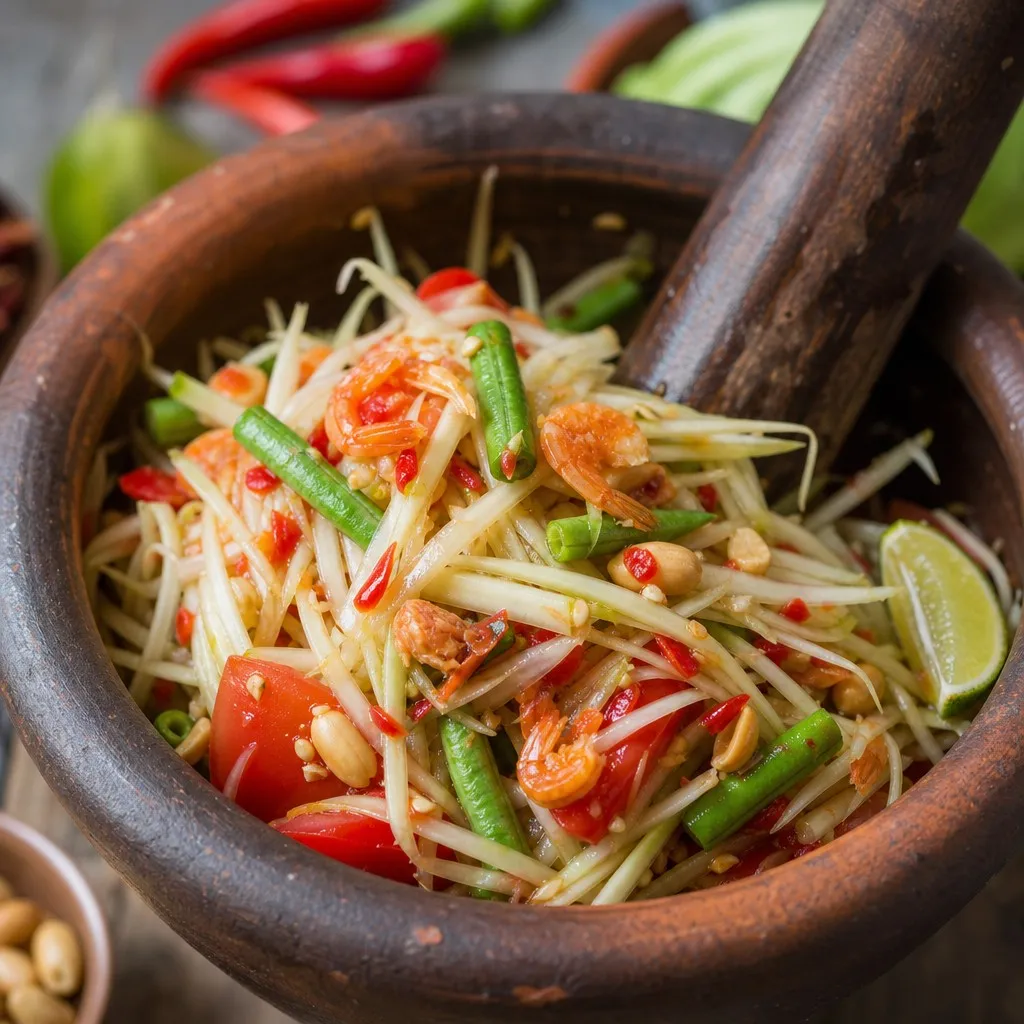
Som tam is Thailand's most popular salad and one of its most famous street food dishes: shredded green papaya, fresh chillies, lime juice, fish sauce, palm sugar, and peanuts, all pounded together in a mortar. Originally from the Isaan region of north-east Thailand, it has spread to become a dish eaten across all regions and social classes, from roadside market stalls to upscale Bangkok restaurants. The appeal is the balance: sour, salty, sweet, and spicy all at once, in one bowl.
Ingredients
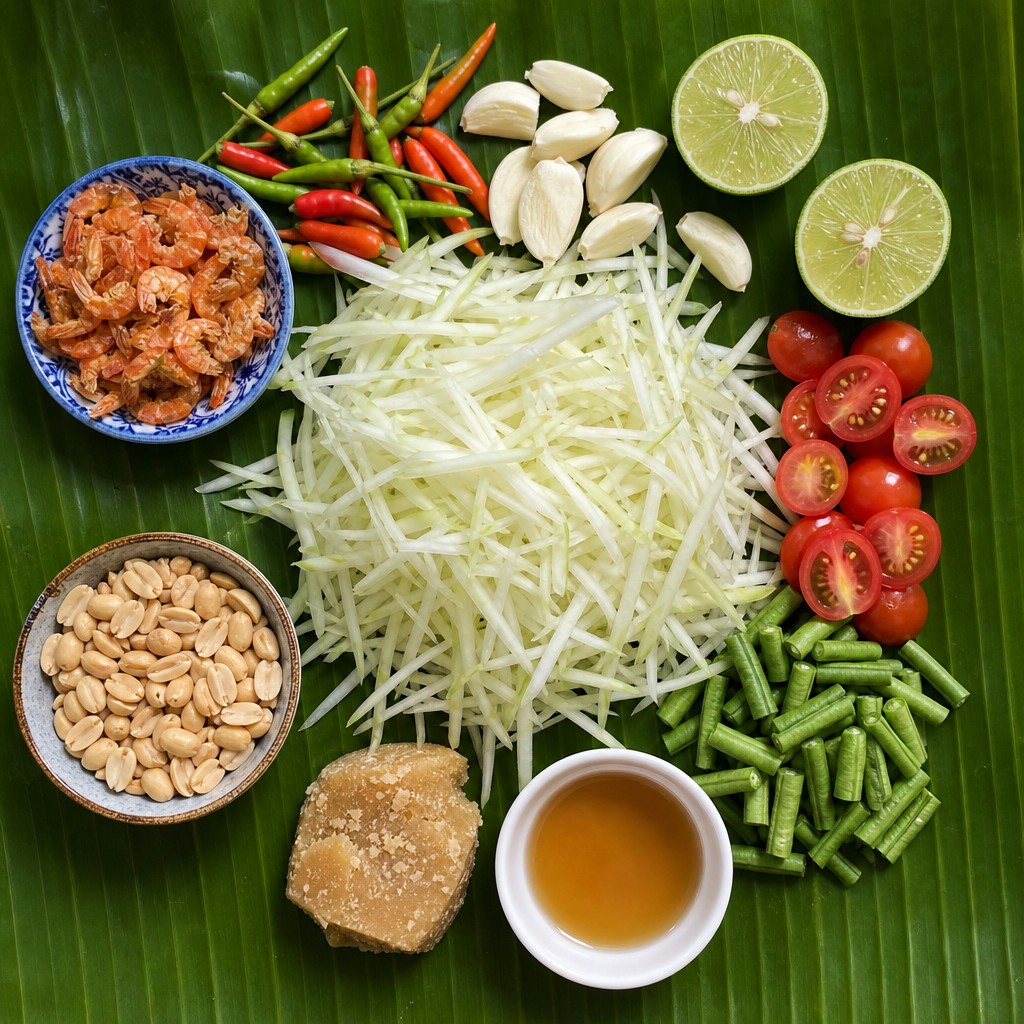
- 200g green (unripe) papaya, peeled and shredded
- 2 cloves garlic
- 2–4 fresh Thai chillies (adjust to taste)
- 6 cherry tomatoes, halved
- 50g long beans, cut into 3cm pieces
- 2 tbsp dried shrimp
- 2 tbsp roasted peanuts
- 2 tbsp fish sauce
- 1.5 tbsp palm sugar (or brown sugar)
- 3 tbsp fresh lime juice
Instructions
- Pound the garlic and chillies in a mortar until roughly crushed, not a paste. You want some texture.
- Add the long beans and tomatoes. Lightly pound to bruise them and release their juices.
- Add the dried shrimp and palm sugar. Pound briefly to combine.
- Add the fish sauce and lime juice. Stir and taste. Adjust for the balance of sour, salty, sweet, and spicy.
- Add the shredded papaya and toss everything together, lightly pounding to mix the dressing through.
- Transfer to a plate and top with roasted peanuts. Serve immediately.
What is som tam?
Som tam (sometimes written "som tum") is made from green, unripe papaya. This is not the sweet, orange-fleshed papaya you might eat for breakfast; green papaya is hard and virtually flavourless on its own, with a crunchy texture similar to a firm courgette or daikon radish. Shredded finely, it becomes the ideal base for a punchy dressing because it absorbs flavour without contributing its own.
The mortar and pestle is central to the dish and to the technique. Som tam is not a tossed salad in the Western sense. The pounding process bruises the ingredients to release their juices and flavour compounds, creating a dressing as you go rather than making it separately. The goal is bruising and mixing, not grinding to a paste: you want to see texture in the finished dish, not a mush.
Som tam originated in Isaan, the north-eastern region of Thailand bordering Laos. It is closely associated with Isaan food culture, traditionally eaten alongside sticky rice and grilled meats, and has a strong claim to being one of the most popular Thai dishes across the country. Today you find it everywhere, from market stalls to restaurant menus, in versions ranging from mild and peanut-topped (suited to non-Isaan palates) to aggressively spicy and fermented (the authentic Isaan way).
Som tam ingredients
Every ingredient in som tam has a job. Understanding what each one does helps you make the dish your own.
Green papaya is the base. In the UK, you will find it reliably at Asian supermarkets. Look for a firm, entirely green fruit with no give when pressed. If you cannot find green papaya, shredded unripe green mango makes a very good substitute with a similarly firm texture and neutral flavour.
Long beans (also called yard-long beans or snake beans) add crunch and a slightly grassy flavour. They are also found at Asian supermarkets; French green beans work as a substitute, though the texture is slightly different.
Cherry tomatoes add juiciness and a gentle acidity. Pound them lightly so they release their liquid into the dressing without completely disintegrating.
Dried shrimp is one of the elements that gives som tam its characteristic depth and umami quality. Small, pale pink, and intensely savoury, they are pounded in with the other ingredients early in the process. Available at Asian supermarkets and online. Omit for a vegetarian version, though the flavour will be significantly different.
Roasted peanuts go on last, as a topping, to preserve their crunch. Use dry-roasted peanuts rather than salted ones if possible.
The dressing (fish sauce, lime juice, and palm sugar) is what ties everything together. Fish sauce provides saltiness and umami; lime provides sourness; palm sugar (or brown sugar) rounds out the sharpness. Getting this balance right is the skill at the heart of the dish.
How to make som tam (step by step)
The mortar and pestle method is not just traditional; it genuinely produces a better result than tossing the same ingredients in a bowl. The pounding releases flavours that stirring does not.
Start with the garlic and chillies. Pound them firmly until the garlic is broken up and the chillies are bruised but not completely pulverised, with pieces rather than a paste. The number of chillies determines how hot the dish will be; two makes a mild-to-medium version, four or more takes it into serious heat territory.
Add the long beans and tomatoes and pound lightly. You are bruising them to release their juices; the long beans should be slightly split, the tomatoes should be breaking down but not gone. Add the dried shrimp and palm sugar and pound again briefly to combine. Then add the fish sauce and lime juice. At this point, taste the liquid at the bottom of the mortar. This is your dressing, and now is the time to adjust it. More lime for sourness, more fish sauce for saltiness, more palm sugar for sweetness. The hallmark of good som tam is that you should taste all four flavours (sour, salty, sweet, spicy) simultaneously, with none overpowering the others.
Add the shredded papaya last and toss everything together, using the pestle to lightly pound the papaya so the dressing works through it. Transfer to a plate and top with the roasted peanuts. Serve immediately. Som tam does not keep well once dressed, as the papaya continues to soften.
Som tam variations
Som tam comes in several distinct versions, most of them regional.
Som tam Thai is the version in this recipe, the milder, peanut-topped version that became popular across Thailand outside Isaan. It tends to be less spicy and less pungent than Isaan versions, and is generally the one served in Thai restaurants abroad. It is a good starting point.
Som tam pu uses fermented blue crab (pu pla ra) instead of dried shrimp, a version deeply authentic to Isaan and considerably more challenging in flavour. The fermented crab adds a funky, intense pungency that is not for everyone but is widely considered the "real" version by those who grew up with it.
Som tam mamuang substitutes shredded green mango for the papaya. The mango adds a fruitier sourness and the texture is slightly crisper. It is a good option if you cannot find green papaya.
What to serve with som tam
The traditional pairing in Isaan is sticky rice. You pinch a small ball, use it to scoop up a little salad, and eat them together. The starchiness of the rice balances the sharp, spicy dressing beautifully. See our guide on how to cook sticky rice if you want to make the full combination.
Grilled chicken (gai yang) is the other classic accompaniment. Som tam, sticky rice, and grilled chicken is Thailand's most iconic street food trio, particularly in Isaan. As a side dish, som tam works alongside almost any Thai meal: its brightness and acidity cut through the richness of curries and stir-fries. It is also one of the most nutritious dishes in the Thai repertoire, which we cover in more detail in our article on whether Thai food is healthy.
Tips for getting som tam right
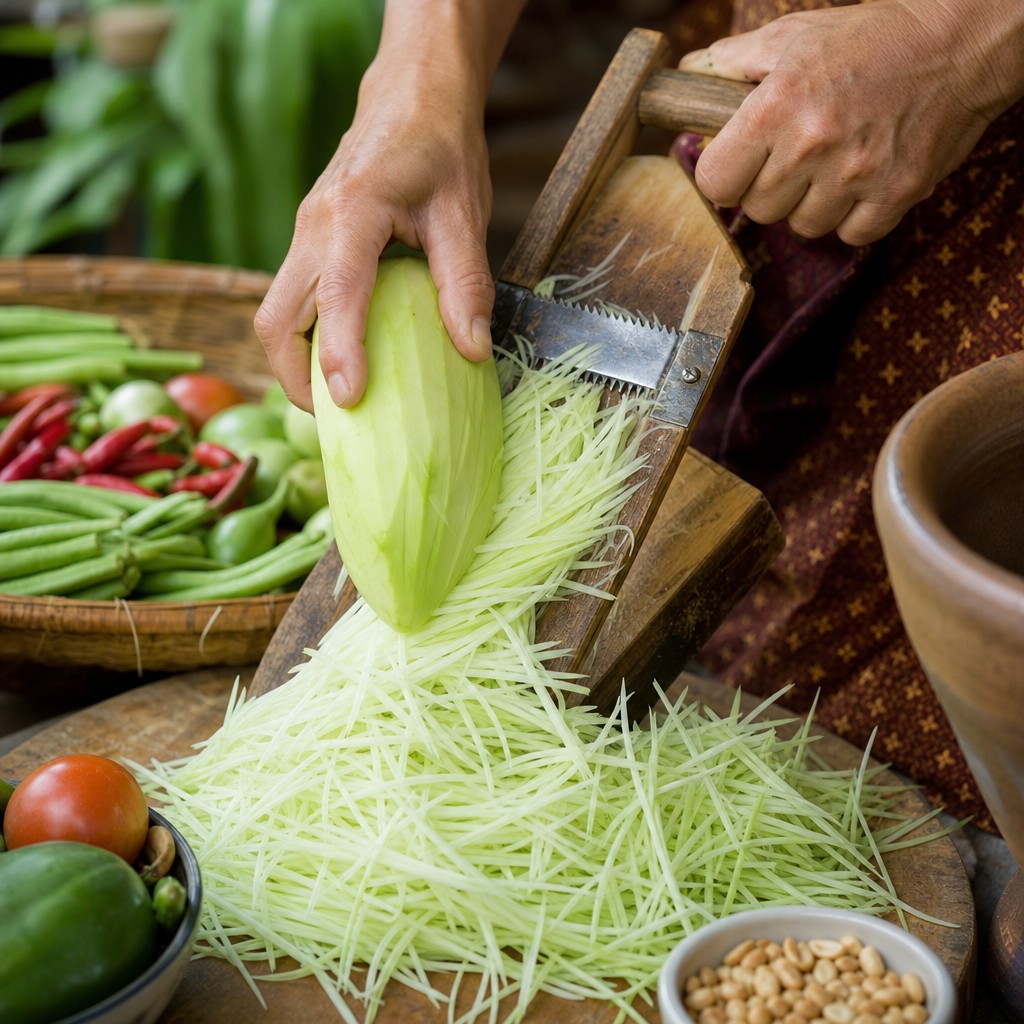
Shred the papaya finely. The finer the shreds, the better the texture and the more the dressing coats each strand. A box grater on its large holes works; a julienne peeler gives even better results. The traditional tool is a papaya shredder (a cleaver used to chop rapid score marks into the skin, then shave them off), which produces the characteristic irregular shreds you see in Thailand.
Do not over-pound. The goal is bruised, not mashed. Som tam should have texture, with pieces of tomato, bean, and papaya you can see and chew. Pound everything to a pulp and the dish loses what makes it interesting.
Taste and adjust constantly. The dressing balance is not fixed: it depends on the acidity of your limes, the saltiness of your fish sauce, and your own preference. Taste after adding each liquid ingredient and adjust before you add the papaya.
Use green (unripe) papaya only. Ripe papaya will go soft and sweet and will not hold up to the dressing. If your papaya gives when you press it, it is too ripe.
Som tam is one of those dishes where the simplicity of the ingredients is deceptive. The skill is entirely in the balance. Once you understand that the four flavours (sour, salty, sweet, spicy) need to be present and roughly equal, the recipe becomes intuitive. Make it once and you will find yourself adjusting the dressing by instinct every time after that. It is quick, deeply satisfying, and one of the most rewarding dishes in the Thai repertoire to master at home.
Frequently asked questions
Can I substitute green papaya with something else?
Yes, shredded unripe green mango makes an excellent substitute. It has a similar firm texture and neutral flavour that work well in the dressing. The taste will be slightly fruitier. Some recipes use shredded cabbage or courgette for a Western adaptation, though the result is less authentic.
What if I don't have a mortar and pestle?
A metal or glass bowl with the back of a wooden spoon will work in a pinch. Crush the garlic and chillies first, then lightly pound the vegetables to release their juices. The result won't be quite as good (the mortar's smooth surface and rounded shape help you bruise rather than chop), but it's a workable substitute.
What's the difference between som tam Thai, som tam pu, and som tam mamuang?
Som tam Thai is the mild version with papaya and peanuts, the version you'll find in most Thai restaurants. Som tam pu uses fermented blue crab (pu pla ra) instead of dried shrimp for a deeply savoury, pungent flavour; this is the more authentic Isaan version. Som tam mamuang substitutes shredded green mango for papaya, giving a fruitier taste and slightly crisper texture.
Can I use brown sugar instead of palm sugar?
Yes, brown sugar is a good substitute for palm sugar. The flavour will be slightly different (palm sugar has a more caramel-like depth), but brown sugar will balance the sourness and spice in the same way. Adjust the amount to your taste preference.
Should I use raw or roasted peanuts?
Fresh roasted peanuts are preferred. They have better flavour and texture than raw. Use dry-roasted (not oil-roasted) peanuts if possible, and unsalted varieties work best since the fish sauce already provides saltiness. Roasting them yourself from raw peanuts gives the best result.
How do I know when to stop pounding?
Pound in stages: first the garlic and chillies until they're broken and bruised, then the long beans and tomatoes until they begin to release their juices but still have texture, then briefly with the shrimp and sugar. Once you add the papaya, pound lightly until the dressing coats the strands, roughly 2–3 minutes. Stop when everything is mixed but still has visible pieces.
Why does my som tam taste watery or mushy?
Over-pounding is the most common mistake. The papaya in particular will soften and break down if you pound it too much. Also ensure you're using truly green (unripe) papaya. Ripe papaya is too soft. Finally, check your ingredient ratios: if there's too much liquid (lime juice or fish sauce) relative to solids, drain some off before serving.
How do I prepare green papaya correctly?
Peel the papaya first using a vegetable peeler or sharp knife, removing the green skin and the thin white layer underneath. Then shred the flesh into fine, even strands using a box grater (large holes), a julienne peeler, or ideally a traditional papaya shredder. The finer the shreds, the better they absorb the dressing.
What's the best fish sauce substitute for vegetarians?
Soy sauce or tamari provide saltiness and umami, though the flavour profile will be different. For a closer match, use miso paste (dissolved in water) or a combination of soy sauce plus a pinch of kelp powder. Fish sauce's funk is central to the dish's character, so vegetarian versions will taste noticeably different.
Can I make som tam ahead of time, or must it be served immediately?
Som tam is best served immediately after assembly. The papaya will continue to soften and the crisp vegetables will wilt. You can prep all your ingredients in advance (shred the papaya, chop the vegetables, measure the dressing), but assemble it only when you're ready to eat. If you must make it ahead, keep the components separate and combine just before serving.

Comments