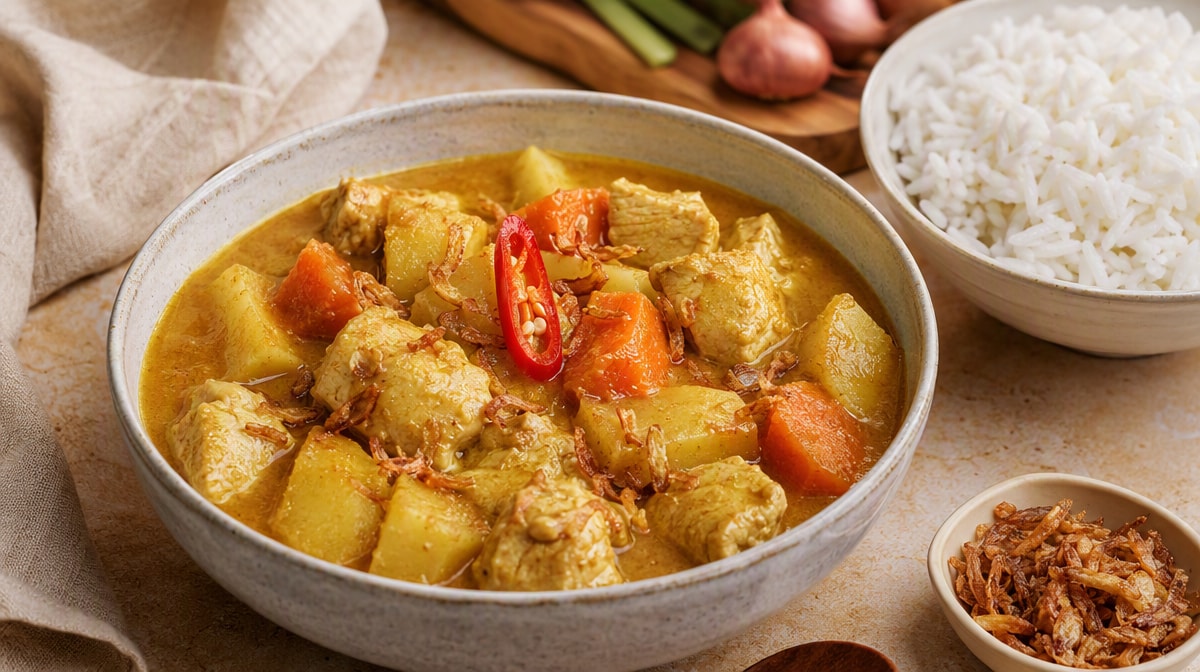
Most people get yellow Thai curry wrong because they assume it's green curry with the chillies left out. It isn't. It's a distinct dish with its own logic, and the whole character comes from turmeric and a relatively small amount of chilli.
It's the mildest of the main three, and if you want a first Thai curry, this is the one. Warm rather than hot, and closer in feel to a good stew than anything else on the menu.
First, which yellow curry

Two things in English are called "yellow curry" and they aren't the same dish.
Thai yellow curry, gaeng karee, also written gaeng kari or gaeng gari, is turmeric-led, coconut-milk-based, with lemongrass and galangal. Mild, creamy, faintly sweet.
British or Indo-Chinese yellow curry is a coconut-and-turmeric curry built around mango chutney powder, with a smoother, thicker, more uniform sauce and a sweeter edge.
If you've eaten the second and are wondering why Thai yellow is less sweet and more fragrant, that's the difference. This page is about the first, which is what you'll find in Thailand and on a real Thai menu.
What it actually tastes like
Warm, earthy, creamy, and gently sweet rather than savoury-forward.
The character comes from a short list, and it's worth knowing which ingredient is doing which job.
Turmeric gives the colour, the earthiness and most of the warmth. Cumin is the second spice pillar, nutty and slightly peppery. Coriander seed adds a light citrus note, sometimes roasted. Lemongrass, galangal, ginger and garlic are the aromatic base, sitting in the background. Coconut milk is the body, the creaminess and the sweet rounding. Palm sugar is a light sweetness that rounds off the turmeric's bitterness. And chilli, a small amount, which is the surprise.
That last one is what most people miss. Yellow curry isn't chilli-free. Most pastes contain a few dried red chillies. The heat is low but the dish is built with a controlled quantity of chilli rather than without any.
How hot, honestly
Mild. Genuinely mild, not mild for a Thai curry.
The reason is structural. Yellow curry uses a high coconut milk ratio, and fat and sugar both physically buffer capsaicin. You can put real heat into a dish and the coconut milk takes the edge off it. Add that to a comparatively small quantity of chilli and you have something that reads as warm and fragrant.
For scale: fresh bird's eye chillies, which green curry paste is pounded from, run roughly 50,000 to 100,000 Scoville. Dried red chillies in red curry paste run about 5,000 to 30,000. Yellow's paste sits at the bottom of that scale, softened further by turmeric, cumin and a generous amount of coconut milk.
The real determinant is the paste rather than the dish name. Shop-bought pastes vary enormously in chilli content between brands, so the label tells you less than the brand's reputation does.
A minority of sources get this backwards, claiming green is the mildest. That's outdated information from before green pastes began using fresh rather than dried chillies. The modern consensus, and the reason UK restaurant green curry often tastes mild, is that many kitchens tone it down for Western palates. Authentic green paste is fierce. We have covered red and green in detail on red vs green curry.
Heat is set by the paste, and you can lower it deliberately. The most reliable adjustment is more coconut milk rather than less chilli, because you can't remove heat once it's in but you can always dilute it. Adding potato does the same job and makes the dish better. Sugar is the wrong instrument; it flattens everything it touches.
The name is a clue
Kaeng is simply the Thai word for a curry or soup, a liquid dish. What follows tells you which one.
Gaeng karee is named for the curry leaf, and it's the mild turmeric curry of the northern and central Thai kitchen, and the one most often called yellow curry in English because the turmeric gives it a golden colour.
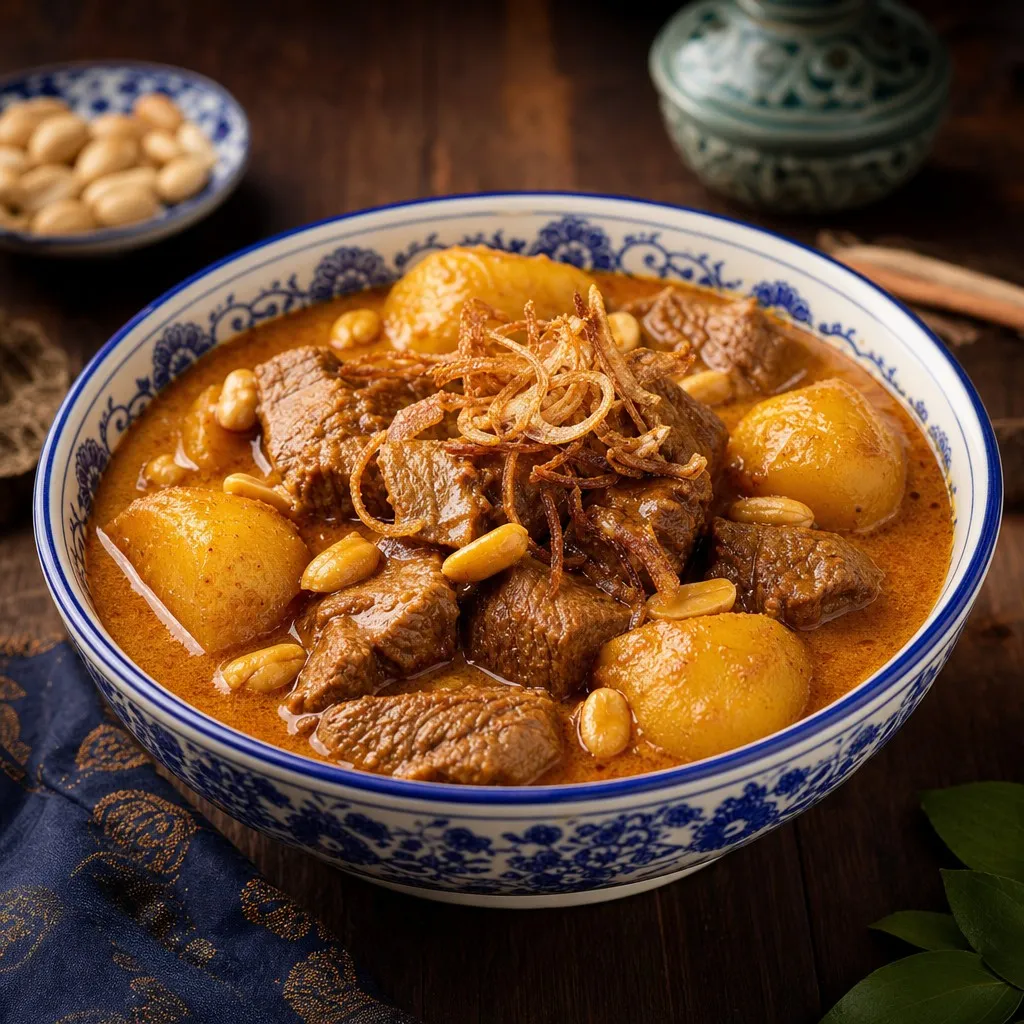
Gaeng massaman is the southern Muslim-influenced curry: peanuts, potatoes, a heavy sweetness of dried fruit, and a richness quite unlike any other curry. Even milder than yellow in heat terms, and a different dish entirely. We have a full guide to massaman curry.
Gaeng phanaeng is a dry, thick, curry-leaf curry from the south, more paste than sauce, usually beef, and again nothing like yellow.
Gaeng som is a sour orange curry from the south. We have covered that one here.
The confusion in English is largely because "yellow" is a colour description that British cooks applied to several different southern and central dishes, all of which are yellow-orange to some degree and none of which are the same as each other.
Why the paste looks nothing like a curry

Worth knowing, because it stops a lot of people buying the wrong jar.
It Rains Fishes puts it directly: in Indian cooking dry spices and aromatic seeds accentuate the flavours, but in Thailand we rely on a large number of fresh herbs and roots to make our curry pastes. Lemongrass, galanga, kaffir lime peel, cilantro roots, garlic, shallots and chillies are found in most Thai curry pastes.
The consequence is that Thai curry is built from wet aromatics rather than dry spice. Gkapi, the concentrated fermented shrimp paste, is near-essential, and it reflects a country that has always depended on the sea.
And the same source is blunt about dried mixes: occasionally you may come across ready-made, dried Thai curry mixes, and to be expected, these are inferior to those in paste form, as the fresh taste of herbs is lost in the process of dehydration.
Which is the whole argument of curry powder versus curry paste, in two sentences from a published source.
The sauce, and why coconut matters so much
Yellow curry is unusually dependent on the coconut, and it's worth understanding why rather than treating it as a liquid to add.
Coconut milk does four jobs at once. It carries the fat that carries the aroma of the lemongrass, galangal and garlic. It buffers the heat, as described above. It thickens the dish without flour, which is why the sauce feels substantial with nothing else in it. And it rounds the turmeric, which can taste bitter and medicinal on its own.
This is also why the dish can fail in a way a tomato-based curry can't. A curry that's too hot, too thin, or bitter-tasting is often a coconut problem rather than a spice problem. Coconut cream makes it worse in the right direction, and there's more on when to reach for which in coconut milk versus coconut cream.
One practical note: if your curry splits, greys or goes grainy, the coconut milk has broken, usually from too high a heat or boiling rather than simmering. Lower the heat, whisk it vigorously off the flame, and it will usually come back.
How to cook it from a jar

Yellow curry is one of the most forgiving curries to cook from a shop-bought paste.
Fry the paste first, in oil, before any liquid goes in. This is the single step that most improves a jarred paste and the one most people skip. Two or three minutes until it darkens and the raw edge goes off. It concentrates the aromatics and it's the difference between a paste that tastes like a paste and one that tastes like a curry.
Then coconut milk, and use cream rather than milk if you can. The fat is the point and it's what carries the turmeric colour.
Add your protein, then your vegetables. Chicken is the most approachable and the most common. Potatoes and onions are traditional and they do real work, thickening the sauce and making the dish feel substantial.
A little fish sauce for salt and a pinch of palm sugar to settle it. Taste and adjust rather than trusting any single measure.
For beginners specifically
If yellow is your first curry, these are the decisions that make the difference.
Use chicken. It's the most approachable protein, it absorbs the sauce without competing, and it's what the dish was designed around. Beef makes it heavier, tofu is the plant alternative, and seafood is more work for a first attempt.
Don't skip frying the paste. It's the highest-value step and it costs three minutes.
Fry it gently, on medium heat, not screaming. Turmeric and chilli both darken fast and burnt curry paste tastes bitter and won't recover. If it goes from golden to brown quickly, drop the heat.
Add the coconut milk before the protein. The sauce needs to come together before the chicken goes in, or the chicken sits in an uneven sauce and dries unevenly.
Potato is your friend. It thickens the sauce, balances the coconut, and makes the dish substantial. It's traditional, not a compromise.
Season in layers. Fish sauce, then taste, then sugar, then taste. Yellow curry forgives much but not a fully unsalted version.
Give it a simmer. Twenty to thirty minutes is normal and it's where the flavours marry. Rushing it gives you a hotter, thinner, less interesting curry, which is a common reason people find it blander than expected.
If it's still too hot, the fix is more coconut milk and more potato, not more sugar. Sugar flattens the dish; coconut rounds the heat without flattening anything.
And if a yellow curry comes out bland rather than hot, that's usually the paste rather than the salt. A yellow paste that's been open for months has lost its turmeric aroma, and no amount of fish sauce brings that back. A fresh jar is the fix.
Where yellow sits against the other curries
Briefly, and then I'll stop, because there's a full comparison on red vs green curry.
Yellow is milder than red, and this is consistent across the sources. It's richer and nuttier than red too: red is sharper and cleaner, yellow is rounder and more savoury.
It's less herbal than green, and that's the real difference rather than the heat. Green gets its character from fresh green chillies and basil. Yellow gets its warmth from turmeric, which is a completely different kind of heat altogether.
Made from scratch, it isn't a hard dish
A real yellow curry paste is simpler than a green one, because it leans on turmeric and cumin rather than on a large quantity of fresh green chilli.
It also connects to a broader Thai point about how curries used to be made. One of our sources describes a time when each household made its own paste from the freshest ingredients available, using a stone mortar and pestle, and because every family devised its own formula the balance of ingredients was based on personal taste, giving rise to subtle differences in the recipes even though curries employ a common ingredient, chilli peppers.
That's a useful thing to hold when cooking any Thai curry today. There was never one correct ratio. There were a great many personal ones, and the common thread was chilli.
If you want to go from scratch, our green curry paste recipe and red curry paste recipe are the fullest on the site, and the method transfers directly. Swap the green chillies for dried red ones and a little turmeric and cumin in. Our pestle method guide covers the equipment if you have no processor.
Serving it
Yellow curry is a main dish rather than a shared one, which makes the serving decisions simpler than for a stir-fry.
It goes down with plain jasmine rice, and rice is the point. There's nothing acidic or salty on the plate to compete with it, which is why yellow curry is the easiest of the three to serve without thinking about it.
A little acidity at the end does it good. A wedge of lime on the side, or a spoon of pickled vegetables alongside, sharpens the turmeric rather than fighting it.
And a hard warning about the sweet tea. A glass of sweetened Thai iced tea with a yellow curry is a genuinely overwhelming combination, because the sugar in the curry is doing a balancing job rather than a sweet one. Unsweetened tea, or water, and the curry tastes much better.
What goes wrong, and why
The four failures I see most often, in rough order of how often they happen.
The paste never got fried. This is by far the most common, and it's the one that makes a jarred-paste curry taste like a jarred paste. Two or three minutes in oil, until it darkens.
The heat was too high. Turmeric and chilli darken fast, and burnt curry paste tastes bitter and doesn't recover. If it goes golden to brown in seconds, drop the heat.
The coconut milk boiled. Simmer it. Boiling splits the emulsion, and you get a grainy grey sauce that tastes like coconut cream and hot milk rather than a curry. Lower heat and whisk it back together.
And the seasoning was added all at the end. Fish sauce, sugar and salt dumped in together after the curry is finished leaves you guessing and correcting in the dark. Layer it.
Is it healthy
Reasonably, by curry standards. It isn't usually fried in a deep layer of oil and coconut milk carries the fat rather than the dish being fried in it. But the coconut milk and cream together make it calorically significant, and mild doesn't mean light. It's a savoury bowl, not a salad.
A note on sources
The Scoville figures are consistent across sources and not contentious. The brand comparisons are accumulated cook experience rather than tested results, and tamarind and chilli strength vary by batch regardless. Treat the ratios as a starting point and your palate as the arbiter.
Frequently asked questions
Is yellow Thai curry spicy?
Not very, and the reason is structural. It contains a small quantity of dried red chilli rather than none, but it's carried in a high coconut-milk ratio, and fat and sugar both blunt capsaicin. The result is a gentle warmth rather than heat. It's consistently the mildest of the main three curries.
Why is my yellow curry hotter than expected?
The paste, not the dish name. Shop-bought yellow pastes vary a lot in chilli content between brands, and the label tells you nothing about it. Cook it with more coconut milk than you planned, or add more potato, rather than trying to remove heat once it's in.
Why is my yellow curry bland?
Usually salt, or the balance tipping sweet. Yellow curry should taste savoury with a faint sweetness behind it, not sweet. Add fish sauce a teaspoon at a time and taste. If the paste has been open a long time the aromatics will have faded, and no amount of salt will fix that.
Is yellow curry the same as British curry?
No. Thai yellow curry, gaeng karee, is turmeric and cumin led with fresh aromatics, lemongrass, galangal and garlic, and is lighter and more fragrant. British or Indo-Chinese yellow curry is built on mango chutney powder, is thicker and smoother, and is noticeably sweeter. If you expected the second and got the first, that's why.
What is gaeng karee?
Thai yellow curry, named for the curry leaf, and the mildest of the main curries. But "yellow curry" in English is a loose label covering several Thai dishes that happen to be yellow-orange, including the dry southern gaeng phanaeng and the sour gaeng som, none of which taste anything like gaeng karee.
Can I make yellow curry from a jar of paste?
Yes, and it's one of the easier curries to do that way. Fry the paste in oil for two or three minutes first, until it darkens, then add coconut milk, protein and vegetables. That step is what stops a jarred paste tasting like a jarred paste, and most people skip it.
Is yellow curry milder than red curry?
Consistently yes. Across the sources, yellow is the mildest of the three, red sits in the middle and green is the hottest. Note that restaurant versions in the UK often tone green down for Western palates, so a mild green curry at a takeaway doesn't mean authentic green paste is gentle.
Does yellow curry have chillies in it?
Yes, usually a small quantity of dried red chilli in the paste. What makes it mild is the quantity and the volume of coconut milk around it rather than the absence of chilli. Some very commercially made pastes use very little, but traditional yellow curry paste isn't chilli-free.



Comments