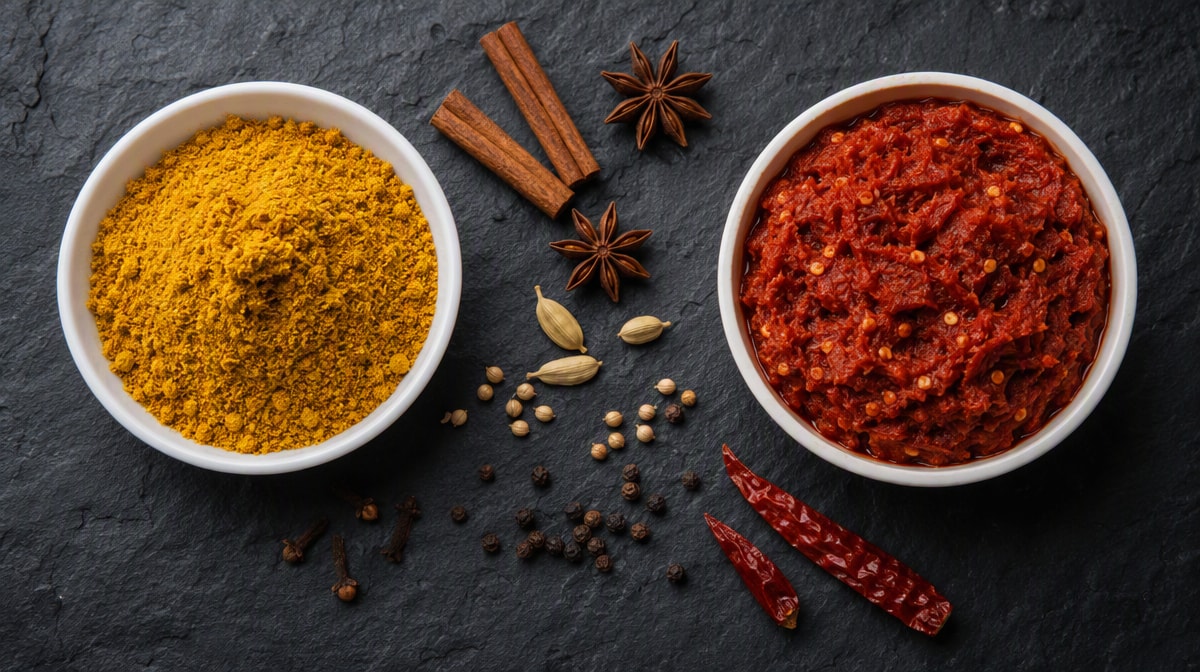
For a Thai curry, use curry paste. Curry powder is a different ingredient doing a different job, and it isn't a substitute, it's a downgrade.
That's not purity. Curry powder is a perfectly good product, widely used, and useful. It just isn't what makes a dish taste Thai, and anyone telling you otherwise has never had the real thing next to it.
Here is why, and when powder is genuinely the right call.
What curry powder actually is

A dry ground spice blend. Commonly coriander, cumin, turmeric and chilli, and often fennel, cinnamon and clove. The turmeric is what makes it yellow.
Two things follow from it being dry. It has no fresh aromatics in it: no lemongrass, no galangal, no kaffir lime peel, no cilantro root, no shrimp paste. And it needs liquid or fat to activate, like any ground spice.
It's also milder than Indian curry powder and considerably milder than Thai curry paste.
What curry paste actually is

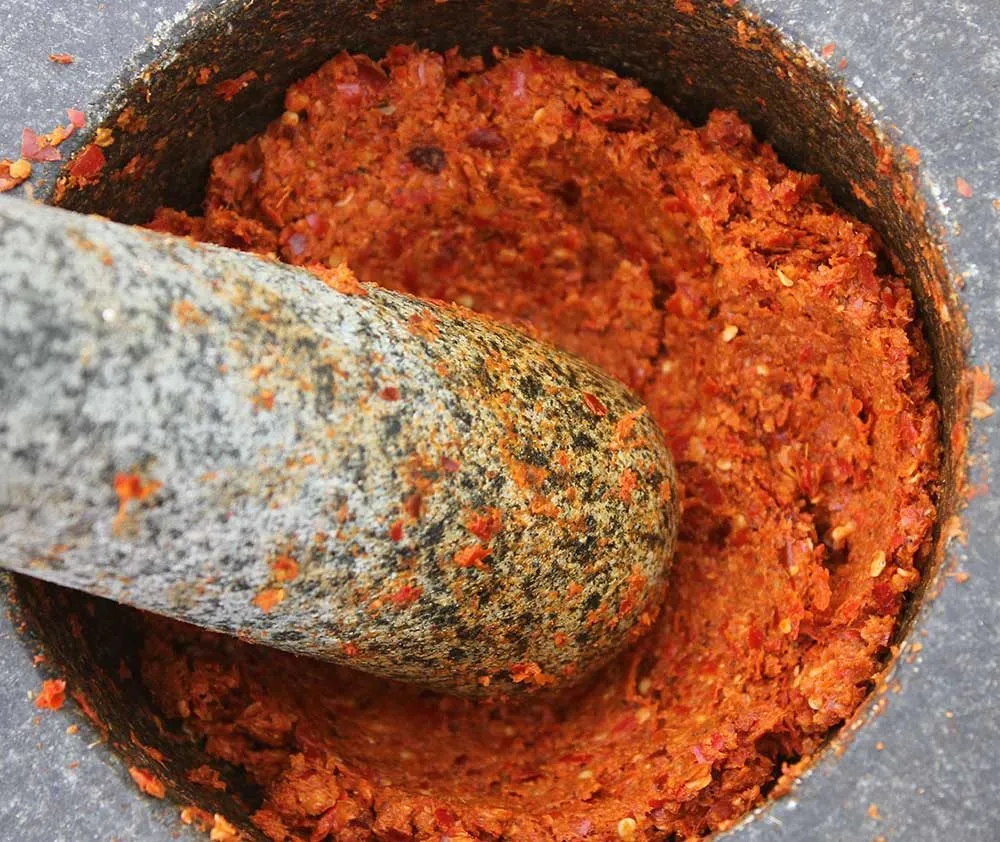
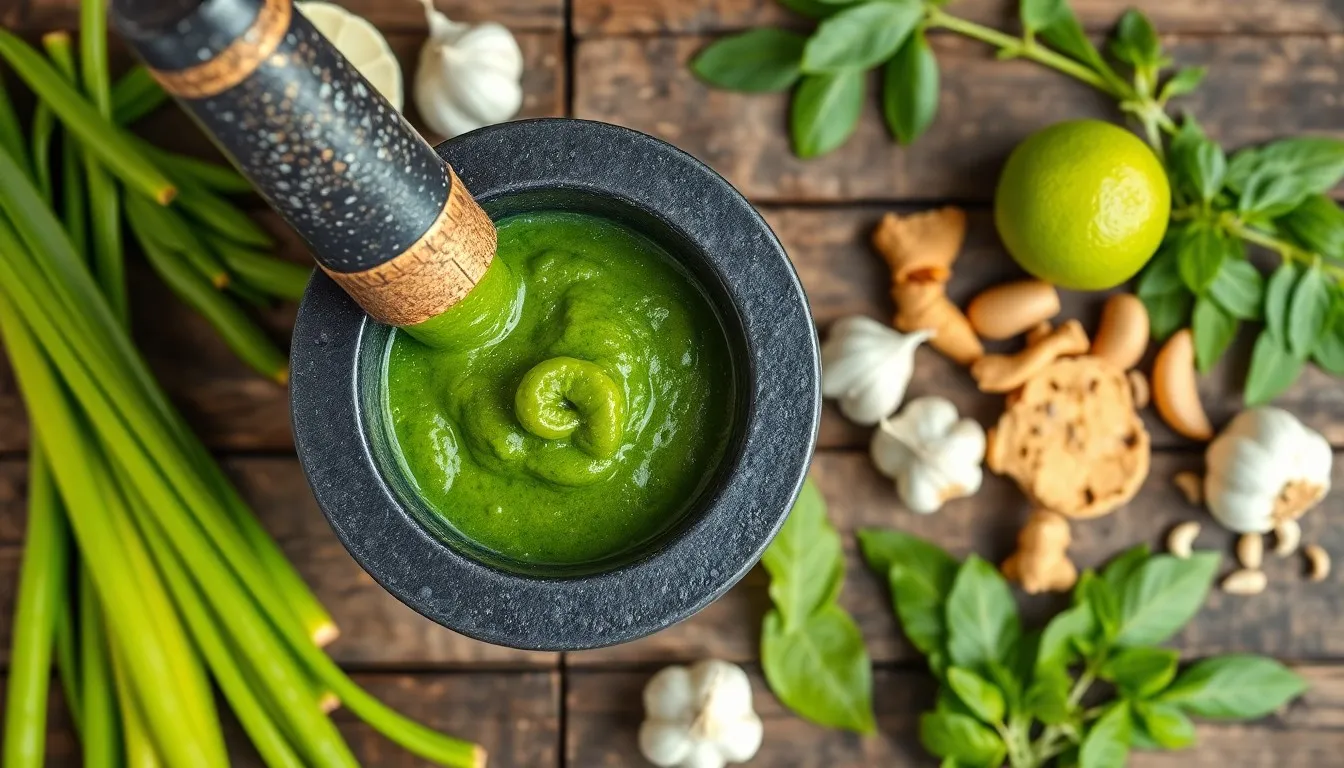
A wet, pounded concentrate of fresh ingredients. The thing a Thai cook makes in a mortar with a pestle. Lemongrass, galangal, kaffir lime peel, cilantro roots, garlic, shallots, chillies, coriander seed, cumin, cardamom, and kapi, the fermented shrimp paste that's near-essential and reflects a country that has always depended on the sea.
It Rains Fishes states the distinction better than any packaging does: in Indian cooking dry spices and aromatic seeds accentuate the flavours of India's cuisine, but in Thailand we rely on a large number of fresh herbs and roots to make our curry pastes.
And it says what it thinks of dried versions without much ambiguity: occasionally you may come across ready-made, dried Thai curry mixes, and to be expected, these are inferior to those in paste form, as the fresh taste of herbs is lost in the process of dehydration.
That's a published author on Thai cooking calling dried curry mixes inferior. It's the position of the cuisine itself.
Why the difference is felt rather than read
It's easy to dismiss this as fussiness about fresh against dried herbs. It isn't, and here's what's actually happening.
Pound a paste and you rupture the cell walls of the lemongrass, galangal and lime peel. The aroma compounds come out into the paste in concentrated form, and they're what you smell the moment the paste hits a hot pan. A powder has none of that, because those compounds were lost or never extracted at all.
It's a texture difference too, not only a flavour one. A paste is moist, and it disperses into oil and turns it into a sauce base. A powder sits in the oil as grit until you add something else to wash it in.
And it's about method. A paste is fried. You cook it in oil for several minutes until it darkens, until the fat separates and the raw edge goes off, and that process produces most of a Thai curry's aroma. A powder is stirred in and bloomed for a minute and is basically done.
The chemistry of wet against dry, for the sceptics
It's reasonable to think some of this is tradition rather than chemistry. Some of it is, and there's also a physical reason a paste behaves differently in a pan.
Cell rupture. Those aromatics hold their oils inside plant cells. Pounding destroys the cells and the oil comes out into the paste. A processor blade cuts between cells rather than crushing them, so the oil stays trapped in the fibre. Same ingredients, less flavour released.
The Maillard reaction. A paste fried in oil for several minutes browns, which generates hundreds of new aroma compounds. This is why a properly fried paste smells transformed by cooking while a powder stirred into the same oil simply smells of the spices you put in it. The cooking is producing flavour, not just releasing it.
And the emulsion. Paste is a wet mixture, so it disperses into hot oil and forms the base the rest of the dish is built on. Powder is hydrophobic, so it clumps in the oil and sits there until something wet washes it in, which is why it tastes dusty unless bloomed.
None of this makes powder bad. It makes it a different ingredient for a different purpose.
What a real paste takes
Thai Sensations describes buying paste in a Bangkok market and notes that this leaves it to the experts to pound and blend the 15 to 30 different ingredients required for each paste.
That number is the point. Nobody builds that profile in a jar of powder, and it's why pound-your-own recipes are worth the effort if you cook this often. We have full green curry paste and red curry paste recipes on the site, and a pestle method guide if you have no processor.
A warning about the wrong paste
The single most common reason a home Thai dish comes out one-dimensional is a paste mix-up rather than a technique failure, so it's worth naming the three.
Red curry paste used where nam prik pao belongs. Red curry paste is wet, fresh, built from green aromatics and shrimp paste. Nam prik pao is roasted, dried-chilli based, jammy and smoky. They're not interchangeable and one doesn't stand in for the other.
Ketchup used as a tamarind replacement. This isn't a paste question but it produces the same symptom, a curry that tastes sweet and thin with no sour anchor anywhere.
Sambal oelek used as a curry paste. It's an Indonesian raw chilli paste, bright and uncooked, and it goes into a dipping sauce or a sambal rather than a curry.
If a curry tastes wrong in a way you can't pin down, work out which paste actually went in before you start adjusting quantities. Adjusting the ratio of the wrong paste will never get you there.
The regional pastes, if you want to go further
Thai curry pastes aren't one thing, and knowing that is half of understanding why a jar is never quite a substitute.
Northern pastes are relatively mild and heavily aromatic, built on a broad spice base of coriander, cumin, cardamom, cinnamon and cloves, with a little chilli. This is the family of gaeng karee and gaeng hung lay, the mild yellow curries of the north, and it's why yellow curry is a good first curry. It's a genuinely different profile from southern pastes.
Central pastes, of which nam prik is the archetype, are the most aromatic and the most aggressive. This is the fermented, shrimp-heavy, chilli-forward family, and it's what you find in a jar marked simply red curry paste or prik pa.
Southern pastes are milder, rounder and sweeter, frequently containing cinnamon and star anise where a northern paste wouldn't, and they're often coarser and less smooth. This is the family behind gaeng phanaeng and gaeng massaman, and that sweetness is a real regional characteristic rather than a Westernised softening.
The northern and southern split isn't marketing. It follows real culinary geography. The north borders Burma and Laos, the south borders Malaysia, and both edges of the country developed different spice traditions. Massaman, the most distinctive curry on the menu, is southern and reflects a Muslim, largely Malay and southern-Thai heritage that nothing else in the curry family shares. We have covered it in detail here.
So when a shop-bought paste doesn't taste like a curry you've had in Thailand, that may be the reason. It's a central or northern paste and the dish you remember was southern, or the other way round.
When powder is the right answer
It isn't always wrong. Three cases.
You have no paste and can't get one. Two tablespoons of powder will carry a curry that would otherwise be plain. It'll be milder, less fragrant and less authentically Thai, and it'll absolutely be edible. This is a genuine emergency substitution and it works better than leaving the dish unseasoned.
You want a rounder, gentler flavour deliberately. Powder has no sharp fresh aromatics to overpower, which makes it useful in a soup or a stew where the protein is meant to be the point. It blends rather than announces itself.
For marinades and dry rubs, where a paste would be too wet and too perishable. A powder mixes into oil and coats meat properly, and it keeps indefinitely where a paste doesn't.
And for a curry powder blend of your own, which is genuinely good and keeps for years. Coriander, cumin, turmeric and chilli toasted and ground is a real product, and using a tablespoon or two to boost a paste rather than replace it is a better use of it than most people know.
How to use it if you do
Bloom it in oil first, exactly as you would a paste. Thirty to sixty seconds in hot oil until fragrant. Powder dumped straight into liquid tastes dusty and thin, and this is the whole difference.
Add it early, not at the end. It needs time with heat to release its compounds, which is the opposite of a finishing seasoning.
Use less than you think. One to two tablespoons is typical for a dish serving four. Curry powder accumulates and it's easy to overwhelm something with it.
And if you want to make it into something paste-like, Savory Spice's approach is useful. Mix the powder with an equal part of fish sauce or water plus a little lime and you have something that behaves much more like a paste in a wok. It's a stopgap, but a useful one, and it closes the body gap that powdered blends have rather than just the flavour gap.
Which is milder
A common and persistent confusion: both Thai curry powder and Indian curry powder are milder than Thai curry paste.
Indian curry powder is a household blend, sweet and mild, and the Madras variants are the spicy ones. Thai curry powder sits in a similar place, mild and turmeric-yellow. Thai curry paste is the concentrated, aromatic, properly hot thing, and it's what gives a curry its heat and its character.
So if a recipe's curry is bland and you're wondering whether to add more powder, the answer is no. Add paste, or more chilli, and see why pad thai tastes too fishy for why chilli and sauce are the same lever in a different dish.
Storing each, briefly
Paste is perishable. Opened, about a week or two in the fridge, and it must be refrigerated and used with a clean spoon. It freezes well, and freezing in an ice cube tray is the practical way, a cube being about a tablespoon.
Powder is effectively indefinite. A sealed jar keeps a year or more in a cool dark cupboard, and improves slightly in the first few months as it settles. This is its genuine advantage, and it's why it's worth keeping in the house as a backstop even if you always use paste.
The trade is freshness against convenience, and the practical answer for most people is to keep both. Paste for cooking, powder for the times you have neither, which is more often than you'd expect.
How much a jar of paste is actually worth
If you're weighing up a bag of paste at the supermarket, a couple of things are worth checking before you buy it.
Colour is a guide. A good red or panang paste is a deep brownish red rather than a bright scarlet. Bright red usually means colour has been added, and very dark can mean it's been over-processed or has sat. This isn't a rule, but it's a fast read.
The ingredient list length. A proper paste involves 15 to 30 ingredients. A short list is a short paste, and it will taste like it.
And visible fibre. Shredded lemongrass and galangal should be visible in a good paste. A perfectly smooth uniform paste has usually been blended too far, which is the same problem as using a blender rather than a mortar.
None of this is decisive on its own. It's thirty seconds of looking before you commit, and it'll save you being disappointed on a Saturday.
The quick test
If you want to know whether what's in front of you is the real thing.
Does it smell of lemongrass the moment you open it? Paste does. Powder doesn't.
Is it moist and oily rather than dry and dusty? Paste is.
Is there visible fibre in it? Paste has shredded lemongrass and galangal.
Does it contain shrimp paste? A proper red or panang paste does, and it's what gives those curries their depth.
If none of those are true, it's a powder, whatever the label says.
A note on sources
The chemistry of wet against dry is well established and consistent. The ingredient lists and brand comparisons come from recipe development and cooking sources rather than laboratory work, but they don't conflict. The one genuinely well-researched finding is that of the pad thai brief: the dried-filler content, which we've covered in the palm sugar guide. The rest is cooking knowledge that holds up in a pan, which is the only test that matters here.
Frequently asked questions
Is Thai curry powder the same as Indian curry powder?
No. Indian curry powder is a household blend, usually sweet and mild. Thai curry powder is turmeric-yellow and includes its own profile of coriander, cumin, chilli and often fennel and clove. Both are mild compared to Thai curry paste, and neither is what a Thai curry is built on.
Can I use curry powder instead of curry paste in a Thai curry?
You can, and it will be edible. Roughly two tablespoons of powder is a serviceable stand-in. It'll taste milder, less fragrant and less authentically Thai, because powder has none of the fresh lemongrass, galangal or kaffir lime that carries the aroma. If you can get paste, get paste. If you can't, this works better than leaving the dish unseasoned.
Is curry powder or curry paste spicier?
Paste, considerably. Powder is a dry spice blend and is relatively mild. The heat in a Thai curry comes from the fresh and dried chillies pounded into the paste, and that isn't something a jar of powder reproduces. Thai curry powder is closer to Indian curry powder in strength than to Thai curry paste.
Why does my curry taste dusty when I use powder?
Because you probably didn't bloom it. Curry powder is a dry ground spice and needs fat or liquid to release its compounds. Fry it in hot oil for thirty to sixty seconds before anything else goes in, the same way you would a paste. Adding it straight to liquid is the usual reason it tastes thin and dusty.
What is Thai curry powder made from?
Typically ground coriander, cumin, turmeric and chilli, with some makers including fennel, cinnamon and clove. It varies a lot between brands, and it's always milder and simpler than a curry paste, which may contain fifteen to thirty pounded ingredients.
Does curry paste need cooking before you add other ingredients?
Yes, and it's the most important step in a Thai curry. Fry the paste in oil for several minutes until it darkens and the fat separates, and only then add coconut milk. This is what develops most of the dish's aroma. Skipping it is why some jarred-paste curries taste flat, and there's a walkthrough in our yellow curry guide.
How long does curry paste keep?
Opened, about a week or two in the fridge, and it will keep far longer frozen. Curry powder is the opposite: a jar keeps a year or more, which is its main practical advantage. For storage detail on both, see how long opened coconut milk lasts for the fridge mechanics, which apply to any opened jar.
Can I make my own curry powder instead of buying paste?
Yes, and a homemade blend of toasted coriander, cumin, turmeric and chilli is a real improvement on a bought jar, and it keeps for years. But it's still a powder. It won't replace paste in a curry that's trying to taste Thai. Use it to boost a paste rather than to stand in for one.


Comments