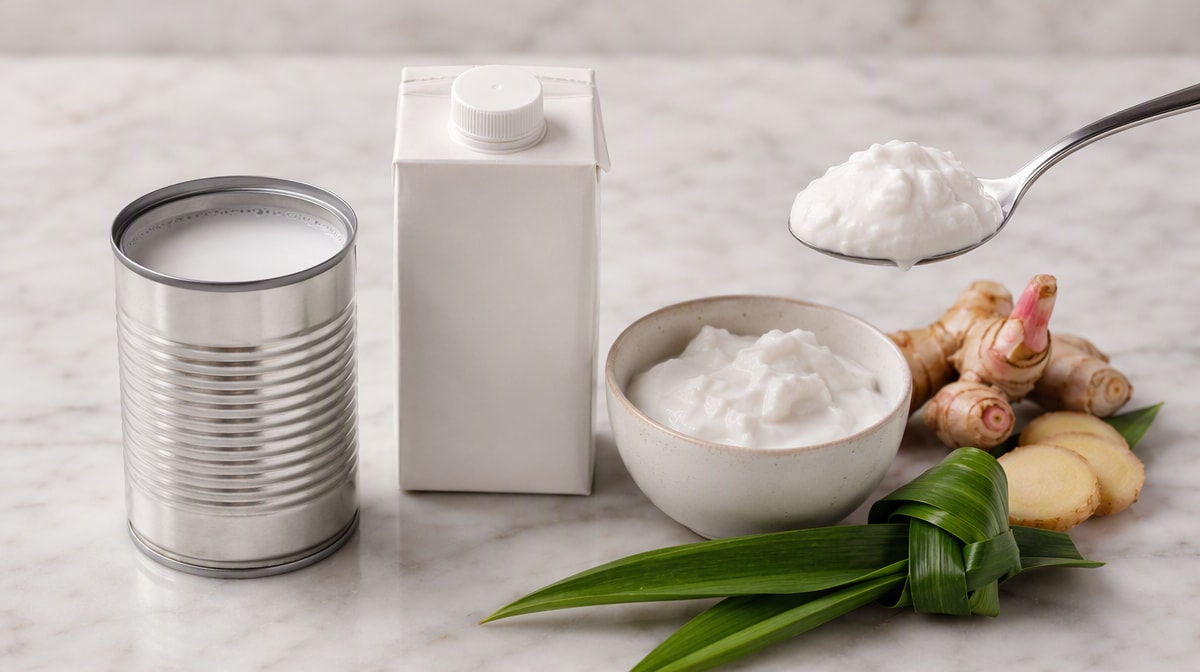
Yes, you can substitute one for the other. You just almost always need to dilute the cream first, and the direction of the swap matters more than people expect.
Coconut milk to cream is safe and easy. Cream is richer, and full-fat milk used one for one gets you close enough for most curries.
Cream to milk is the swap that goes wrong. Cream is roughly twice the fat and far thicker. Put it into a curry undiluted and you get something rich, heavy and often greasy. Not a disaster, but not what the recipe was going for.
And there's a third thing worth knowing, which is that the traditional Thai way round is the opposite of the assumption most recipes make. Authentically, Thai cooks use the thick cream first and reach for the thinner milk second. Mark Wiens's authentic green curry calls for two to three cups of hua gati, coconut cream, not milk.
What the difference actually is

Both come from the same thing. Grated mature coconut flesh pressed with water. The only difference is how much water.
Coconut milk is a thinner press, more water, roughly 5 to 13% fat and typically about 10% for full-fat canned. Coconut cream is a thick press, less water, roughly 19 to 25% fat.
It's exactly the same relationship as dairy milk and dairy cream, from the same kind of nut.
Three things that affects in a curry: how thick it is, how rich the coconut reads, and how much it calms down heat. The fat in cream is why it fills the mouth differently and mutes chilli more than milk does.
And there's a third product, badly named

Three things sit on the shelf in most UK supermarkets and they're genuinely different.
Coconut milk is the cooking one. The one you want for curry.
Coconut cream is the thick one, unsweetened, for cooking or whipping.
Cream of coconut is sweetened and made for piña coladas. Don't put this in a curry.
The names overlap confusingly in English and cream of coconut is a trap. Check whether the can is sweetened before you buy it.
And never use coconut beverage. The UHT drinking cartons are made for drinking, not cooking, and they're thinner and much less coconutty than the cooking cans.
How to substitute, with numbers
Cream for milk: use it one for one and accept a richer, thicker curry. Most recipes will be an improvement rather than a problem. This is the swap to reach for when you want more body.
Milk for cream, to get the thickness: chill an unopened can of full-fat coconut milk overnight and scoop the solid layer from the top. That's genuinely the closest thing to coconut cream and it costs nothing but planning ahead.
Or reduce: simmer a can of full-fat milk, uncovered, for 10 to 15 minutes, until it's reduced by about a third. That thickens it and concentrates the flavour, and it works for any recipe that calls for cream.
Diluting cream back down to milk consistency: roughly one part cream to one or two parts water or broth. Or three parts cream to one part water for a closer match to full-fat milk. You'll see both figures and the difference is how rich you want it to end up.
The method matters more than the ratio. Start with less cream than you think and add liquid until the consistency looks right. Creeping up is much easier than backing off from a curry that's already split.
The traditional Thai method, which reverses the intuition
This is the part worth reading, because it changes what "correct" means.
Thai cooking uses two grades of coconut product from the same nut. Hua gati, the thick rich head, and haang gati, the thinner tail. A cook with both will use the rich one for the base of a curry and the thin one to loosen it.
Authentic Thai curry is therefore frequently built on coconut cream rather than coconut milk. Mark Wiens is explicit that using only thin coconut milk can make the oil separate, and that fresh coconut cream is what is wanted in Thailand.
The technique that depends on this is that you fry the separated thick cream in the pan first, until the fat splits out and the solids brown, and you cook the curry paste in that. MyThaiCurry describes it as that separation being what a Thai cook is seeking.
Which makes the substitution question run the other way. Swapping milk for cream in a recipe written for the traditional method doesn't break it, it moves it closer to what's done in Thailand. Swapping cream for milk is the move that costs you something.
The one thing to check on the can
If your coconut milk contains emulsifiers or stabilisers such as guar gum, it won't separate into a cream layer and it can make a watery curry.
This is the one practical difference between brands that matters more than the fat percentage on the label. Thai brands such as Chaokoh and Aroy-D are the ones generally preferred for this reason. If a can won't split when you open it, the technique won't work, and that's a packaging difference rather than a fault in the product.
It also explains why "my curry is thinner than the restaurant's" is a common complaint. Two coconut products, one with a stabiliser and one without, don't behave the same in a pan.
When to use each
Coconut milk for lighter, brothier curries where the liquid should dominate. Green and red curries where the sauce should run. Anything you want to stay light.
Coconut cream for panang, where a thick sauce is the point. Massaman. A green curry where you want it richer than usual. Any dish where you want more body or more coconut flavour. Reducing a curry that's too thin, because it thickens faster.
For a low-fat swap the other way, cashew cream is the best plant-based answer. Soaked raw cashews blended with water until silky. Neutral in flavour, so it disappears behind the spices, and it works for both Thai and Indian curries.
Worth saying that most of the perceived richness in a Thai curry is aroma rather than fat. A curry built on thin coconut milk and a good paste can taste more coconutty than one built on cream and a tired jar of paste. The paste matters more than the milk, which is why our green curry paste recipe is the more useful thing to get right.
Plant milks are much weaker and need help. Oat milk, ideally barista-style and unsweetened, doesn't split when simmered and is the safest of the lot. Almond and rice milks are thin and need a thickener. Silken tofu blended with water works, and a spoon of coconut oil restores the richness.
Dairy works if you're not avoiding it. Heavy cream one for one is the richest match, added at the end over low heat so it doesn't curdle, plus a little sugar for the coconut sweetness. Evaporated milk is a reasonable middle ground. Greek yoghurt is tangy, so it pulls the dish off-authentic. Use it sparingly and off the heat.
How to cook with each, step by step
The practical difference shows up in method as much as quantity.
With coconut milk, the fat is already dispersed, so the sauce thickens gradually as it simmers. Add it after frying your aromatics, bring it to a gentle simmer, and let it reduce to the consistency you want. Because it's thin it takes longer to get there, which is why so many people add more oil to compensate and end up with a greasy curry. Our guide to why pad thai is oily covers that mechanism in the noodle context, but it's the same principle in any dish.
With coconut cream, fry it first, on its own, until the oil splits and the solids turn golden. That takes a few minutes and it's the step that can't be hurried. Then fry your curry paste in that oil, and only then loosen with the thinner milk, water or stock.
The fat splitting isn't a fault. Coconut cream is an emulsion, and breaking it is what releases the aroma compounds the coconut is there for. A cream curry that never split hasn't been cooked, and a cream curry that split too hard can turn grainy, which we've covered in detail on green curry going grainy.
If a cream curry is splitting badly, lower the heat, whisk it off the flame, and add a little water. Almost always recoverable.
The trap, in full
Several recipes tell you to chill a can, scoop the cream off the top, simmer that until the oil splits, then add the rest of the milk.
It's a good technique and it produces a better curry. It's also not a step you can perform on a can that won't separate, and emulsifier-containing brands won't. Do it with the wrong can and you wait for a layer that never arrives, and the recipe quietly fails.
Making cream from milk, or milk from cream

To get cream from milk: chill the can overnight and lift the solid top layer. Or reduce by a third. Or blend a spoon of the milk with a little cornflour and stir it back in.
To get milk from cream: dilute with water or broth, one part cream to one or two parts liquid, and taste as you go.
And when you have neither, a good stock with a spoon of oil and a little cornflour slurry gives you the body, if not the coconut flavour. You'll miss the latter and the dish will still work.
Shelf life, briefly
Coconut milk, opened, keeps four to seven days in the fridge. Coconut cream, opened, keeps longer, a week to ten days, because there's less water for anything to grow in.
Both are much better frozen than kept, and both freeze well. See how long opened coconut milk lasts for the detail and the freezing method.
A bit of history, because it explains the confusion
One of our sources explains why coconut does so much work in Thai cooking at all: unlike coconut cream, animal fat spoiled quickly in the tropical heat, making it difficult to keep for any length of time.
Coconut cream was the preservative. It's fat that keeps where butter doesn't, and in a hot climate before refrigeration that's not a small thing.
The rest of the story is more unexpected. During the reign of King Narai, 1656 to 1688, a Greek adviser named Phalkan became the first foreigner appointed to the royal court. His wife, half Japanese and half Portuguese, was so accomplished at making coconut cream desserts that the king created a court position for her. She taught the women of the household to use coconut cream and milk in place of butter and cream in the European tradition, and a whole repertoire of Thai sweets and dishes came out of it.
So coconut cream in Thai cooking isn't a modern Western substitute for dairy. It came first, and European dairy followed.
Working out a recipe you've never cooked
Because both products get used in recipes that assume the other, it's worth having a method rather than relying on recall.
If a recipe says coconut cream and you only have milk, chill the can overnight and lift the top layer, or reduce it. If you can't do either, use the milk and add nothing. The curry will be thinner but perfectly good.
If a recipe says coconut milk and you only have cream, use it as is for a richer result, or dilute one part cream into two parts water to get back to roughly milk consistency.
If the recipe calls for both and you have one can of each product, you're fine. Most recipes that call for cream and milk together want the cream fried first and the milk added later, which is the two-grade method, and one chilled can gives you both.
The one thing not to do is reach for sweetened cream of coconut, or a drinking carton, because both will make a curry that's inexplicably sweet and thin.
Which to buy
For Thai cooking, full-fat, in a can, Thai or Southeast Asian brand, no stabilisers.
Avoid light coconut milk, which is mostly water and a marketing term. Avoid coconut beverage. And avoid anything sweetened unless you want a dessert.
Best of both if you can: two cans of full-fat milk, chilled overnight. You get both grades, the cream off the top for the base of your curry and the thin milk to loosen it at the end. That's the traditional two-grade method, from the same can, for the price of one.
The one thing to remember
If you take a single line from this page: coconut milk is thinner, coconut cream is richer, and in traditional Thai cooking the richer one goes in first.
Almost every mistake on this page comes from swapping them without adjusting. Cream into a thin recipe gives you a heavy curry. Milk into a rich one gives you a thin curry. They're the same nut, the same press, and the same coconut. Only the water is different, and once you know that the confusion stops.
Frequently asked questions
Can I substitute coconut cream for coconut milk in curry?
Yes, and it's the safer direction of the swap. Use it one for one and expect a richer, thicker curry, which is an improvement in most cases. Only dilute it if the dish is meant to be light or brothy, in which case mix it with roughly one or two parts water or broth.
Can I substitute coconut milk for coconut cream?
Not one for one, because you'll end up with a thin curry where the recipe wanted body. To get the same result, chill an unopened can of full-fat coconut milk overnight and scoop the thick layer from the top, or simmer it uncovered for 10 to 15 minutes until it's reduced by about a third.
What is the difference between coconut cream and cream of coconut?
Coconut cream is unsweetened and thick, for cooking. Cream of coconut is sweetened and made for piña coladas. They aren't interchangeable, and putting the sweetened one in a curry will wreck it. Check the label before buying.
Why is authentic Thai curry made with coconut cream rather than milk?
Because Thai cooking traditionally uses two grades from the same nut, the rich head and the thinner tail, and the rich one goes in first. The technique depends on frying that thick cream until the fat splits and cooking the paste in it, which thin milk doesn't give you. So for that kind of recipe, cream is more authentic and milk is the substitution.
Does coconut milk need to separate before I cook with it?
For the traditional technique, yes. You want the fat to split out. Brands containing emulsifiers or stabilisers such as guar gum won't separate and can make a thinner curry, which is why Thai brands like Chaokoh and Aroy-D are generally preferred. If your curry comes out watery and no coconut milk would split, that's usually why.
Can I use coconut milk in a green curry instead of cream?
Yes, and this is the normal home version. You'll get a lighter, looser curry than a traditional recipe, which suits a lot of people. Add more coconut milk than the recipe states to compensate, and expect the sauce to be thinner than a restaurant's.
What can I use if I have run out of coconut milk entirely?
A good stock gives you liquid but no richness, so pair it with a spoon of oil and a little cornflour slurry for body. For plant-based richness, blended cashews soaked and blended with water are the best substitute. They're neutral in flavour and they disappear behind the spices. Avoid sweetened cream of coconut and coconut drinks.
Is coconut cream healthier or fatter than coconut milk?
Considerably fatter, roughly 19 to 25% fat against about 10% for full-fat milk, and that's deliberate since it's made by removing water. For a lighter curry use milk, and if you need to cut fat overall, cashew cream is the plant-based answer that still gives you body.



Comments