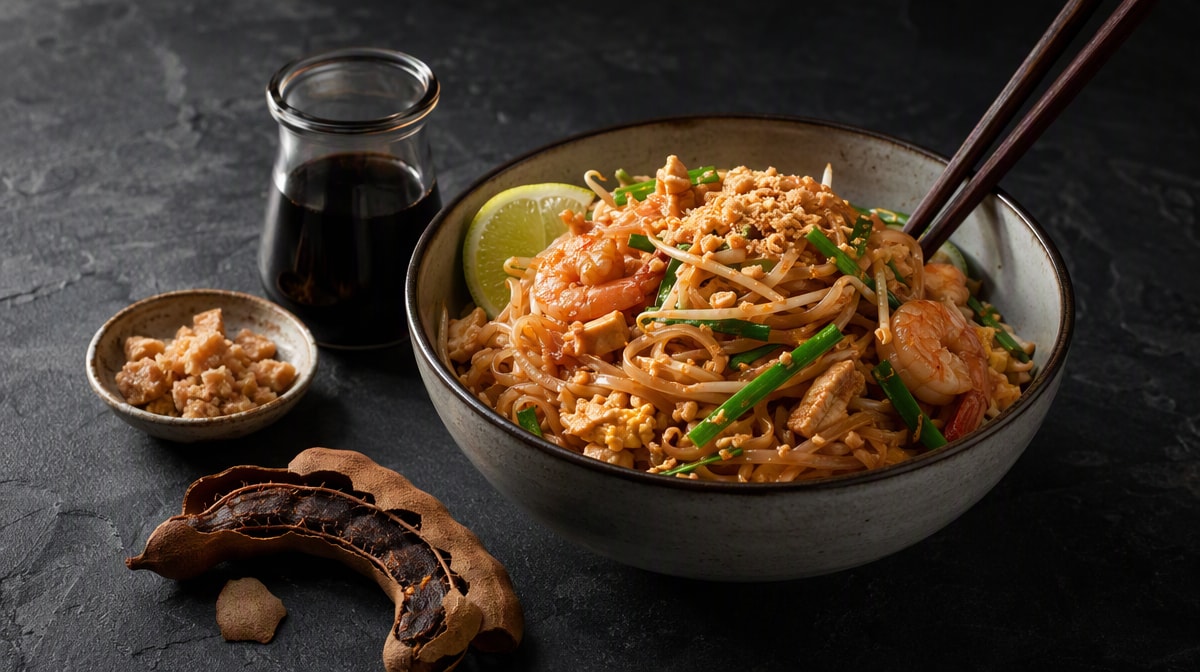
Too sweet and too sour are the same problem from opposite directions, which is why they belong on the same page.
Both mean the tamarind, palm sugar and fish sauce are out of proportion, and both are almost always caused by the tamarind rather than the sugar. Too much tamarind tastes sour. Too little tamarind means nothing to balance the sugar, and the dish tastes sweet. A bottle of fish sauce that has lost its aroma is a quiet way to overshoot the salt while the sour stays short, and does fish sauce go bad covers what actually fades with age.
Pailin Chongchitnant of Hot Thai Kitchen puts it bluntly: being overly sweet is the single biggest pitfall of North American pad thai. She's right, and the reason is usually the jar of tamarind rather than the sugar.
Too sweet: the tamarind isn't doing its job

There are four ways a pad thai ends up sweet, and only the last one is actually about sugar.
You reduced or omitted the tamarind. The single most common cause. Some Westernised recipes use white vinegar instead, or ketchup, or leave it out entirely. There's no sour anchor, so the sugar has nothing to sit against and reads as sweetness rather than as one of four flavours.
You used white sugar instead of palm sugar. This is closer to a real difference than most people expect. Palm sugar is less intensely sweet on the tongue and carries caramel notes that white sugar lacks, so the same volume reads as gentler and integrates with the sour. Refined sugar just makes the dish sweeter and keeps doing it.
Your tamarind was weak. Indian tamarind paste is thicker, more concentrated and more sour than Thai. If you're using a different jar than last time, the same spoon measure gives you a different result.
Or you genuinely added too much sugar. Least common, but it happens, particularly when a recipe written for one portion is cooked for four.
There's also a plate-level cause worth naming. Sweetness compounds twice in this dish: once in the sauce, and again in what's served alongside it. Sweet Thai iced tea, a sweet chilli sauce for dipping, or a sweet chilli in the dish itself will all push a correctly seasoned bowl past the point where it reads as balanced. If the sauce is right and the plate isn't, the plate is the problem.
The fix for the first three is the same: more tamarind, or more acid. Not less sugar.
What the American version is doing
Worth being clear about, because the dish most people have eaten isn't the one being described here. Three things happen to it in the West, and they compound.
Ketchup replaces tamarind, which removes the sour anchor entirely rather than reducing it. Refined sugar replaces palm sugar, which is sweeter and has none of the caramel depth. And the ratio is then adjusted upward for a sweeter palate, so the final dish carries more sugar and less acid.
The cook then reaches for fish sauce to make it taste like something, which raises the salt, and you get the too-sweet, too-salty dish that's the subject of how to fix salty pad thai. The three problems in this cluster are the same problem arriving by different routes, which is why they're worth understanding together.
Too sour: usually the tamarind, occasionally vinegar
Too much tamarind. Usually a misjudged jar rather than a misjudged recipe. Tamarind varies enormously between brands, and some are strong enough to make you pucker, so plenty of recipes calibrated for a milder paste are suddenly too sour by a third.
Concentrate instead of paste or block. This is the most common tamarind mistake, because the packaging doesn't distinguish the two clearly enough. Concentrate is much stronger than paste, and plenty of recipes that say paste are, in practice, written with concentrate in mind or not adjusted for the difference. If you've swapped, your dish is now substantially more sour than intended.
White vinegar. If you've used white vinegar for the acid, that's the problem. It's a harsh, one-dimensional sourness with none of tamarind's fruitiness, and it doesn't behave like tamarind in a sauce. One recipe developer put it quite bluntly: don't use white vinegar, trust me. Rice vinegar is milder and more usable, but it's still not tamarind.
For context, Real Thai notes that Thai cooks themselves sometimes use freshly squeezed lime or white vinegar where tamarind would go, adding that although the flavour is not as wonderful, it will do. The sourness is the function, and the complexity is what's missing.
Or the sugar is too low to balance it. The mirror image of the sweet problem. Sour with nothing to round it reads as sharp rather than as sourness in a balanced sauce.
The other sour sources people forget
Tamarind is the one everyone thinks of, and it's often not the one at fault. These are the others.
Lime juice added during cooking, which is meant to brighten and instead turns bitter. Lime belongs at the end.
Fish sauce brand. Some are noticeably more acidic than others, and the variance isn't only in salt. If the fishy taste is strong but the salt isn't, your tamarind and sugar are the things to increase — see our guide on why pad thai tastes too fishy.
A second acid you forgot. Some recipes include a splash of rice vinegar as well as tamarind. Read the ingredient list rather than remembering it, because two acids is very easy to overlook when both feel like the sour bit.
Tomato or ketchup in the base, which adds sugar and acid that reads as sweetness. It tints the noodles as well, which is why restaurant pad thai comes out orange.
If the dish is too sour and you're confident the tamarind quantity was right, work through this list before reducing the tamarind. It's faster and more accurate, because you avoid weakening the acid and having to rebuild the balance afterwards.
The ratio, and why it's a starting point not a rule
A widely used anchor is one part tamarind to one part palm sugar to one part fish sauce. Another is 3:2:2 by volume, tamarind to fish sauce to palm sugar. Both appear repeatedly in the research, and neither is a law. The prawn pad thai recipe gives one worked set of quantities for all three.
The reason to have a number at all is that it gives you somewhere to start when you're adjusting a dish you can't see a diagram of. The reason not to treat it as a law is that the pastes and sauces themselves aren't fixed quantities, and the salt content of fish sauce varies by about 20% between common brands.
Dancing Shrimp makes the general principle clearer than any ratio can: whether more sugar should be added depends on whether the sweet component is an important feature of a particular savoury dish. Its role varies from dish to dish and on the taste preference of the people at the meal. Balance is judged at the table, not calculated in advance.
The one habit that prevents both
Taste the sauce before it goes into the wok, and expect it to be slightly too strong on its own.
This is repeated by almost every source in the research and it remains the best advice on this page. The sauce is concentrated and the noodles dilute it. A sauce that tastes correct on a spoon will taste under-seasoned once it's been through a pan of noodles and a plate.
The target is a sauce that tastes slightly too intense by itself. If it tastes right on the spoon it'll taste flat in the dish.
Building the sauce separately costs thirty seconds, and it's the only point at which you can correct it. Once it's in the wok with the noodles, you're adding corrections to a finished dish rather than seasoning it.
Fixing too-sweet pad thai that's already cooked
Add acid first. Fresh lime, or tamarind if you have it. This is the direct correction and the first thing to reach for.
Then add fish sauce. It brings salt and umami, which counterbalance sweetness as well as correcting it, though if the dish is also too salty add only a little.
Then chilli. Fresh slices or flakes, which redirect attention away from sweetness. This is redistribution rather than balance, and it works better than people expect.
Then bulk. Plain rice, extra bean sprouts, fresh vegetables, diluting the sweetness per bite rather than changing the dish.
What not to do: add more sugar to balance it. That's the instinct and it's exactly wrong.
Fixing too-sour pad thai that's already cooked
Add palm sugar, incrementally, off the heat. Dissolve it in a little warm water or it'll sit in grains. A quarter teaspoon, taste, repeat. This is the direct correction and the one that works.
A pinch of salt reduces perceived sourness, which sounds backwards and isn't. Salt and acid don't cancel the way sweet and sour do. Salt sharpens rather than softens, so it takes the edge off the acid without flattening the dish.
A tiny amount of baking soda neutralises acid directly. Use it sparingly. It's a correction, not a technique, and too much leaves a soapy note.
Add more fish sauce for umami, carefully, for the same reason as above.
Dilute with more noodles, protein or vegetables, which spreads the sourness across more bites.
And add lime at the end rather than during cooking, because cooked lime turns bitter. This is a small detail that catches people out.
Choosing tamarind, which is where most of this starts

Buy Thai tamarind and look for "Product of Thailand" on the label. Indian tamarind is generally more sour and the two are treated as interchangeable on many Western shelves when they aren't.
Prefer paste or block, and treat concentrate as a different ingredient. If you're using concentrate, start with a quarter of the quantity the recipe states and work up. It's concentrated by definition, and this is the most useful adjustment if your pad thai keeps coming out too sour.
Avoid tamarind powder. It's considerably more acidic and much harder to control.
Taste the paste when you open the jar. If it makes you wince, use less than the recipe says. A jar that was mild last month won't be mild next month, and this is the check that takes two seconds.
Real Thai recommends buying small blocks of tamarind pulp, makahm biak, from an Asian market, soaking them in warm water, mashing to a paste, and straining for the liquid. More work, and the result is both better flavour and predictable strength, because you control the concentration.
A worked example

You've made it and it tastes too sweet. It isn't salty, and it isn't obviously sour.
That combination is diagnostic. You're not short of acid, you're short of sugar relative to the sugar that's there. Add a quarter teaspoon of palm sugar dissolved in warm water, off the heat, stir, wait thirty seconds, taste.
If that's now too sweet in the other direction, you had roughly the right total but wrong proportion, and the tamarind is the variable. Add a quarter teaspoon of tamarind and taste again. Sweet with acid available usually means the acid isn't in the sauce yet, so the sugar reads louder than it is.
If it was sweet and also salty, add acid rather than sugar. Lime, a squeeze, off the heat. The acid gives you something to work against without making it worse.
A note on sources
The chemistry of the vinegar problem is well established and consistent. The brand comparisons are not tested results but accumulated cook experience, and tamarind strength varies by batch and season regardless of brand. Treat the ratio as a starting point, your own taste as the arbiter, and the taste-before-wok habit as the thing that actually fixes this.
Frequently asked questions
Why does my pad thai taste too sweet when I followed the recipe?
Almost always because the tamarind isn't doing its job rather than because the sugar is excessive. Check three things in order: that you used tamarind rather than white vinegar or ketchup, that you used palm sugar rather than refined white sugar, and that the jar is Thai rather than more sour Indian tamarind. Add tamarind or lime to correct it. Don't cut the sugar.
Is tamarind concentrate the same as tamarind paste?
No, and this is the most common cause of a pad thai that's too sour. Concentrate is considerably stronger than paste, and plenty of recipes that say paste aren't adjusted for the difference. If you've switched to concentrate, use about a quarter of the quantity the recipe states and increase from there.
Is white vinegar a substitute for tamarind in pad thai?
It is acidic so it'll do something, but it's a poor substitute. White vinegar is harsh and one-dimensional, with none of tamarind's fruity depth, and it doesn't behave like tamarind in a sauce. Rice vinegar is milder and more usable. Better still, add more tamarind, or use lime juice added at the very end.
Why does my pad thai taste so sour when I did not add extra tamarind?
Check what form of tamarind you're using rather than how much. Concentrate is much stronger than paste, and tamarind powder is stronger and less controllable again. Indian tamarind is sourer than Thai. If you've changed jar or changed form since the last time the recipe worked, that's the likely cause.
Should I add sugar to fix sour pad thai?
Palm sugar, in small increments, off the heat, dissolved in a little warm water. A quarter teaspoon at a time, tasting between. This is the direct correction. A pinch of salt also helps, which seems backwards and isn't. Salt sharpens rather than softens, so it takes the edge off the acid without flattening the dish.
Does it matter that I use Thai tamarind rather than Indian?
Yes, and it's one of the first things to check. Indian tamarind paste is thicker, more concentrated and more sour than Thai, so the same spoonful gives a different result. Look for "Product of Thailand" on the label. If you must use Indian, reduce the quantity and adjust upward from there.
Does the sauce taste right on a spoon but the dish is wrong?
That's expected, not a mistake. The sauce is concentrated and the noodles dilute it, so a sauce that tastes correct on its own will taste under-seasoned in the finished dish. Taste the sauce before it goes into the wok and aim for it to be slightly too intense.
Can I add lime juice to a pad thai sauce while it cooks?
Not without it turning bitter, which is why lime is added at the very end. Lime juice added during cooking loses its brightness and picks up bitterness from the heat. Add it off the heat just before serving, which also makes it the most flexible acid adjustment you have.

Comments