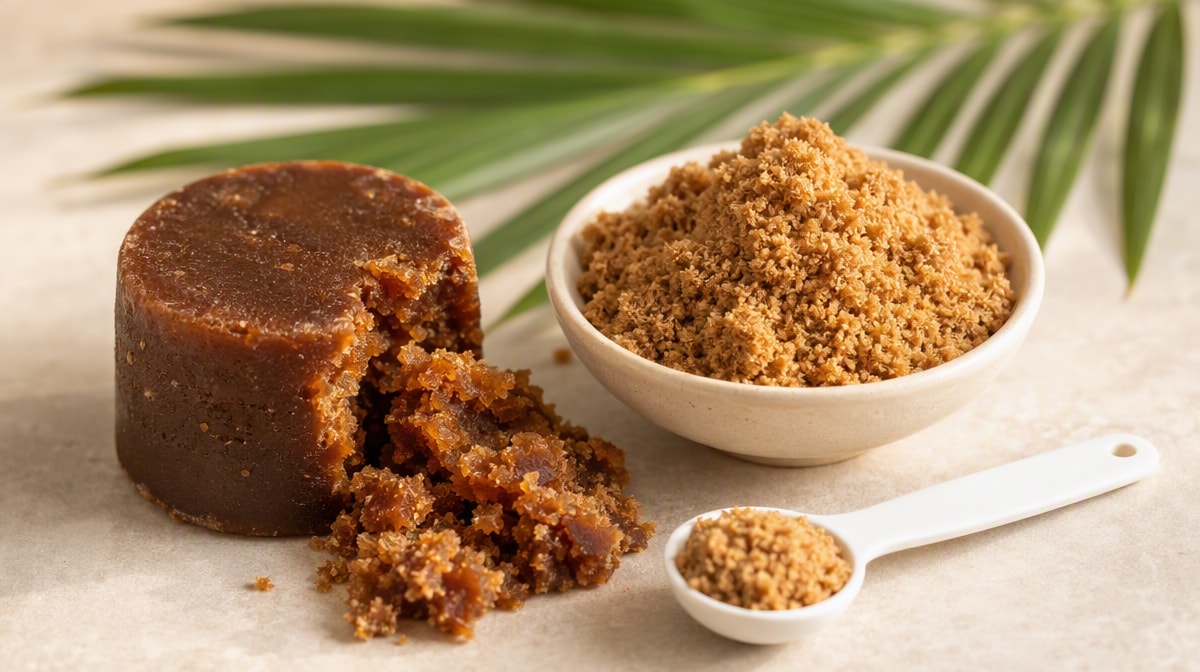
Brown sugar is the best substitute for palm sugar, one for one, and dark brown sugar is closer still. Coconut sugar is the same ingredient by another name. White sugar works in a small proportion but it's the weakest option, because palm sugar brings caramel, butterscotch and a slight moisture that plain sugar doesn't.
Read the rest before you substitute in a curry, though, because the "palm sugar" in most UK supermarkets isn't fully palm sugar.
What palm sugar actually is

The sap of palm flowers, coconut palm or the toddy palm, and in Thai it's nam taan peep. It predates refined white sugar in Thai cooking, and it predates it by a long way.
In flavour it's caramel, butterscotch and floral with earthy undertones, and it's less sweet than white sugar despite looking and measuring similarly.
Two forms. The soft paste, nam taan peuk, which is dark, moist, pourable, and more common in Thailand. And the hard puck or disc, which is drier, harder, and more common on export packaging.
It also carries a small nutritional difference. Potassium, magnesium, zinc and iron from the sap, and a lower glycemic index than white sugar at roughly 35 against 60 to 65. Neither is a health argument worth making, but the minerals are real.
The thing to check before you buy it
Most commercial Thai palm sugar contains white sugar as a filler, and often a lot of it.
Pailin Chongchitnant of Hot Thai Kitchen investigated this and found anywhere from 25% to 75% added white sugar in products sold as palm sugar. So a "palm sugar" on a UK shelf may be substantially ordinary sugar already, which changes what you're substituting when you substitute it.
The practical consequence is that if the palm sugar you're replacing was mostly filler, brown sugar isn't a downgrade at all. It's closer to what was actually in the jar. The premium on palm sugar is a real but small thing, and buying better palm sugar helps more than substituting around a cheap one.
Palm sugar against brown sugar, side by side

| Palm sugar | Brown sugar | White sugar | |
|---|---|---|---|
| Source | Palm flower sap | Refined sugar plus molasses | Refined sugar |
| Flavour | Caramel, butterscotch, floral, earthy | Molasses-forward, deeper | Neutral, clean sweetness |
| Sweetness | Noticeably less sweet | Slightly less than white | Full sweetness |
| Texture | Dry, hard pucks | Soft, moist, clumping | Dry and free-flowing |
| Moisture | About 4% | About 2% | About 0.4% |
Brown sugar's weakness is moisture rather than flavour, and in a hot curry that washes out entirely. In a cold dessert it doesn't.
The forms, and which to buy
Worth being concrete, because "palm sugar" on a shop shelf is one of several physically different things.
The soft paste, about 4% water, dark and pourable, and the most useful form for cooking because you can measure it by the spoonful and it dissolves evenly.
The hard puck or disc, drier and harder, and more common on export packaging. You have to break it down and it dissolves more slowly, so warm the sauce before adding it rather than stirring into something cold.
And granulated, which dries it into loose grains that behave more like brown sugar, and the most convenient form if you're measuring by volume.
Which to choose: the paste for dressings and anything you taste raw, granulated for measuring accurately, and the puck is fine if that's what you can get, just put it in earlier and give it heat.
The substitutions, ranked
Coconut sugar is technically palm sugar. All coconut sugar is palm sugar, though not all palm sugar is coconut sugar, because coconut sugar comes specifically from coconut palm flowers while "palm sugar" can be from toddy or date palms. One for one, and it's the best match available because it is the same thing.
Dark brown sugar. The molasses content, about 6.5% against 3.5% for light, gives it a depth closer to palm sugar's caramel. One for one. Light brown works, but dark is the better match.
Muscovado and jaggery. Dark, unrefined cane sugars with real depth. Genuinely close, and worth seeking out if you cook Thai food often. One for one.
Maple sugar. Unusually close in flavour for a non-Asian sugar. One for one.
Light brown sugar. Works, less depth. One for one.
White or granulated sugar. One for one for sweetness, and the weakest match. It works, particularly in a sauce where a tablespoon is going into a hot pan. It'll taste flat in anything where the sugar is a visible flavour.
The bridge if you only have white sugar is a teaspoon of molasses per cup, which recovers most of the missing depth. That's the standard fix and it works better than you'd expect.
Date syrup is a defensible swap at a slightly reduced quantity because it's less sweet, and it brings a dark fruit note. Jaggery is a block and needs breaking up, but it's one for one and close. Rock sugar dissolves more slowly and is used in Thai cooking in its own right, in soups and braises, where it doesn't dissolve at all and seasons through the broth, so it's not a direct substitute for a sauce.
And what none of them do is fix a dish that's unbalanced. If the curry tastes too sweet, better sugar won't fix it. The tamarind or the fish sauce is out of proportion, and that's where the correction belongs.
Why it dissolves better than brown sugar
This sounds minor and it's one of the practical reasons palm sugar behaves better in a Thai sauce.
Brown sugar is roughly 2% water and is genuinely clumping. It has to be warmed to dissolve, and in a cold dressing it sits at the bottom as a gritty layer. Palm sugar is closer to 4%, and its crystals are less prone to binding, so it disperses through a dressing or a sauce far more readily.
If you've used brown sugar in a cold som tam dressing and found the sugar gritty at the bottom of the bowl, that's why, and it's a reason to prefer palm sugar, or coconut sugar, or to dissolve the brown sugar in a little warm liquid first.
White sugar, at 0.4% water, dissolves instantly and has no such problem. So the ranking on dissolution runs white, palm, brown, which is another way of seeing that white sugar is substitutable in a sauce and less so in a dressing.
Where it matters and where it doesn't
It matters a lot in som tam dressings, where sugar balances sour and salt. In pad thai, where the sweet-sour-salt triangle depends on it. And in every dessert, where it's a headline flavour.
It barely matters in a stir-fry with strong aromatics, where the fish sauce, chilli and tamarind carry the dish. And in a long braise, where anything starchy is going into the sauce anyway.
The test is whether the sugar is being tasted or dissolved. Dissolved in a hot liquid, the difference largely disappears. Tasted as a distinct element, it doesn't.
Quick reference for the ratios
So you don't have to read the above to answer the question in a kitchen.
| Substitute | Ratio | Quality |
|---|---|---|
| Coconut sugar | 1:1 | Excellent, the same ingredient |
| Dark brown sugar | 1:1 | Very good |
| Muscovado | 1:1 | Very good |
| Jaggery | 1:1, break up the block | Good |
| Maple sugar | 1:1 | Good |
| Light brown sugar | 1:1 | Acceptable |
| Date syrup | Slightly less than 1:1 | Acceptable, different character |
| White sugar | 1:1 | Sweetness only |
| White sugar plus molasses | 1 tsp molasses per cup | Recovers most of the gap |
| Honey | 1:1, not cooked hot | Changes the character |
The two rules that cover most cases: use 1:1 unless noted, and use dark rather than light if you have the choice. Dark brown sugar's extra molasses is doing most of the work of recreating palm sugar's depth.
The health comparison, honestly
Both are sugar. Palm sugar has a lower glycemic index and a few trace minerals. Brown sugar is essentially white sugar with molasses, and molasses does contain minerals and some antioxidants.
None of this makes palm sugar a health food and the differences are small enough that the dish matters more than the sweetener. It's worth a line in an article and not worth a lifestyle change.
The one genuinely useful point is comparative: palm sugar is less sweet than white sugar per unit volume, so a recipe that tastes sweeter than expected may simply need less of it.
Why the sugar matters more in Thai cooking than it might seem
A last thing, and it's the reason a sweetener-only article is worth a whole page.
Sweetness in Thai cooking is usually doing structural work rather than just adding pleasure. It balances the sour of tamarind and lime and the salt of the fish sauce, and it's one of the points in a triangle rather than a flavour of its own. In pad thai, in a som tam dressing, in a yam salad, the sugar isn't making the dish sweet. It's stopping the acid and the salt from dominating.
Which means the type of sugar changes the balance rather than just the taste. Palm sugar's caramel depth sits against tamarind differently from white sugar's clean sweetness, and in a dish with no other strong flavours that difference is audible.
It's also why reducing sugar in a Thai dish to make it "less sweet" is often the wrong move. If it tastes sweet, the balance is off rather than the quantity, and the usual cause is too little tamarind rather than too much sugar. See our guide to pad thai that's too sweet or sour for that in detail.
Reading a label
The UK labelling is poor and worth a moment of attention.
Coconut sugar says coconut sugar. Palm sugar says palm sugar, and the two are close enough that either is fine for cooking. What you want to avoid is a product that lists sugar among the first ingredients, because that's the filler showing itself.
Some Thai shops sell the paste and the hard puck side by side, and the paste is what I'd buy if you can. It measures well, dissolves well and keeps well, and the difference between it and granulated is smaller than the difference between either and brown sugar.
If you're buying from a general supermarket, in the world food aisle, you're most likely to get a granulated product with a name that says palm sugar on the front. It'll do the job, and it'll be closer to brown sugar than the packet suggests.
Making it, and the fun of a three-ingredient job
If you can get coconut palm sap, sold in some Asian shops and in season in a tropical country, the process is short and the result is better than anything you can buy.
Collect the flower, and let it drain. The sap runs from the coconut flower and is collected into a vessel, traditionally overnight.
Heat it slowly, and don't stir it. The water evaporates and the sugar crystallises into a puck at the edge of the pan. The reason you don't stir is that the texture forms in layers, and the result is a soft, dense, almost fudge-like mass rather than a grainy one.
The whole process is a few hours and needs no attention beyond the occasional check. It's one of the more satisfying things you can make in a kitchen, and it's a genuine 100% palm sugar with none of the filler.
It's a considerably firmer, less forgiving ingredient than shop-bought, so measure it packed rather than loosely.
If you can't source the sap, making a caramel and stopping before it burns gets you a roughly similar flavour profile. A dark, moist, slightly bitter caramel that behaves like palm sugar in a sauce. It's not the same and it's more work than it's worth for everyday cooking, but it's the honest home answer.
If you can't get palm sugar at all
Coconut sugar is the shortcut, because it's the same thing and it's widely available in the UK now.
Honey is the one to know about. It's one for one and it works well in a cold dressing. It doesn't work in anything cooked very hot, because above about 140C it loses its character and turns bitter, so it's a poor choice for a stir-fry or a fried paste.
And the honest answer for a curry in a hurry is dark brown sugar and a small splash of molasses, or a teaspoon of soy sauce. The soy is the traditional cook's answer to missing depth anyway, and it does the same job.
A note on sources
The chemistry and proportions here are consistent across sources and not contentious. The filler content of commercial palm sugar comes from one investigation rather than a body of testing, but it was done carefully and it explains a lot about why shop-bought palm sugar disappoints people, so it's worth knowing about. Check a second packet against a third before drawing a firm conclusion about a particular brand.
Frequently asked questions
Can I substitute brown sugar for palm sugar in Thai cooking?
Yes, one for one, and dark brown sugar is the closest match because of its higher molasses content. It's the standard substitute and works in curries, stir-fries, dressings and desserts. Light brown sugar works but has less depth. Coconut sugar is a better still, because it's the same ingredient under a different name.
Is coconut sugar the same as palm sugar?
Essentially yes. All coconut sugar is palm sugar, but not all palm sugar is coconut sugar, because coconut sugar is made specifically from coconut palm flowers while palm sugar can come from toddy or date palms. For Thai cooking they're interchangeable one for one, and coconut sugar is usually easier to find in the UK.
Is white sugar a workable substitute for palm sugar?
For sweetness, yes, one for one. It's the weakest match, because palm sugar brings caramel, butterscotch and a little moisture that white sugar doesn't, so the result tastes flat. It's fine in a small quantity in a hot sauce and noticeably wrong in a som tam dressing or a dessert. A teaspoon of molasses per cup bridges most of the gap.
Why does my palm sugar not taste very palm sugar-ish?
Because most commercial palm sugar contains a significant amount of white sugar as filler, and between 25% and 75% has been found in products sold in the UK. Check the ingredients list, and consider that buying a better palm sugar may serve you better than substituting around a cheap one. Coconut sugar is the same ingredient with less filler and is widely available.
Does palm sugar have health benefits over brown sugar?
Marginally. Palm sugar has a lower glycemic index, around 35 against 60 to 65 for white sugar, and retains trace potassium, magnesium, zinc and iron from the sap. Brown sugar is refined sugar with molasses and carries a little more. The differences are small enough that the dish matters far more than the sweetener, and neither is a health food.
Can I use honey instead of palm sugar?
You can, at roughly the same volume, but it's a change of character rather than a swap. Honey is sweeter and stickier, it behaves differently in a sauce, and in anything heated past about 140C it loses its character and turns bitter. In a dressing it works well. In a fried paste it doesn't. If you want the closest single substitute, use dark brown sugar.
Why is my curry tasting too sweet when I followed the recipe?
Most likely because palm sugar is less sweet per unit volume than white sugar, and a recipe calibrated for one doesn't transfer to the other. It's also worth checking whether you measured packed rather than loosely, because palm sugar pucks crumble irregularly and a spoon of it can vary a lot. Taste as you go, and remember that sugar is there to balance sour and salty, so reduce it alongside the tamarind or fish sauce rather than on its own.
What is the best substitute if I want the most authentic flavour?
Coconut sugar, because it is the same ingredient, or making palm sugar yourself from coconut palm sap if you can source it. Failing both, dark brown sugar with a small splash of molasses gets you most of the way, and a teaspoon of soy sauce in a savoury dish adds a similar depth that you would want anyway.



Comments