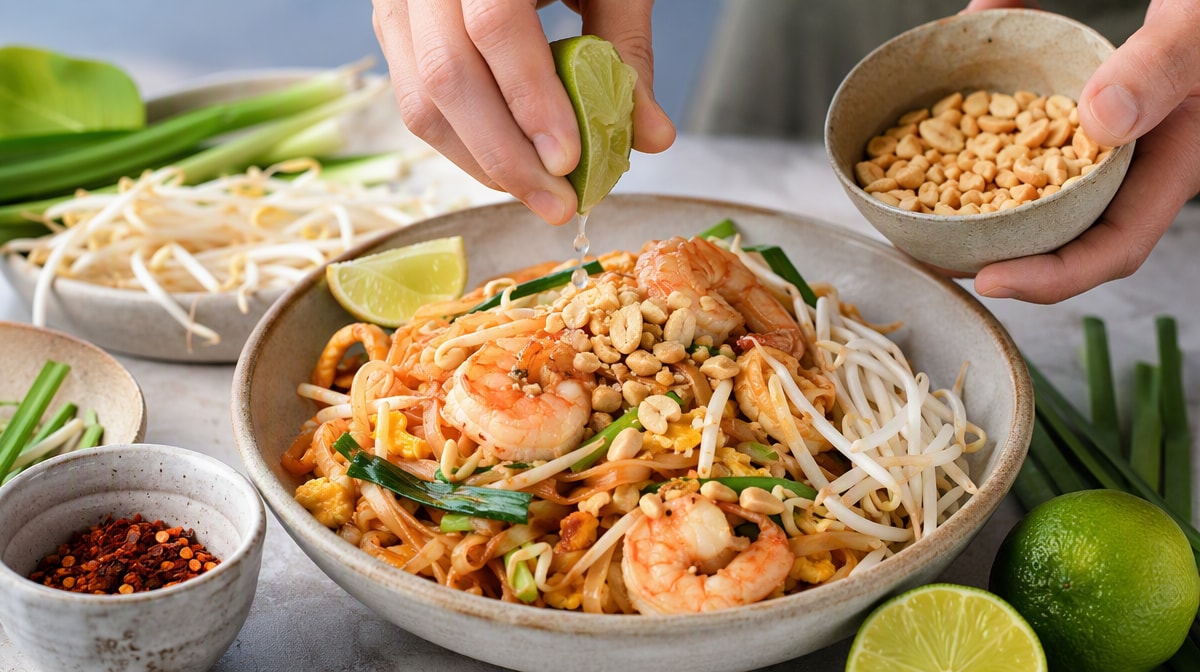
Pad thai is supposed to be salty. It's a seasoned stir-fry and salt is one of the four things doing the work. A dish with no salt isn't a better pad thai, it's a flatter one.
The problem is salt without balance, where the fish sauce is the loudest thing in the bowl rather than the floor under everything else. If the bowl reads as fishy rather than salty the cause is different, and that is why your pad thai tastes too fishy.
If your pad thai is already made and too salty, start below. If you want to stop it happening, read the prevention section, because a salty pad thai can only be rescued so far and a well-balanced one never needs it.
Why it's salty in the first place
Fish sauce is the main source, and brands vary a lot. Measured sodium per tablespoon:
| Brand | Sodium per tbsp |
|---|---|
| Squid | 1,670 mg |
| Megachef (export) | 1,500 mg |
| Red Boat (premium) | 1,490 mg |
| Thai Kitchen | 1,360 mg |
That's a spread of roughly 300mg per tablespoon, about 20%. Switching brand can meaningfully change a dish without touching the recipe.
Worth saying that Squid is both a well-regarded Thai brand and the saltiest of these four. Quality and saltiness aren't the same axis, and a good bottle can still be the heaviest one on your shelf. Ageing changes the aroma but not the sodium, so an old bottle of fish sauce is no lower in salt than a fresh one.
Reducing a sauce concentrates it. Make too much, pour off the excess and keep it in the fridge, and any reduction thickens the salt as it goes. Common and easily missed.
The salt is often somewhere you're not looking. Salted peanuts rather than unsalted. Salted butter. Oyster sauce. Pre-salted protein. And preserved radish chosen from the wrong jar.
And the underlying issue is usually the tamarind. A weak or wrong tamarind gives less sourness than the recipe assumes, so the instinct is to add more fish sauce to compensate, and you end up with something salty and short of acid, which is exactly what too salty tastes like. The same weak tamarind reads the other way in pad thai that tastes too sweet or too sour.
Where the salt actually hides
Beyond the fish sauce, a surprising amount of sodium arrives in things you wouldn't count as seasoning.
Salted peanuts, rather than unsalted, in a dish you've already salted deliberately. Salted butter if you're finishing with it. Oyster sauce, which is a significant salt source in its own right. Pre-salted or cured protein in the prawns or chicken. Preserved radish from the wrong jar. And a pinch of salt added at the end out of habit, on top of a sauce that was already correct.
One tablespoon of soy sauce carries around 900mg of sodium, which is close to a teaspoon of salt. Stir-fry sauces built on soy or fish sauce are among the most sodium-dense things in a home kitchen, and pad thai is unusual in combining both.
The fix that works: acid first

If you do one thing, add lime juice or tamarind.
Acid cuts perceived saltiness directly. This is the most recommended fix across every source, and it comes from Thai cooks rather than Western ones, because the acid is already part of the dish. You're not adding a foreign ingredient to disguise a problem, you're putting back something that should have been there.
Lime juice, a good squeeze, off the heat, then taste. Fresh lime, not bottled, because bottled often carries added sodium and preservatives, which is the opposite of what you need.
Tamarind if you have it. A teaspoon stirred through brings sourness back into the sauce itself rather than brightening the top.
Order matters. Acid first, then sugar. Sugar added before the acid is in tends to just make the dish sweeter rather than better balanced.
The other fixes, in order of usefulness

Dilute with the noodle-soaking water. You have it. You used it to soften the noodles and then, as a rule, poured it away. A tablespoon at a time, tasting between, is the gentlest dilution available and adds starch rather than water. Broth is the richer version of the same thing.
Add more noodles. This is the most pad-thai-specific fix there is, because it keeps the dish a pad thai. Starch genuinely absorbs salt. Extra cooked noodles stirred through at the end will do more than almost anything else you can do at that point.
Add unsalted bulk. Bean sprouts, more vegetables, plain scrambled egg. Same principle, and it adds structure rather than just volume.
A pinch of palm sugar, dissolved in a little warm water. Balance rather than rescue, and in teaspoons, because it goes from fixing to cloying very quickly.
Aromatics. Extra basil, chilli, garlic, ginger or crushed unsalted peanuts redistribute attention away from the salt. It's redistribution, not a fix, and it works.
Coconut milk is the Thai-compatible option if you want fat to coat the tongue, and cream or butter will do the same job less authentically.
A cornflour slurry, if you haven't yet tossed the noodles in. Thickened sauce holds salt in suspension rather than concentrating it on the noodles. Once they're tossed and plated it's too late for this to help.
Fixing pad thai that's already too salty
Work off the heat and taste after every single addition. The compounding risk here is real. The most common way to ruin an over-salty dish is to add a big splash of something to fix the salt and then have to fix the result.
A sensible order: lime juice, a squeeze, taste, another squeeze if needed. Then tamarind, a teaspoon, if the dish is also short on sourness. Then noodle-soaking water or broth, a tablespoon at a time. Then more plain noodles if you have them. Then a pinch of dissolved palm sugar, last.
And the honest limit: nothing in this research found a way to genuinely de-salt finished noodles. Salt has already moved into them and into the sauce clinging to them. If the dish is badly over-salted, more noodles and more acid will improve it but won't rescue it. At that point the realistic options are to eat it with something unsalted alongside, or to make another.
A worked rescue
You've just tasted it and it's clearly too salty, and not much else is wrong.
Squeeze in half a lime's worth, off the heat, stirred through, wait thirty seconds, taste again. Often this is most of the correction, because the acid was thin rather than the salt being excessive.
Still salty: add two tablespoons of your noodle-soaking water, or broth if you have it. Stir, wait, taste. You're looking for the point where the salt stops being the first thing you notice.
Still salty: stir in a small handful of plain cooked noodles. This is the step that changes the character of the dish rather than just diluting it, because the starch takes the salt out of the sauce.
Still salty after that: a quarter teaspoon of palm sugar, dissolved. This is the last cheap move, and adding more turns a salty noodle dish into a sweet salty one.
Four adjustments is a lot. If you've gone through all of them and it's still aggressively salty, the sauce had roughly double the fish sauce it should have, and no amount of adjustment will disguise that. Add unsalted protein and vegetables, eat it with something plain, and start with less next time.
Stopping it next time
Build the sauce separately and taste it before it goes anywhere near the wok. This is the highest-value change you can make and it costs about thirty seconds. Stir-frying moves fast. You can't correct seasoning in a wok, because anything you add has to cook through and the noodles are already in there. Bangkok Street Food makes the general point about how Thai stir-frying works: all the cutting is done in advance so that once done you heat the oil and quickly toss in your ingredients in the right order. All that preparation is also the moment you can taste and fix your sauce.
Measure the fish sauce in teaspoons. Not a glug, not a pour. The difference between a tablespoon and a generous one is roughly 1,500mg of sodium.
Start with less and adjust. A common authentic ratio uses a third of a cup of fish sauce where many recipes call for half.
Reduce and increase something else. If you cut the fish sauce you must put the flavour somewhere else: more tamarind, more palm sugar, more lime, more chilli. A dish that's simply less salty is bland. This is the part people skip, and it's why "I used less fish sauce" so often produces a disappointing bowl.
Use unsalted peanuts. Salted peanuts in a dish you've already seasoned for salt is a common and avoidable doubling-up.
Pick the right preserved radish. Chai po waan, the sweet one, rather than the salty variety. The names are on the same shelf and they are not interchangeable.
Rinse dried shrimp before using them to wash off surface salt. Larger dried shrimp are also less salty than small ones, in the counterintuitive way that small ones are more heavily seasoned during drying.
And fresh lime, never bottled.
The "authentic" question
Authentic pad thai is salty, and the goal is the right ratio rather than less salt.
The trap is that many Western versions of the dish are too sweet. Ketchup, or an excess of sugar, and the cook then reaches for more fish sauce to compensate. Get the tamarind right and the need for excess fish sauce falls away on its own.
The four flavours in a properly seasoned pad thai sit at roughly equal weight: sweet, sour, salty, umami. A dish reading as too salty is one where the third of those four is overshooting while the other three sit behind it.
If you need to cut sodium properly
Lower-sodium fish sauce or tamari is the direct route. Low-sodium soy is around half the sodium, and it changes the flavour, so it wants more of everything else to compensate or the result tastes flat rather than light.
Coconut aminos are significantly lower in sodium and slightly sweet, which lands them closer to the seasoning in a green curry than to nam pla. Fine in a stir-fry, not a like-for-like replacement.
MSG adds umami with considerably less sodium than fish sauce; what MSG is and whether Thai cooking uses it covers the trade-off. It's a legitimate shortcut here and it's the one ingredient most people reaching for a salty pad thai haven't tried. Mushroom powder does a similar job.
Toasted peanuts add depth and savouriness without salt, and the depth matters as much as the salt does.
A fully de-salting approach can get a bowl down to around 140mg of sodium per serving against 1,000mg-plus in a typical version. That's a significant change to the dish, not a subtle one, and it's worth doing deliberately rather than by accident. If sodium is a general concern rather than a pad thai one, which Thai dishes are actually the healthiest is worth reading alongside this.
Tasting as you go
The technique that prevents all of this is less glamorous than any of the fixes above, and it's the one that works.
Taste the sauce before it goes in the wok, and expect it to be slightly too strong on its own. The sauce is concentrated and the noodles dilute it, so a sauce that tastes correct on a spoon will taste under-seasoned once it's been through a pan of noodles and onto a plate.
This isn't a Thai technique so much as a general one, and it's the difference between cooking a recipe and cooking to taste. Nobody measures a wok sauce and then walks away from it.
And season to the least spicy eater at the table, not the most. You can always add chilli at the end. You can't take heat out.
A note on sources
Most of what's published on this is food writing rather than testing. The chemistry is well established and consistent across sources. The brand comparisons are not tested results but accumulated cook experience, and tamarind strength varies by batch and season regardless of brand. Treat the ratio as a starting point, your own taste as the arbiter, and the taste-before-wok habit as the thing that actually fixes this.
Frequently asked questions
How do I fix pad thai that is too salty?
Add acid first. A squeeze of fresh lime, or a teaspoon of tamarind off the heat. Then dilute with a tablespoon of noodle-soaking water at a time, tasting between. More plain cooked noodles is the most effective pad-thai-specific fix, because starch absorbs salt. A pinch of dissolved palm sugar comes last. Don't add more fish sauce, and don't add everything at once.
Why is my pad thai so much saltier than the restaurant's?
Usually one of four things: more fish sauce than the recipe called for, a wetter tamarind giving less sourness so the salt was topped up to compensate, a heavier fish sauce brand, or a sweet base such as ketchup or too much sugar that needed salt to balance. Note that sodium varies by about 20% between common brands, so the brand alone can account for a real difference.
Does adding more noodles fix salty pad thai?
It's the most pad-thai-specific fix and often the most effective, because starch genuinely absorbs salt rather than just diluting it. Stir in plain cooked noodles at the end. It's a genuine improvement rather than a cover-up, and unlike adding water it doesn't make the dish soggy.
Should I add sugar to salty pad thai?
A pinch, and only after you've added the acid. Sugar balances salt but it goes from fixing to cloying within a teaspoon or two, and adding it before the tamarind or lime just makes the dish sweeter rather than better balanced. Use dissolved palm sugar for an authentic result.
Is authentic pad thai supposed to be salty?
Yes. It's a seasoned stir-fry and salt is one of four flavours carrying the dish, alongside sweet, sour and umami, which sit at roughly equal weight. The aim is the right balance rather than a lower salt level. A dish that reads as too salty is usually one where fish sauce has overtaken the other three rather than where there is simply too much salt.
Can I use low-sodium fish sauce or soy sauce in pad thai?
Yes, and it works, but it changes the dish. Low-sodium soy is roughly half the sodium, so you'll need to raise the tamarind, sugar and lime to compensate or the result tastes flat rather than light. It's a deliberate change to the recipe rather than a quiet swap, and worth making knowingly.
Is bottled lime juice OK when fixing a salty dish?
No. Bottled lime juice often carries added sodium and preservatives, which works directly against what you're trying to do. Fresh lime is the whole point of the fix, and it's the acid cutting the perceived salt, not the sugar. If you only have bottled, use tamarind instead.
Can you de-salt noodles that are already cooked and sauced?
Not really. Salt has already moved into the noodles and into the sauce clinging to them, and nothing in the research genuinely reverses it. More plain noodles, more acid and more unsalted vegetables will improve a badly salty bowl, but if it's far past the point the honest options are to eat it alongside something unsalted, or to start again.

Comments