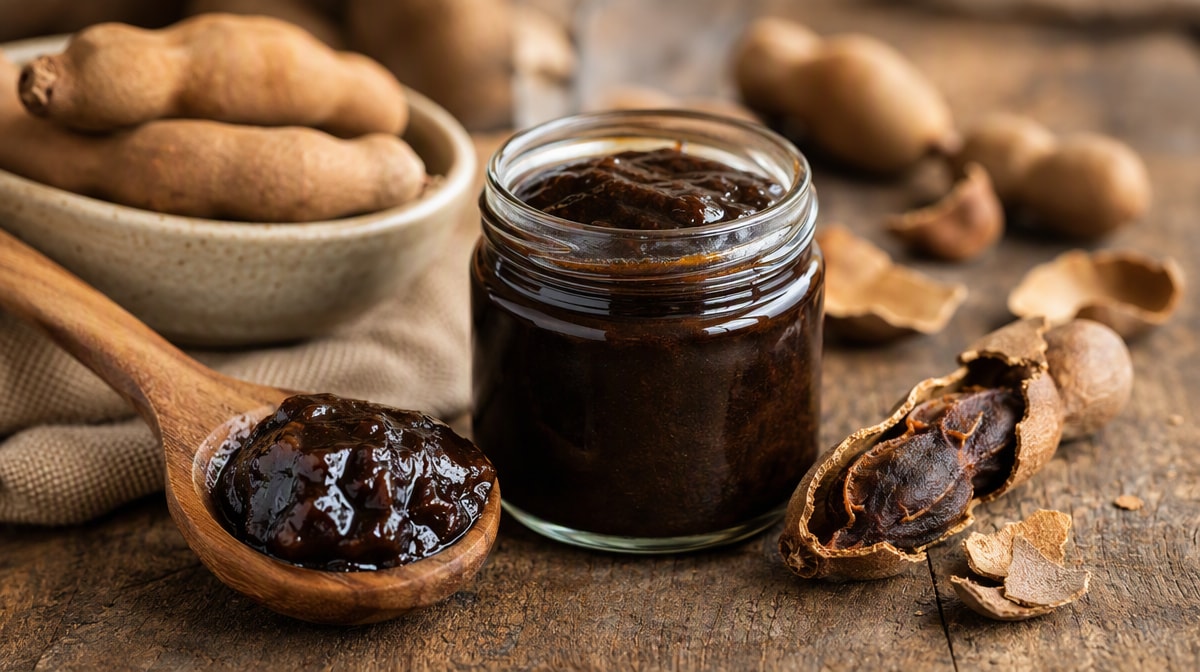
Paste is ready to use. Concentrate has to be diluted first, and it's roughly three times stronger. Get that wrong and your dish will be catastrophically sour, and this is the most common way people get a Thai curry wrong through no fault of their own.
The labelling is genuinely confusing, and the reason is that in a lot of the world "concentrate" is not a concentrate at all.
What tamarind is
A tropical tree, Tamarindus indica, native to Africa and now grown across Thailand, India, Southeast Asia and the Americas. In Thai it's makaam, and the fruit is a long brown pod filled with sticky dark pulp and seeds.
The flavour is sour-forward with a fruity, caramel or date-like sweetness underneath. "Eye-wateringly tart" is the phrase that appears most often in the sources. It's frequently compared to lime or lemon, but it's richer and more complex than either.
And it's not hot, despite appearances. It shows up next to chillies constantly, in som tam and curry paste, and this confuses people regularly.
A distinction English sources mostly miss: Thais separate makaam, the sour tamarind used for cooking, from makaam wan, the sweet tamarind eaten as fresh fruit. In Thai cooking tamarind is almost entirely savoury, even though the sweet form would work in a dessert.
The four forms, and which is which

This is the heart of the confusion, so it's worth getting straight.
Whole pods. Rarely sold in the West, and you need to shell them. You may find fresh pods occasionally, and if you do the flavour is exceptional.
Block or pulp. Compressed seeded pulp, sold as a brick. You must soak it in hot water and strain it to get usable tamarind. About half the block's weight is seeds and stringy fibre. This gives the freshest, brightest flavour of any form, and Real Thai recommends buying small blocks of pulp, makahm biak, soaking in warm water, mashing to a thick paste, and straining for the liquid.
Paste or purée. Pulp diluted with water, ready to use, sold in a tub or jar. This is what most UK supermarkets stock, and what most recipes mean when they say tamarind paste.
Concentrate. Pulp cooked down, syrupy, intensely sour and shelf-stable. It must be diluted before use, and it's substantially stronger than paste.
The trap: "concentrate" often doesn't mean concentrate

This is the finding that matters most, and it comes from America's Test Kitchen.
Thai and Indonesian products labelled "concentrate" are frequently not true concentrates. They're pastes that have been thinned with water. The real thick, dark concentrate is the Indian-style product.
So if you buy a jar of something labelled Thai tamarind concentrate and dilute it 1:2 because that's what the packet says, you may have just made a jar of thin, weak tamarind paste and wondered why the dish was flat.
Other sources report the same confusion from the other direction. Several note that paste and concentrate are frequently the same product in a smooth spoonable jar, and that what the recipe wants is paste.
The reliable rule is the one below.
The rule to actually use
Buy something sold as paste or purée, for most purposes. It needs no dilution, the strength is predictable, and the recipes you're following were written against it.
If you have concentrate, dilute it one part concentrate to two parts water before use. That's the near-universal figure.
Then use about a third of the volume of paste. Concentrate is roughly three times stronger, the "3:1 rule" that appears across the sources. So one tablespoon of paste is approximately one teaspoon of undiluted concentrate, or one tablespoon of concentrate with two teaspoons of water.
And when in doubt, taste it. Dilute a spoonful, taste it, compare. This takes five seconds and it's the only method that cannot be wrong, because tamarind strength varies noticeably by brand and origin.
Why the strength varies so much
Indian tamarind is considerably sourer than Thai. Look for "Product of Thailand" on the label if you want the milder, more predictable version that Thai recipes are calibrated against.
Thai and Vietnamese tamarind is lighter and milder, and it's what you want for pad thai, where the tamarind has to balance fish sauce and sugar rather than dominate.
Brand matters within each type. Several sources note that a given brand's paste can be up to three times stronger than another's, with the dilution varying. There's no fixed conversion between brands, only between forms.
The tamarind you make yourself from a block is the most intense of all, which is why a recipe written for a jar will often taste too sour when made with fresh block. A jar of paste works out at roughly 1.5 times the strength of a homemade block paste, by one estimate.
What tamarind actually brings to a dish
Worth understanding, because it explains why it's so hard to substitute and why the "just use lime" advice so often produces something disappointing.
It isn't simply sour. That's the misconception. Tamarind contributes three things at once: a sharp sourness, a fruity, almost caramel sweetness underneath it, and a body that thickens a sauce slightly. It's a balanced sour, not a single sharp note.
That sweetness underneath is the part you can't reproduce with lime. Lime is sour and nothing else. When you swap tamarind for lime juice you lose the depth and the slight body, which is why the substitute reads as thinner even when the sourness is matched.
It's also why tamarind works so well against the other two elements in a Thai dish. In pad thai it's doing the same job as the fish sauce's umami and the palm sugar's sweetness. It's a third point in a triangle. Swap it for lime and the triangle becomes a line, which is why pad thai made with lime instead of tamarind tastes thin even when it's technically balanced.
The seeds and fibre contribute something too, which is another argument for making it from the block rather than straining it to nothing. A fully sieved paste is cleaner but slightly emptier than one that keeps some texture.
Which form for which job
Once you've read the above, the practical choice narrows quickly.
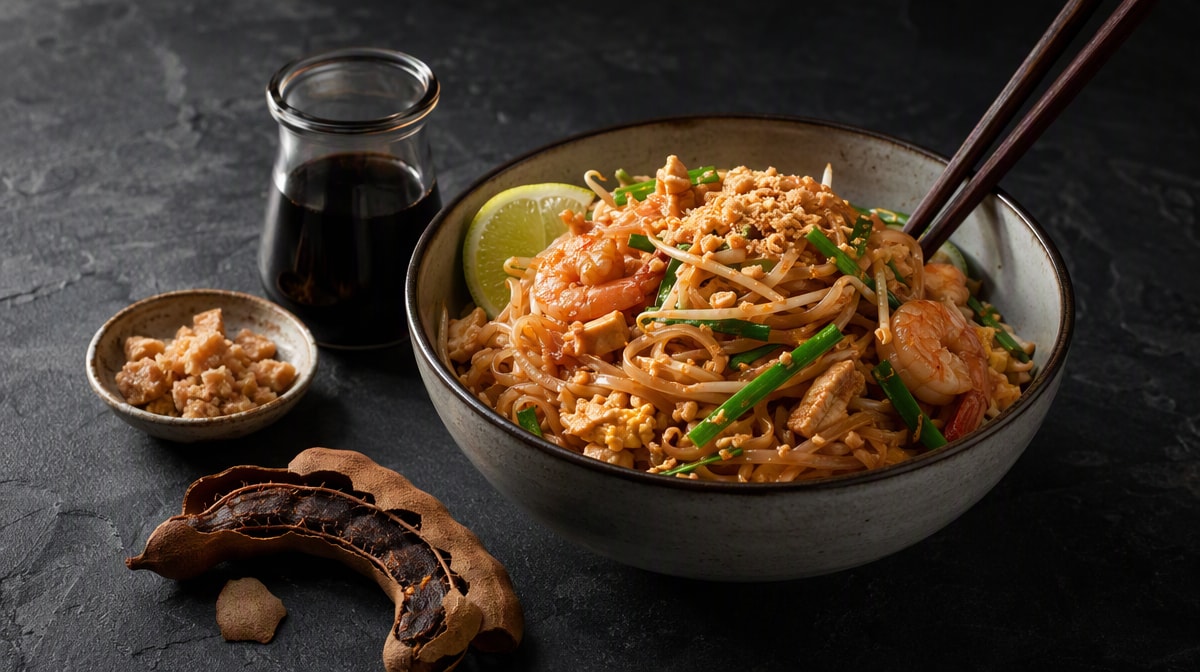
For pad thai and any light, fresh dish, paste. Thai-style, mild, and measured against sugar and fish sauce rather than against heat. This is the form the recipes were written for.
For a heavy braise, a stew, or a soup where the tamarind is cooked down, concentrate. It's stronger, syrupy, and holds its character through long cooking, so you use less and it doesn't dissipate.
For a dressing or a salad, paste, and use it fresh. Vinegar-style acids like this want the fruitiness, and a syrupy concentrate in a cold dressing is cloying rather than sharp.
For a dessert, the block, or a fresh pod. Thai tamarind is used almost entirely in savoury cooking, but makaam wan, the sweet variety, is a genuinely different ingredient and worth seeking out if you want to go there.
And for anything you make often, buy a 1kg tub of paste. It's the best value, it keeps, and it removes the whole question from your cooking.
Making it yourself, if you can find a block

Worth doing once, because the difference is the same order as the difference between fresh lemon juice and bottled, and because it teaches you what tamarind actually is.
You need a block of tamarind pulp, sold in most Asian shops, and boiling water. That's the entire ingredient list.
Break the block and cover it with equal parts boiling water. Leave it 10 to 15 minutes, longer if the block is hard, and some are very hard indeed.
Work the softened mass with your fingers. The pulp separates from the seeds and string easily at this stage, and the seeds float. Pick them out, or push everything through a sieve, which is faster and gives a smoother result.
You're left with roughly half the weight of the block in usable pulp. Budget for that. A 200g block gives you closer to 100g of tamarind.
Strain it and you have tamarind liquid, which is what most recipes want. Keep it in a jar in the fridge for a couple of weeks, or freeze it in an ice cube tray.
A note on straining: you have a choice of texture. Straight from the block, pressed, it's fibrous and rustic. Through a sieve it's smooth and commercial-looking. Both are correct, and the fibrous version is more traditional, being what you get in a paste made by hand.
One practical tip that saves real time: if your recipe needs only a spoonful, don't make the whole block. Tamarind doesn't spoil quickly, so make a full batch and freeze it. Half a block thrown away because a recipe called for two teaspoons is a waste of about a pound.
What it's used in
Tamarind is one of two main acids in Thai cooking, alongside lime. It appears in a lot more than you'd expect.
Pad thai, where the signature sour note lives and authenticity genuinely hangs on using it rather than a rice vinegar shortcut.
Som tam, the sour backbone of the dressing.
Tom yum and tom kha.
Sour curries, including gaeng som, which we have covered here.
Nam jim jaew, the dipping sauce for grilled meats.
Son-in-law eggs.
Tamarind fish and prawns, where it's cooked down into a sauce.
And stir-fried morning glory, where the tamarind is often the whole dressing.
It's a savoury ingredient in Thai cooking, essentially without exception, which surprises people who know it as a sweet snack.
Choosing a jar in the shop
Two seconds of looking saves disappointment later.
Look at the consistency before anything else. Paste is pourable, like a thick yoghurt. Concentrate is syrupy, closer to treacle. If it slumps off a spoon it's paste, and if it ribbons it's concentrate.
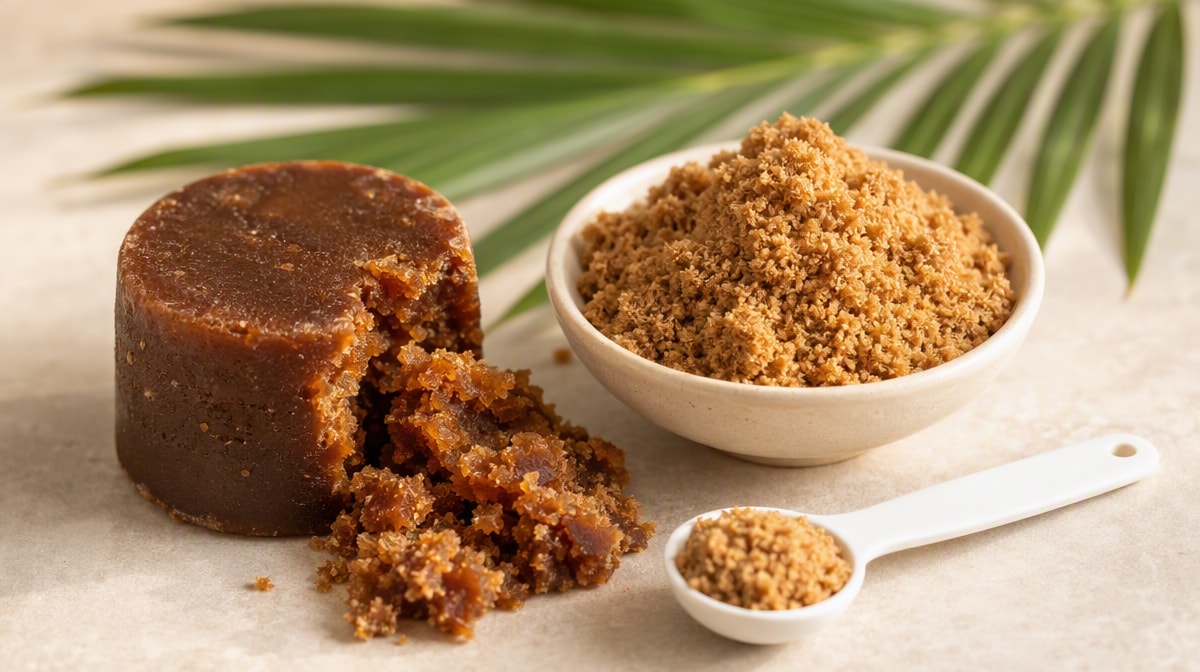
Read the ingredients list. Good paste lists tamarind pulp and water. If you see sugar high up the list, some of what you're paying for palm sugar is sugar.
And check whether it says concentrate at all. Plenty of jars labelled concentrate on a Thai product are thinned paste, as covered above, and using them as a concentrate leaves you with a weak curry rather than a sour one. That's the quieter failure of the two.
If you need to substitute it
In pad thai specifically, there is no genuinely good substitute. Pailin Chongchitnant of Hot Thai Kitchen is blunt about this. The tamarind is the flavour, and replacing it produces something else. If you have no tamarind, the honest options are to omit it and increase the lime, or to accept the dish will taste different.
Elsewhere, the standard substitute is equal parts lime juice and dark brown sugar. That gives you sour and sweet, which is much of what tamarind is doing in a dressing or a sauce. It lacks the fruitiness and the depth, so it's a compromise rather than an equivalent.
Vinegar is a weaker substitute. White vinegar is harsh and one-dimensional, rice vinegar is better but still not tamarind. And Real Thai notes that Thai cooks themselves sometimes use freshly squeezed lime or white vinegar where tamarind would go, adding that although the flavour is not as wonderful, it will do.
In a soup or a braise, tamarind is much more forgiving than in a salad or a stir-fry, because there's more liquid and more going on to absorb the difference.
A quick decision guide
| What you have | What to do |
|---|---|
| Jar of paste or purée | Use as the recipe says |
| Jar labelled concentrate, Indian style | Dilute 1:2 with water, use a third of the quantity |
| Jar labelled concentrate, Thai or Indonesian | Probably a paste. Taste it, and use as directed |
| Block of pulp | Soak 10 to 15 min in boiling water, strain, use |
| Fresh pod | Shell it, treat as block |
| Nothing, and cooking a curry | Lime juice and dark brown sugar, equal parts |
| Nothing, and cooking pad thai | No good substitute. Increase lime and accept the difference |
If only one line of this page sticks: buy paste, and taste it before you trust it.
Storing it
All four forms keep at room temperature for a year or more unopened. They're stable products, because the sugar and the acidity do the work.
Opened, keep it in the fridge. Both paste and concentrate will keep for months, and neither freezes badly if you have a large jar you won't get through.
A homemade block paste freezes well, around six months, which is a good way to make a batch and use it across several dishes.
A note on sources
The proportions and the 3:1 rule are consistent across the sources. The America's Test Kitchen finding about mislabelled concentrate is the single most useful piece here, and it's a test kitchen rather than a casual blog, which is why I'd weight it heavily. Brand comparisons are cook experience rather than testing, and tamarind strength varies by batch and season regardless of brand. Trust the label over the ratio, and your own palate over both.
Frequently asked questions
What is the difference between tamarind paste and tamarind concentrate?
Concentrate is pulp cooked down, so it's syrupy, shelf-stable and roughly three times stronger. Paste is pulp diluted with water and ready to use. To use concentrate, dilute one part with two parts water and use about a third of the volume the recipe would use for paste.
Are Thai tamarind paste and concentrate really different products?
Often not, and this is a labelling problem rather than a culinary one. America's Test Kitchen found that Thai and Indonesian products labelled "concentrate" are usually pastes thinned with water, while the true thick, dark concentrate is the Indian-style product. The reliable rule is to buy something sold as paste, and dilute only if the packet is a clear Indian-style syrup.
How much tamarind concentrate should I use instead of paste?
About a third of the volume. One tablespoon of paste is roughly one teaspoon of undiluted concentrate, or one tablespoon of concentrate plus two teaspoons of water. But taste it first, because strength varies by brand and origin and a fixed conversion can't account for that.
Can I use tamarind paste instead of tamarind pulp?
Yes, and it's the easier route. A jar of paste works out at roughly 1.5 times the strength of paste you'd make yourself from a block, so use slightly less. Making it from the block gives a noticeably fresher, brighter flavour, but the jar is entirely adequate for most cooking.
What can I substitute for tamarind?
The standard substitute is equal parts lime juice and dark brown sugar, which reproduces the sour and sweet that tamarind provides. It lacks the fruitiness, so it's a compromise rather than an equivalent. In pad thai specifically there's no good substitute, because the tamarind is the flavour of the dish rather than an accent in it.
Is Indian tamarind sourer than Thai tamarind?
Yes, noticeably. Indian tamarind is considerably more intense, and Thai and Vietnamese versions are lighter and milder. Thai recipes are calibrated against the Thai version, so if you're using Indian, reduce the quantity. Look for "Product of Thailand" on the label for a predictable result.
How do I use a block of tamarind pulp?
Soak it in equal parts boiling water for 10 to 15 minutes, then strain out the seeds and stringy fibre, of which there's roughly half the block's weight. Press the softened pulp through a sieve for a smooth liquid, or mash it for a coarser paste. The result is fresher and more fragrant than anything from a jar.
How long does tamarind paste keep?
Unopened, all forms keep at room temperature for a year or more, because the sugar and acidity make them very stable. Opened, keep it in the fridge and it will last for months, and a large jar freezes fine if you won't get through it.

Comments