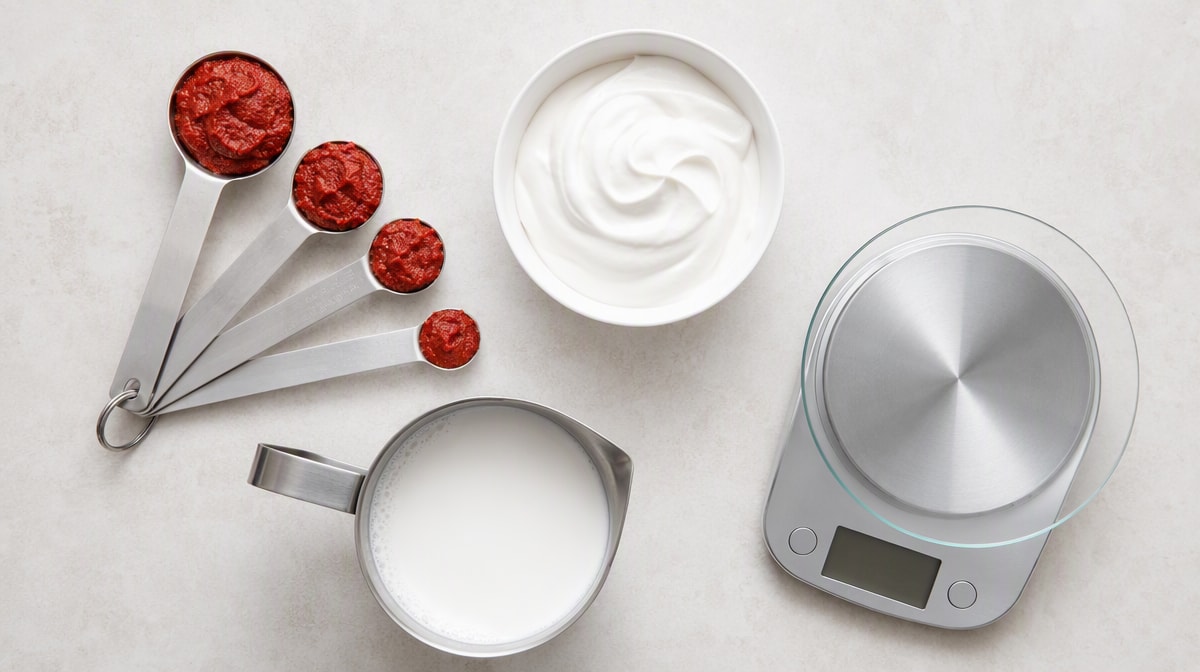
Two tablespoons of paste to a 400ml tin of coconut milk. That's the number most Thai curry recipes land on, and it serves three or four people.
It is also a starting point rather than a rule, and the reason it works better than most ratios is that the coconut milk is doing more work than it's usually given credit for. Get the ratio right and the curry tastes composed. Get it wrong in either direction and the dish tastes flat or harsh, and neither problem is fixable afterwards.
The one number to start from
Two tablespoons of curry paste per 400ml can of coconut milk, for a medium-heat curry serving three to four.
That appears in more places than any other ratio in Thai cooking, which is a reasonable signal on its own. The BBC recipe, the WellPlated recipe, the Garlic Dairies recipe, a dozen others, all landing in the same place.
Expressed per person rather than per can, it's one to two tablespoons per serving. The two framings aren't quite the same, because a can of coconut milk is a fixed volume and a serving isn't, but they agree closely enough for home cooking.
A reasonable ceiling is about a quarter cup of paste for four to six servings. Past that, the paste overwhelms the dish and you get something that tastes hot rather than complex, which is a different thing and usually not what you wanted.
Why the ratio works, chemically

Nobody in the sources gives a satisfying explanation of this, which is a shame, because the mechanism is the interesting part and it explains the whole thing.
Capsaicin is fat-soluble. It dissolves in fat and barely dissolves in water. So the coconut milk is the delivery mechanism for the heat, and the ratio of paste to milk is really a ratio of capsaicin to fat.
Too little milk and the capsaicin has nowhere to go. It sits in concentrated form in the paste, the oil looks red and angry, and you get a curry that burns without tasting rounded. That's the signature of an over-pasted curry, and it looks alarming before you even taste it.
Too much milk and the capsaicin is spread thin. The fat is there, the body is there, but the flavour has been diluted to the point where the dish reads as bland rather than mild. This is the more common failure and the more annoying one, because a bland curry is indistinguishable from a badly made one.
Salt plays the same role from the other direction, because paste is salty and so is fish sauce and so is most of the seasoning in a Thai curry. Dilution isn't only about heat.
So the ratio isn't a convention. It's a solubility problem, and the correct amount of coconut milk is the amount that carries the paste's whole flavour profile without flattening it.
By curry type
| Curry | Paste per 400ml can | Notes |
|---|---|---|
| Green | 2.5 to 3.5 Tbsp | Hotter and more herbal |
| Red | 2.5 to 4 Tbsp | The most paste-tolerant |
| Yellow | 2 to 3 Tbsp | Mildest |
| Panang | 2.5 to 4 Tbsp | Rich, paste-forward |
| Massaman | 2.5 to 4 Tbsp | Richest, tolerates more |
Green and red are the ones you'll cook most, and the practical difference is that green is more herbal and sharper while red is rounder and sweeter. Both take more paste than yellow.
Yellow is the mild one, because the base is turmeric and coconut rather than chilli, so the paste is seasoning rather than heat. Two tablespoons is plenty and three is usually too much for a curry you're labelling mild.
Panang and massaman are the two that take the most paste without complaining, because both are built around a thick, rich, sweet sauce where paste is one of several strong flavours rather than the only one. Massaman in particular is a dish where people routinely use more paste than the baseline and it improves.
What brands actually do to the number
This is the caveat that appears in almost every source, and it's the one that matters most in practice.
Mae Ploy and Maesri, the Thai imports, are noticeably stronger and hotter than the mild supermarket jars. If you're cooking with a Mae Ploy tin, the two tablespoons baseline is already a decent heat and you may want less. With a mild British supermarket jar, two tablespoons will taste flat and you'll want three.
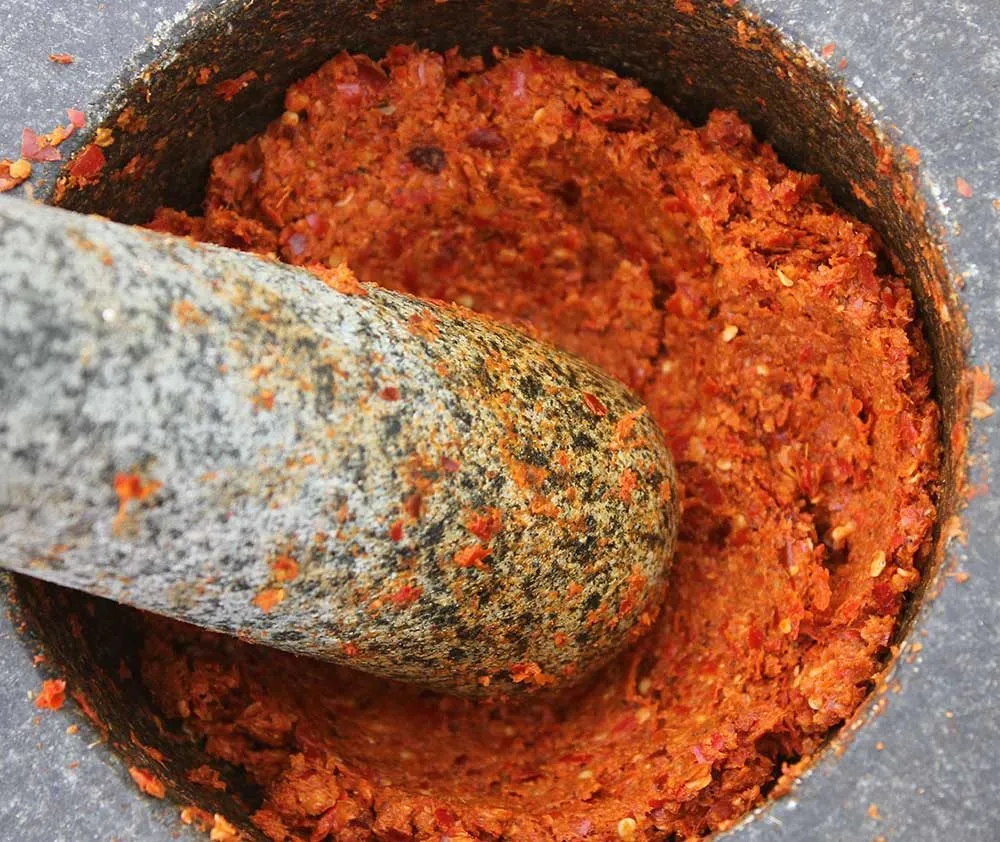
Homemade paste is a third category. It's denser than jarred paste, because there's no added oil or water holding it apart, and it's stronger by volume. A tablespoon of homemade paste is closer to a tablespoon and a half of jarred.
The Mae Ploy tub suggests about 50g, roughly three tablespoons, for two to three portions, which sits at the upper end of the baseline and is a sensible guide for their strength.
Given the variation, the honest answer to "how much curry paste" is that the number is a starting point and the adjustment is the actual technique.
Start low and build, because you can't take it out
This is the most consistent piece of advice in the entire research, and it's the one that will improve your cooking fastest.
Start at one tablespoon per serving, or one per cup of coconut milk. Simmer, taste properly, then add more in half-tablespoon increments until it's right.
Adding is easy. Removing is not. A curry with too much paste can't be fixed by adding coconut milk without thinning the whole dish, and it can't be fixed by adding sugar without turning it into a dessert.
Two minutes of simmering and tasting before you commit costs almost nothing and prevents the single most common curry mistake.
And taste the sauce, not the curry. The sauce tastes different from the finished dish, because the protein, the vegetables and the rice all change how it reads on the palate. Get the sauce right and the rest follows.
Bloom it first, and this is the step people skip

Frying the paste in oil before the liquid goes in is the highest-value technique in this entire article, and most home curries skip it.
Spoon the thick cream from the top of the tin into a hot pan, add one or two tablespoons of oil, add the paste, and fry it for two or three minutes until it darkens, oil splits, and it smells profoundly of itself rather than merely of raw chilli.
Then add the rest of the milk.
What this does is extract the fat-soluble compounds from the paste into the oil, which is exactly the mechanism described above, deliberately rather than by accident. The aromatics that would otherwise be locked inside the paste fibres are released into the fat, and the fat is going into the curry anyway. It also drives off the raw, vegetal edge that undercooked paste has and replaces it with a deeper, roasted note.
It takes three minutes and it is the largest single improvement available to a home cook. The oil splitting, going slightly glossy and separating at the edges, is the signal that it's done. Past that point you burn the paste and it turns acrid, so it's worth watching rather than walking away.
Full fat, and the coconut cream on top

Use full fat coconut milk. Light coconut milk is coconut-flavoured water, and in a dish whose entire structure depends on fat carrying flavour, using it means a thin curry that tastes diluted no matter what you do to the ratio.
Look for 40% extract or above. Aroy-D and Chaokoh are the reliable ones in the UK, and the fat percentage is on the tin.
And that thick cream at the top of the tin isn't waste. It's the best part of the can for this purpose, and the traditional method involves cracking it, which means cooking it hard enough to separate, and then using that first-cooked cream as the base for frying the paste. The sources describe frying a quarter of a tin's worth first for exactly this reason.
Portioning and scaling
For one person, one tablespoon of paste to about 120ml of coconut milk. This is a small curry and it's the size most people actually want, which makes it awkward to make from a tin. Half a tin is the practical unit, and the other half keeps for a week in the fridge.
Scaling is linear. Two cans of coconut milk, twice the paste. This is one of the few things in cooking that scales exactly, and it's worth trusting rather than adjusting.
A rough weight conversion helps if you're buying paste by weight rather than volume. A tablespoon of paste is roughly 15 to 20g, and a 50g tub is therefore about three tablespoons, which is the figure Mae Ploy print on their own packaging.
One more thing worth doing: freeze surplus paste in an ice cube tray, roughly a tablespoon per cube, and bag them up. Then a curry for one is a thirty-second job, because you're not measuring anything.
The powder substitution
If you're using curry powder instead of paste, the conversion is roughly one teaspoon of powder to one tablespoon of paste.
This is worth a brief mention and not more, because the substitution is genuinely inferior and the difference is structural rather than a matter of quantity. Paste has aromatics, salt, shallots, garlic and shrimp paste in it, and powder is chilli, turmeric, coriander, cumin, cardamom and fenugreek. A teaspoon of powder is roughly the right amount of the chilli and spice component, and none of the rest.
If you make the substitution, shorten the cooking time and add salt early rather than at the end, because powder salted at the end tastes of salt sitting on top rather than salt integrated into the sauce. Our guide to curry powder against curry paste covers this properly.
The failures, and what they look like
Bland curry is over-diluted. Too much coconut milk, or too little paste, or both. The sauce tastes thin and watery and there's nothing underneath it.
Harsh, oily curry is over-pasted. The oil separates, looks red and angry, and the sauce coats the spoon rather than running off it. You've got more capsaicin than the fat can carry.
A curry that tastes raw and slightly vegetal is under-bloomed. The paste went in with the liquid rather than being fried first.
Bitter curry is usually the paste burnt. High heat, too long, and not enough stirring. Fried paste should darken and split, not go brown and acrid.
Salty curry is nearly always the paste rather than the added salt, because paste brands vary so much in sodium. If it tastes salty before you've added any fish sauce, you know what you're dealing with.
And a curry that tastes flat despite correct quantities is usually one of two things. Either the paste is jarred and mild and needs more, or the fresh aromatics went in too late to cook properly.
Matching the ratio to the rest of the dish
The ratio doesn't exist in isolation, and two things in your pan will change what it should be.
Protein. Meat, fish or prawns dilute the sauce as they cook and add their own savoury weight, so a curry with a protein in it can carry slightly more paste than a vegetable curry of the same volume. Chicken and beef are the strongest of these, because they add umami that competes with the paste rather than with the coconut milk. Vegetables, particularly ones that release water like tomato or courgette, push in the opposite direction and want a little more paste to compensate.
Vegetables that release water. This is the one that catches people out. A curry with courgette, aubergine, tomato or bamboo shoots in it will thin as it cooks, and if you set the ratio for the volume you started with you'll end up with something watery by the end. Either use less liquid, or use less-thin vegetables, or add the watery ones late so the sauce has already reduced.
And the reduction point matters more than people expect. A curry that simmers twenty minutes to a restaurant consistency is more concentrated than the same curry at minute five, so the ratio that tastes right at the start tastes too strong at the end. This is the main reason to taste as you go rather than measure once and trust it.
Cooking it down, and the last five minutes
The final stage of most curries is a reduction, and it's where the dish stops being a soup and becomes a curry.
Simmer it until the oil starts to separate and rise to the surface, and the sauce coats the back of a spoon rather than running off it. In a properly reduced Thai curry you'll see clear oil pooling at the edges of the pan, and that oil is the fat that has carried the paste's flavour all the way through. It looks like a warning sign and it's actually the target.
Keep the heat moderate and stir more often as it thickens, because the bottom catches quickly at the point where the liquid has gone and the fat is all that's left. The point at which the paste would burn is the point at which you're nearly done.
Some cooks take it further and let the curry scorch deliberately, which is called khua in Thai, or frying, and it produces a deeper, smokier sauce. It's a genuine technique rather than a mistake, but it's a second step beyond seasoning and adjusting, so it's worth having the ratio right first.
A note on sources
The 2-tablespoons-per-can figure is very well established and I'd trust it as a starting point. The by-curry-type variations are less rigorously sourced and read as accumulated cook experience rather than anything tested, so treat them as a starting point and adjust. The chemistry is my own explanation of an observed pattern, and while it's consistent with how capsaicin behaves, none of the sources present it as an experiment. Brand strength claims are well supported and are the most practically useful thing in the research.
Frequently asked questions
How many tablespoons of curry paste per person?
One to two tablespoons per serving, and the most reliable single figure is two tablespoons per 400ml tin of coconut milk. If you're unsure, start at one tablespoon per person, simmer, taste, and add more. You can't remove paste once it's in, and you can always add.
What is the best ratio of curry paste to coconut milk?
Two tablespoons of paste to a 400ml can of coconut milk gives a balanced, medium-heat curry serving three or four. For a milder curry use one to two tablespoons, for a hotter one three to four. The ratio works because coconut fat dissolves the paste's capsaicin, so too little milk leaves the heat harsh and too much dilutes the whole flavour profile.
How much curry paste for a green curry?
Two and a half to three and a half tablespoons per 400ml can. Green curry is hotter and more herbal than red, so it needs a decent amount and it's worth tasting as you go. If you're using a strong Mae Ploy or Maesri paste rather than a mild supermarket jar, go towards the lower end of the range.
How much curry paste for a red curry?
Two and a half to four tablespoons per 400ml can of coconut milk. Red curry tolerates more paste than green and is the most paste-forward of the everyday curries. A mild supermarket jar will need the upper end of that range, a Mae Ploy tin the lower end, because imported brands are noticeably stronger.
How much curry paste can I use before it's too much?
About a quarter cup for four to six servings, which is the practical ceiling in the sources. Past that the paste starts to dominate rather than season, and the curry reads as hot and heavy instead of layered. The more reliable check is whether the oil is splitting and looking red and angry in the pan, which means more paste than the fat can carry.
Does the brand of curry paste change how much I need?
Substantially, and this is the most important variable on the page. Mae Ploy and Maesri are noticeably hotter and stronger than mild supermarket jars, so a Mae Ploy tin needs less and a British supermarket jar needs more. Homemade paste is denser and stronger by volume than jarred, because there's no added oil or water diluting it.
Should I fry the curry paste before adding the coconut milk?
Yes, and it's the step that most improves a home-made curry. Spoon the thick cream from the top of the tin into a hot pan, add the paste, and fry for two or three minutes until it darkens and the oil splits. This extracts the fat-soluble aromatics into the oil, which is where they'll end up anyway, and it removes the raw edge that undercooked paste has.
Can I use curry powder instead of curry paste, and at what ratio?
About one teaspoon of curry powder to one tablespoon of paste, but the substitution is structurally inferior rather than just weaker. Paste contains aromatics, salt, shallots and often shrimp paste that powder simply doesn't have. If you use powder, shorten the cooking time and salt early so it integrates, and expect a flatter dish.


Comments