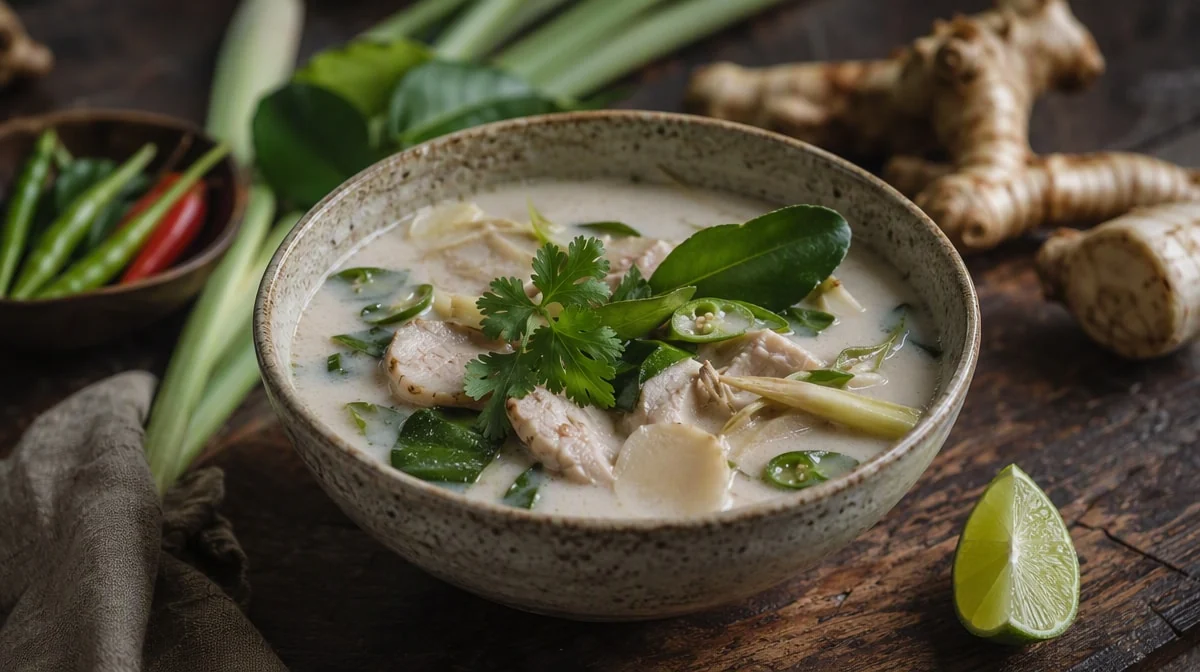
Tom kha gai is chicken poached in coconut milk with slices of galangal, bruised lemongrass, torn kaffir lime leaves and whole green chillies, seasoned off the heat with fish sauce and lime juice. The name says what decides the dish: tom (ต้ม) is a soup boiled in liquid, kha (ข่า) is galangal, gai (ไก่) is chicken. Coconut milk is what makes it not a tom yum. Galangal is what makes it a tom kha.
That is worth getting straight before you cook it, because the English-language literature has been muddling it for decades. An older memoir about Thailand lists its restaurant dishes without hesitation: "Tom kha kai—ginger soup with chicken and coconut milk" (The Thai and I). It is not a ginger soup, and the books that print a recipe are unambiguous about the rhizome. This page is built on four that print recipes, plus this site's own kitchen rules.
What Is Tom Kha Gai?
The three words do the explaining. Tom names a method, not a style: a soup made by boiling meat or fish in a liquid, which is why it heads dishes as different as a clear broth and a coconut soup. Kha (ข่า) is galangal. The glossaries say it in different words and the same direction. The Food of Thailand heads its ingredient page "GALANGAL (khaa) A rhizome with a hot peppery flavour" (p. 175). Solomon's Complete Asian Cookbook lists the Thai name for greater galangal in its list of aliases, "kha (Thailand and Laos)", and states the consequence for this soup: "Slices may be simmered in soups and curries for extra flavour... although if absent from a dish it will be missed."
The ginger error has a print history rather than an internet one. There is the menu list quoted above. There is the cooking-school booklet, which glosses every galangal line it prints as "galanga (Thai ginger)". And there is Solomon's entry for the other rhizome sold as a ginger, lesser galangal, "also known as 'aromatic ginger', this member of the ginger family cannot be used as a substitute for ginger or vice versa". The ginger jar is a documented error, not a random one. We have a whole page on what galangal is and why ginger is not it and will not re-argue it here.
Two structural facts follow. It is a household and restaurant soup, not court food: the guides place it in the central-Thai lane ("central cuisine... is notable for the use of coconut milk", "Trademark dishes include tom kha gai (a soup of chicken, coconut milk and galangal)", Thailand: Insight Guides p. 83), while the royal kitchen manuscript in our corpus has no tom kha in it at all, only clear sour soups such as Tom Jiw Kai, profile "Sour from lime juice and tamarind". And the aromatics in the bowl are neither garnish nor food: kaffir lime leaves says they are bruised and simmered and "not eaten", pushed to the side "just as you would with a slice of galangal".
Tom Kha vs Tom Yum: What Actually Differs

The aromatics are largely the same, which is why the usual comparison is useless. Lemongrass, galangal and kaffir lime leaf are the base of both; tom yum nam sai vs nam khon calls that trio "the tom yum trinity" and treats it as the shared heart of both soups. Three things separate them, and all three are in the methods, not the shopping list.
The liquid. Tom kha is poached in coconut milk, thinned at the start and finished with undiluted milk; tom yum is poached in stock or water. Our chef puts it flatly: "authentic tom yum never contains coconut milk. The soup you're thinking of with coconut is tom kha." The creamy tom yum that does exist, tom yum nam khon, gets its body from evaporated milk and chilli jam, and that page owns it.
The seasoning target. Tom yum is built to be sour first: "This soup should have a pronounced 2. What the seasoning aims at. Solomon says plainly what a tom yum is for: "This soup should have a pronounced acid flavour, so add sufficient lime juice to achieve this" (Kung Tom Yam); the royal kitchen's sour chicken soup wants "Sour from lime juice and tamarind". Neither published tom kha chases sourness, and the fullest one uses no sugar and no tamarind.
What happens to the aromatics. This is the sharpest difference and nobody writes about it. In the 3. What happens to the aromatics. In the clear prawn tom yum in The Food of Thailand (p. 65) you boil lemongrass, galangal, torn lime leaves and bruised chillies in prawn shells and stock for 20 minutes, then: "Strain the stock and return to the pan. Discard the shells and flavourings." In tom kha those aromatics go into the coconut milk at the start and are still in the bowl when you eat it. One soup is infused and then clarified; the other is served with the infusions in it.
Galangal is the load-bearing one: it never leaves a tom kha, and it sometimes leaves a tom yum. That book's tom yum has "3 thin slices of galangal"; Solomon's prawn tom yum has none at all and suggests lemon zest for one of its lemongrass stems. On heat, both soups in the books take whole or bruised chillies rather than paste and differ only in how long the chilli stays in.
What Is Tom Kha Soup Made Of?
The two full recipes in our corpus agree on seven aromatics and disagree on the rest. Read side by side they are more useful than either alone, because what they both do is what matters:
| The Complete Asian Cookbook, "Tom Kha Kai" (5 servings) | Thai Recipes from Thai Cottage, "Tom kha kai" (1 portion) | |
|---|---|---|
| Chicken | 1.25 kg whole chicken, jointed | 50 g breast, sliced 3 cm thick |
| Liquid | 625 ml thin coconut milk, then 250 ml thick | 1 cup coconut milk |
| Galangal | 1 tbsp chopped, or laos (dried galangal) powder | 2-3 slices |
| Lemongrass, coriander root, kaffir lime leaf, chilli | 2 stems, 2-3 roots, 3 leaves, 3 whole green chillies | 2-3 pieces, 1 tsp coriander, 2 leaves, 1-3 crushed chillies |
| Pepper | ½ tsp black | none |
| Sugar | none | 1-1½ tsp |
| Onion, mushroom | none | 30 g onion, 30 g oyster mushrooms |
| Finish | 1 tbsp fish sauce, lime juice, coriander leaves, rice | 1 tbsp fish sauce, 1 tbsp lemon juice, coriander |
Four of those differences are real choices; naming them is the point. Onion: one booklet has it, and that one is a cooking-school booklet written for people getting flavour out of small portions. Mushroom: absent from the fuller recipe, present in the smaller one, and the British-published book puts "straw mushrooms, or quartered button mushrooms" in its tom yum (p. 65), so the swap is Thai rather than invented. Black pepper: half a teaspoon at the start in one book, nothing in the other. Sugar: none, or a teaspoon and a half, taken up below, because jarred paste points in a third direction.
What neither has, in the order people most often add it: no chilli paste, no shrimp paste, no tamarind, no tomato, no curry powder, no turmeric. Turmeric and coconut with chicken is tom kha-min, which the same booklet prints two pages later as a different soup: turmeric, tamarind, chicken stock, no coconut. Kha-min is turmeric, not galangal.
How to Make Tom Kha Gai at Home
Quantities are Solomon's, scaled from her five generous portions to four first courses with rice. The changes that are ours are marked. Thirty minutes, ten of them work.
For 4 as a first course, or 2 as a main with rice
- 600 g boneless chicken thigh, cut across the grain into 4 cm pieces
- 1 x 400 ml can coconut milk, split in half, plus 400 ml water
- 25 g fresh galangal, peeled and sliced thin, about a heaped tablespoon sliced; jarred or dried in section 6
- 2 lemongrass stalks: peel off the tough outer layers, bruise the white base with the back of a knife, cut into 5 cm lengths
- 3 coriander roots, washed and crushed; if yours came without roots, chop the stalks
- 4 kaffir lime leaves (makrut), torn in half (fresh, frozen or dried)
- 3 green chillies, whole and bruised, or 1 long green chilli slit lengthways
- 1-1½ tsp salt, plus 1-2 tbsp fish sauce and the juice of 2 limes at the end
- ½ tsp coarsely ground black pepper
- 1 small onion, quartered, and 200 g oyster, chestnut or flat mushrooms, torn or quartered
- Coriander leaves, and jasmine rice, to serve
Method
- Thin the coconut milk and infuse it. Whisk half the can (200 ml) into the 400 ml water in a 1.5 litre pan. Add the galangal, lemongrass, coriander roots, torn lime leaves, whole chillies, salt and pepper. Boil, then hold at a bare simmer 5-8 minutes, until the pan smells like galangal rather than coconut.
- Poach the chicken. Add it, bring it just back to the boil, skim, then simmer gently until tender: 12-15 minutes for thigh, 20-25 for bone-in pieces. Solomon puts the chicken in with the aromatics from the start and says only "simmer until the chicken is tender, stirring occasionally", using a whole chicken jointed into portions. Two changes are ours: boneless thigh, because nobody wants to bone a whole chicken at ten past six, and a short infusion first, which stops diced thigh from 25 minutes of simmering. With joints, put everything in together as she does; joints give the soup its body.
- Add onion and mushrooms, if using, and cook 5 minutes more.
- Finish with the undiluted milk. Stir in the remaining 200 ml coconut milk and bring the soup back up to a simmer, stirring, and stay at the stove. Solomon: "Add the thick coconut milk and return to the boil, stirring constantly." Ours is narrower: "never let the coconut milk reach a hard boil (it splits)" (easy Thai recipes with chicken). The two agree read carefully: it must come back to temperature, it must be stirred, it must not heave. If it splits: why curries go grainy.
- Season off the heat. Push the pan aside, stir in the fish sauce and lime juice. Solomon: "Remove from the heat and stir in the fish sauce and lime juice." The tom yum in The Food of Thailand agrees ("Take off the heat and add the lime juice", p. 65); the cooking-school booklet seasons in the pan and turns the heat off afterwards, which works too, and is why boiled lime goes flat. Taste, fix salt with fish sauce and sour with lime, leave sugar until last.
- Serve in deep bowls with coriander leaves over it. The galangal, lemongrass and lime leaves go to the table in the bowl and stay there; the slices are not eaten.
Thin and Thick Coconut Milk, and the British Can

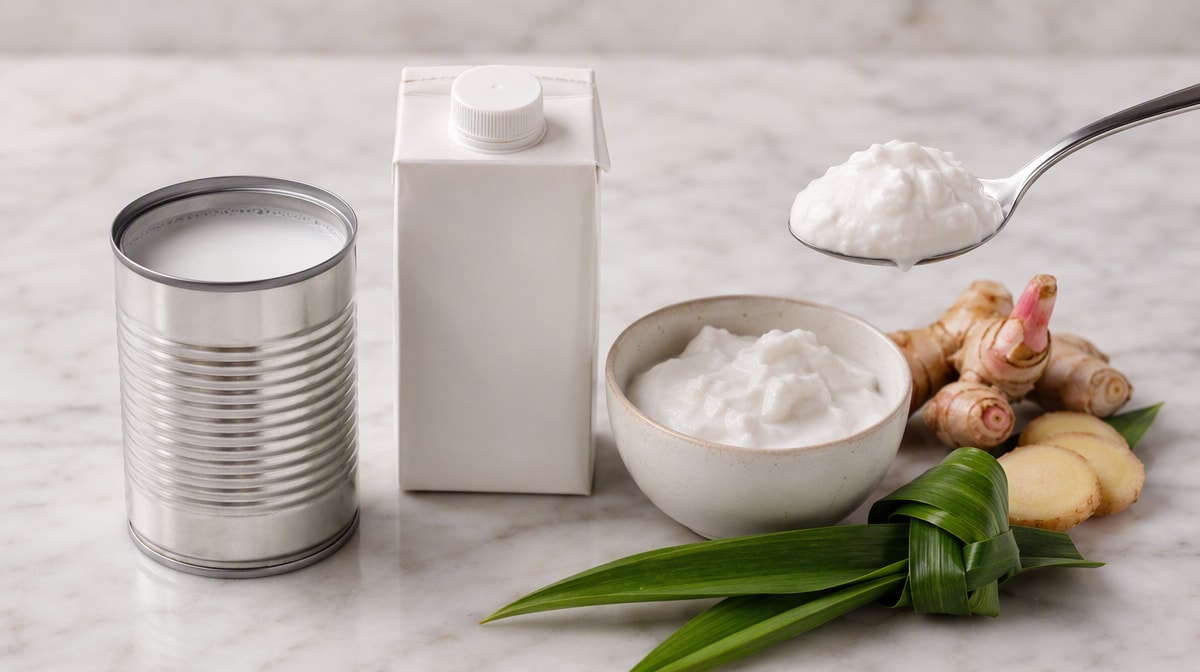
Both published recipes use one tin, and the fuller one splits it into two grades: 625 ml of thin coconut milk with the aromatics and chicken, 250 ml of thick at the end. That is not pedantry; it is how one ingredient gives the soup both its flavour base and its finish. The same author gives the conversion from a British tin: "Where a recipe calls for thick coconut milk, dilute the tinned product with half its volume in water... Where thin coconut milk is required, dilute the tinned coconut milk with two parts by volume of water." Her account of the grades is the pressing order, which most British cooks have not been told: first pressing thick, second thin, and cream is "the rich layer that rises to the top of the thick milk (or first extract) after it has been left to stand" (glossary and method pages, The Complete Asian Cookbook).
That is why one 400 ml can covers this recipe, and why its two additions differ: 200 ml thinned with 400 ml water is close to her thin grade, and the last 200 ml undiluted is stronger than her thick grade, deliberately, because tins here are thinner than fresh and the finish is where the coconut taste should come from. If your tin is a thin one, use less water at step 1, not more coconut at step 4. Her warning about tins is why you read a label: "the quality between brands varies enormously... it should only have coconut and water in it. It is better to avoid brands that include stabilisers and preservatives. Shake the tin well before opening." What "cream of coconut" is in a British shop is on coconut milk vs coconut cream, and what to do with the half tin and half root left over is on how long opened coconut milk lasts.
Tom Kha without Galangal (UK)
A tom kha without galangal is chicken soup in coconut milk with lemongrass in it, which is another dish: the kha in the name is that root. The ranking of substitutes, and how to prep frozen, dried or paste galangal, is on galangal substitute for tom yum and what galangal is; what the recipe books add is narrower.
Dried galangal is written up as a paste and long-cooking ingredient, not a soup ingredient: "The fresh or bottled rhizome will have more impact, but the ground spice can add an intriguing note to curries and dishes requiring longer cooking" (Complete Asian Cookbook, on laos). Buy for the slice, not the jar of powder. And check which galangal you are buying: "Young pale galangal can be eaten in pieces. Older redder pieces are best used in curry pastes" (The Food of Thailand, p. 175). The woody red pieces are the ones that end up sitting in your bowl like bark.
In Britain the form that works is chopped galangal in brine: the standard jar is 114 g of galangal 69% with water and acetic acid, sold by Thai grocers and online grocers; its own instruction is "simply drain the galangal and add to dishes", suggesting 30 g per serving. Supermarket own-label galangal pastes are a different quantity; check which you have bought. What we do not claim is that ginger works: our own page allows it as better than nothing in a broth where galangal is only infused, and this is a soup where the slices are visible.
Can You Make Tom Kha with Tom Yum Paste?
Yes, and you get a hotter, more savoury coconut soup that is nearer tom yum nam khon than tom kha gai. Worth knowing what is in the jars before you decide.
Jarred tom kha paste here is imported: AROY-D 400 g (£2.45 at Longdan, the Thai grocer that stocks the brand), Blue Elephant's 220 g at £4.50. No British supermarket puts its own name on a tom kha paste. Read the AROY-D list in order and you have the shape of the product: salt, sugar, galangal, lemongrass, refined soybean oil, chillies, kaffir lime peel, flavour enhancer 621, citric acid. One retailer lists the shares: salt 22%, sugar 20%, galangal 17%, lemongrass 17%, chilli 5%. The jar's own method is a cup of water, 250 ml coconut milk, 50 g of paste, chicken and vegetables, "a tablespoon of sugar", 8 minutes: chilli and sugar in, both of which the books leave out.
Tom yum paste is a different product for all that it shares lemongrass, galangal and lime peel with it, because it carries shrimp paste and tamarind, and its own advice is to add a splash of coconut milk for the creamy tom yum. If tom yum paste is what you have, use it: add the coconut milk at the end instead of frying the paste, cut the added fish sauce, finish with lime off the heat. Brand rankings are on easy tom yum soup recipe, jar storage on how long Thai curry paste lasts.
Tom Kha Gai (ต้มข่าไก่)
Ingredients
- 600 g boneless chicken thigh, cut into 4 cm pieces
- 1 x 400 ml can coconut milk, split in half
- 400 ml water
- 25 g fresh galangal, peeled and sliced
- 2 lemongrass stalks, bruised and cut into 5 cm lengths
- 3 coriander roots, crushed
- 4 kaffir lime leaves, torn
- 3 green chillies, bruised
- 1-1½ tsp salt
- 1-2 tbsp fish sauce
- Juice of 2 limes
- ½ tsp coarsely ground black pepper
- 1 small onion, quartered
- 200 g oyster, chestnut or flat mushrooms
- Coriander leaves and jasmine rice, to serve
Instructions
- Whisk half the coconut milk into the water in a 1.5 litre pan. Add the galangal, lemongrass, coriander roots, lime leaves, chillies, salt and pepper. Simmer gently for 5-8 minutes.
- Add the chicken, bring back to a bare simmer and cook for 12-15 minutes until tender.
- Add the onion and mushrooms and cook for 5 minutes more.
- Stir in the remaining coconut milk and bring back to a simmer without letting it boil hard.
- Take off the heat and stir in the fish sauce and lime juice. Taste and adjust.
- Serve in deep bowls with coriander leaves. The aromatics stay in the bowl and are not eaten.
Frequently asked questions
How long does tom kha gai take to cook?
Thirty minutes, ten of them active. Neither published recipe gives a time. The breakdown: 5-8 minutes to build the flavoured thin-coconut broth, 12-15 minutes to poach diced thigh in it, 5 minutes for mushrooms, then the undiluted milk and the seasoning off the heat. Bone-in pieces need 20-25 minutes of poaching and give a better soup for the wait.
Do you put sugar in tom kha?
The books disagree, so taste rather than follow a list. The fullest recipe uses none; the cooking-school booklet puts 1-1½ tsp in the pot; jarred tom kha paste has sugar second on its ingredient list. Add none at the start, taste after the lime, and blunt a lime that has gone sharp with half a teaspoon.
Can you make tom kha without coconut milk?
Then you are making a different soup, and that difference is set out on tom yum nam sai vs nam khon. Fat carries galangal, lemongrass and lime leaf, so a coconut-free tom kha is not this soup milder; it is this soup without its body. If coconut is the reason for asking, pick a different soup.
Is tom kha dairy free?
Yes. Nothing dairy goes near it: the body is coconut milk, and no Thai recipe in our corpus puts cow's milk in a tom soup. Dairy does turn up in one neighbouring soup, as evaporated milk in tom yum nam khon, so in a Thai restaurant that is the dish to ask about rather than this one.
Is tom kha healthy, or is it fattening?
The numbers are on is Thai food healthy and the lowest-calorie Thai dishes. What the technique books add is a lever rather than a verdict: Solomon writes that "coconut milk is full of saturated fat" and dilutes the tin at the start for exactly that reason, which keeps the flavour and cuts the fat.
Is tom kha spicy?
Usually mild, on purpose: the published versions put chillies in whole and leave them whole, which perfumes rather than heats. To raise it without muddying the broth, slice a bird's-eye chilli into your own bowl instead of seasoning the pot. If you want heat for a blocked nose, the tested answer is on another page.
Is tom kha gluten free?
Usually, and the risk is not in the soup: fish sauce, coconut milk, galangal, lemongrass, lime and chilli carry no gluten. Where gluten hides is in seasoning sauces and stock powders; it is on gluten-free Thai dishes. Read jarred paste labels, because the brands making tom kha paste also make ready-made tom yum dishes listing soy sauce.
Can you reheat tom kha?
Yes, and it keeps overnight. Cool it, warm it slowly while stirring, because a hard boil splits the milk. Galangal keeps steeping, so day two is often the better bowl; freshen the lime at the bowl. Opened tins keep: how long a tin lasts, and the aromatics keep: storing galangal and lime leaves.
Can you make tom kha without chicken?
Yes, and the swap that matters is the salt, not the meat. Cook firm tofu, mushrooms or banana blossom in the same broth. The cooking-school booklet marks its own swap in a bracket, "(Veg.: soy sauce)", which is the point: without fish sauce there is no salt backbone, so add soy sauce and a little extra lime.
Why has my tom kha split or gone grainy?
A hard boil after the undiluted milk went in, or a tin with no stabiliser. Unstabilised coconut separates and comes back with stirring and gentle heat; a rolling boil is what makes it stay apart. Curry's version of this is on green curry going grainy, and the tins are on coconut milk vs coconut cream.



Comments