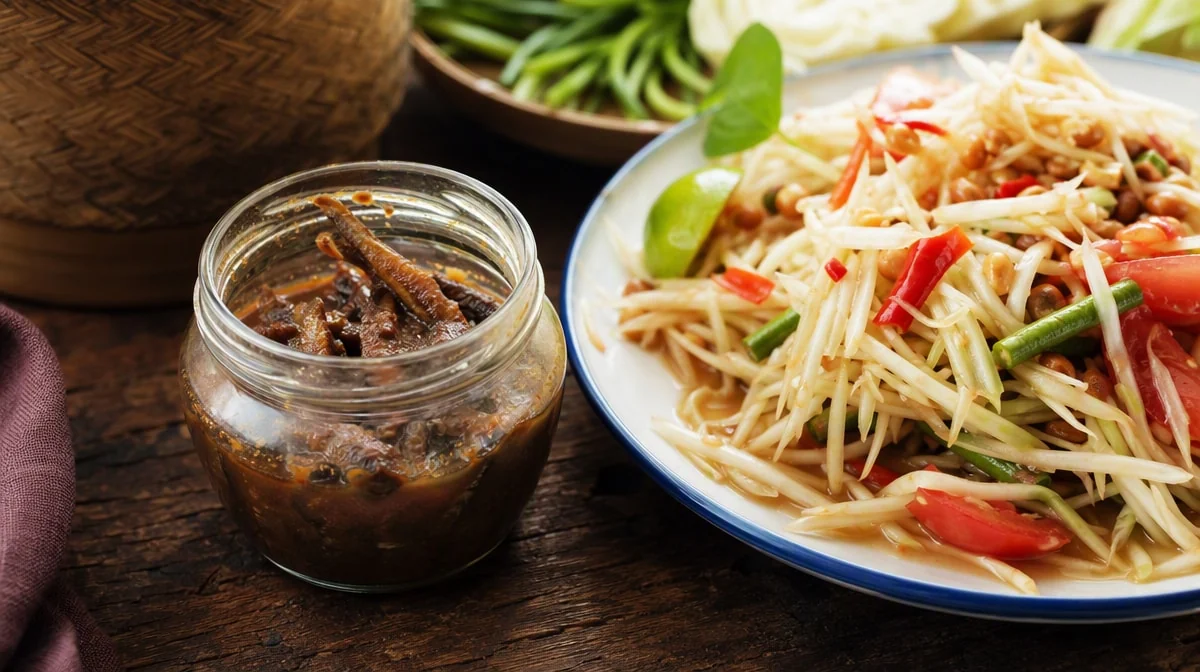
Pla ra is fermented fish from Isaan and Laos. Freshwater fish are packed with salt and rice bran or roasted rice powder and left for months, until the flesh breaks down into a dark, thick, intensely savoury seasoning. It is not fish sauce. It goes into the pot rather than onto a finished plate, and in Isaan it is close to essential.
The guidebook puts it more bluntly than a polite food page would. Outsiders, it says, are rarely fans of pla ra, "a fermented fish sauce (that looks like rotten mud)", but Isan people consider it almost essential for good cooking. "If your som dam doesn't have this, it's not real som dam." That is the argument in one line.
What Is Pla Ra?
Pla ra is made from freshwater fish, salt and rice bran or roasted rice powder. The fish are cut, salted and packed into a container, then left until the flesh softens. The rice bran goes in at the second stage, where it feeds the fermentation and adds colour and aroma. The whole process takes months, often six or more. The result is a dark brown paste or thick sauce with visible pieces of fish, a smell that carries across a room, and a savoury depth that fish sauce cannot copy.
The spelling varies. You will see pla ra, pla rah and plara on UK labels and menus. The Thai script is ปลาร้า. The word is also written with a tone mark in some romanisations; none of that changes the ingredient. If a label says "fermented fish sauce" and the ingredients include fish, salt and rice bran, you are in the right place.
It is a northeast ingredient first. The guidebook calls it Isan's fermented fish sauce and says it is almost essential for good cooking there. The regional pantry is on the Isaan food page. It also appears in Lao cooking, where the same family of preserved fish is central. The taste is salty, fishy, savoury and fermented, with a sour edge and a long umami finish. It is not subtle. A little goes a long way, and the smell is stronger than the taste in the finished dish.
The texture matters for how you use it. Some bottles are thin enough to pour; some jars are thick with fish pieces and need to be spooned. Both are pla ra. If a recipe says "100g pla ra", as the royal-cookery recipe for Pla Ra Nai Kala does, it means the thick product, not a tablespoon of fish sauce.
Pla Ra vs Fish Sauce (Nam Pla)

Fish sauce, nam pla, is the clear brown liquid that comes from fermenting small fish, usually anchovies, with salt. The fish and salt are packed together for 12 to 24 months, and the liquid that drains out is filtered and bottled. It is a seasoning: salty, savoury, clean, and thin enough to pour. You use it to salt a dish, not to define it.
Pla ra is the whole fish, plus rice bran or roasted rice, fermented until the flesh breaks down. It is not filtered to a clear liquid. It is thicker, darker, chunkier and much more pungent. Fish sauce adds salt and umami; pla ra adds salt, umami, fermented fish flavour and body. They are not interchangeable, and a recipe that calls for one will taste wrong if you use the other.
The practical difference is the amount and the moment. Fish sauce goes in at the end, to taste, and you can correct it. Pla ra goes in earlier, often pounded with chillies or simmered into a dressing, and it needs cooking or at least time to settle. You cannot fix an over-pla-ra dish by adding sugar the way you can rescue an over-salted one. Start small.
If you are new to pla ra, the closest familiar comparison is not fish sauce. It is closer to a strong anchovy paste or a fermented shrimp paste in intensity, but with its own sour, rice-fed flavour. The site's fish sauce guide and storage page cover nam pla; this page is about the other thing.
Pla Ra vs Padaek, Prahok and Bagoong
These are cousins, not synonyms. Pla ra is Thai. Padaek is Lao. Prahok is Cambodian. Bagoong is Filipino. All are fermented fish products, and all are salty and savoury, but they are made from different fish, with different salt levels and different textures.
Padaek is the closest relative. It is a Lao fermented fish product, often thicker and less filtered than fish sauce, with chunks of fish and a robust, funky profile. Wikipedia describes pla ra as "similar to padaek in Laos", which is a fair summary: close enough to understand one from the other, not close enough to swap without tasting the difference.
Prahok is the Cambodian version, a pungent fermented fish paste used in dishes such as amok and prahok ktis. The cookbook treats it as a pantry staple in Cambodian cooking, alongside fish sauce, and uses it in a recipe at anchor 201. It is a paste, not a pour-able sauce, and it is usually cooked into a dish rather than used as a table condiment.
Bagoong is the Filipino branch, a fermented fish or shrimp paste with its own regional variations. It is not a like-for-like replacement for pla ra. If you are following a Thai recipe, reaching for bagoong will give you a different flavour, not a shortcut.
The honest rule: if a recipe is Thai, use pla ra. If you cannot get it, padaek is the nearest cousin; prahok is next; bagoong is a different cuisine's answer. None of them is the same, and the page says so rather than pretending otherwise.
Pla Ra Substitute
There is no exact substitute. The closest is padaek, the Lao cousin, because it is also a fermented fish product with rice and fish, and it behaves similarly in a dressing. Prahok is the next closest, but it is thicker and usually cooked, so you need to adjust the amount.
Fish sauce is not a substitute, even though both are salty and savoury. Fish sauce gives salt and umami; it does not give the fermented fish depth, the sour edge or the body. If you use fish sauce in place of pla ra, the dish will taste clean and thin, not Isan.
If you cannot get any of the fermented fish products, the honest answer is to cook a different dish. Som tam thai, the central version, uses fish sauce and tamarind and is a complete dish in its own right. Do not make a pla-ra-less som tam pla ra and call it the same thing. The site's som tam recipe can guide you to the version you can actually make.
One more warning: do not add shrimp paste and call it a substitute. Shrimp paste is a different ingredient with a different fermentation and a different flavour. It belongs in nam prik kapi, not in place of pla ra.
How to Use Pla Ra in Som Tam

Som tam pla ra uses pla ra as the salty-fermented base of the dressing. You pound a small amount with the chillies, then add lime juice, palm sugar and the rest of the dressing ingredients. The pla ra is not a garnish; it is the thing that makes the salad taste Isan.
Start with one tablespoon for a two-person salad, and taste before adding more. The brand matters: some bottles are much saltier and more concentrated than others. If the dressing tastes flat after the pla ra, add lime, not more pla ra. If it tastes too fishy, add palm sugar and lime together; do not try to mask it with fish sauce.
The live som tam recipe carries the full method and the balance of the dressing. This page's job is the pla ra: how much, what it does, and why the dish is different from the central version. Use the recipe for the quantities and this page for the ingredient.
If you are using a jar with fish pieces, mash them into the dressing so they distribute. If you are using a pour-able bottle, shake it first. Pla ra separates, and the liquid at the top is not the whole story.
Som Tam Pla Ra vs Som Tam Thai
Som tam pla ra is the Isan version. It is funky, savoury and hot, with pla ra providing the fermented fish base. Som tam thai is the central version. It is sweeter and cleaner, with fish sauce, tamarind, palm sugar, dried shrimp and peanuts doing the work. Both are papaya salads. They are not the same dish.
The guidebook's line is the one to remember: if your som tam does not have pla ra, it is not real som tam, at least by Isan standards. That is a regional argument, not a national law. Central Thais eat som tam thai and are happy with it. The two versions exist side by side, and the names tell you which one you are ordering.
If you are new to pla ra, order som tam thai first. If you like it and want the louder version, try som tam pla ra next. If you are cooking at home, make the version you can shop for: the som tam recipe is the place to start, and the pla ra question is settled by what is in the cupboard.
Can You Buy Pla Ra in the UK?
Yes. It is not a mainstream supermarket line, but it is an Asian-grocer line and an online one. Look for bottles or jars labelled "fermented fish sauce", "Thai anchovy sauce" or "pla ra", and check for Thai script on the label. Mae Jum, a UK Thai food seller, says pla ra is available in many Asian supermarkets or on Amazon, and advises checking the ingredients and choosing one without unnecessary additives.
UK stockists found on 2026-11-02 include Tuk Tuk Mart, which sells Zab Mike Fermented Fish Sauce 350ml and describes it as pla ra; RaanThai, which lists fermented fish sauce and fermented anchovy sauce; Sing Kee, which lists the Zab Mike 350ml bottle; and Talard Thai, which sells Mae Sri preserved fish chilli paste and other pla-ra-based products. The brands are not identical: some are pure pla ra, some are papaya-salad dressings with pla ra, and some are chilli pastes. Read the label.
The label should tell you whether it is plain pla ra or a seasoned product. Plain pla ra is fish, salt and rice bran or rice. A dressing will list sugar, lime or preservatives as well. For cooking, plain is more flexible; for a quick som tam, a dressing is a shortcut with less control.
Do not buy fish sauce and assume it is the same. The bottles can sit next to each other on the shelf, and both say "fermented fish". The pla ra is the thicker, darker one, usually in a wider jar or a bottle with a screw cap and a warning about the smell.
Does Pla Ra Need to Be Refrigerated?
After opening, yes. The Zab Mike bottle says "Refrigerate after opening", and that is the standard advice for commercial pla ra. Before opening, keep it in a cool, dry place and follow the best-before date on the bottle. Once opened, the fridge slows the change in flavour and keeps the product from getting sharper than you want.
How long does it last? The bottle's date is the guide, not a universal number. Pla ra is a fermented product, so it does not spoil as quickly as fresh fish, but it does change: the colour darkens, the smell strengthens and the texture can separate. Use it within the date on the label, keep the cap tight, and do not leave the bottle open next to the hob.
The smell is the other storage issue. A jar of pla ra in a shared fridge will announce itself. Double-bag it or keep it in a sealed container, and keep it away from anything that absorbs odours. This is not a reason to avoid it; it is a reason to store it properly.
If the bottle has been open for a long time and smells different from when you bought it, or has mould, throw it out. The page does not give a "safe after X months" number because the product, the salt level and the fridge all change it. The label is the authority.
Is Pla Ra Healthy?
Pla ra is high in salt and strong in flavour, and it is not a health food. The more serious issue is safety. In July 2026, the Bangkok Post reported that thousands of university students in Maha Sarakham had tested positive for liver fluke, and that inspections were targeting undercooked pla ra at som tam shops. The liver fluke is a parasitic worm linked to raw or undercooked freshwater fish, and long-term infection is linked to bile duct cancer.
That does not mean pla ra is unsafe by definition. The doctor quoted in the report said: "If pla ra is produced to proper hygienic standards, fermented correctly and boiled before consumption, the risk is very low." The practical advice follows: buy a commercial product from a reputable shop, cook it into the dish where the recipe allows, and avoid raw or undercooked freshwater fish if you are pregnant, immunocompromised or cautious.
This is a page about an ingredient, not a medical advisory. If you have a health condition, ask a doctor. The point here is that pla ra is a fermented raw-fish product, and it deserves the same care as any raw-fish ingredient, not more fear and not less.
Frequently asked questions
Is pla ra the same as pla rah?
Yes. Pla ra, pla rah and plara are spelling variants of the same Thai fermented fish product. The Thai script is ปลาร้า. The spelling on a UK label may vary, but the ingredient is the same. Look for fish, salt and rice bran, and do not confuse it with fish sauce.
What does pla ra smell like?
Strong. It smells of fermented fish, salt and rice, with a sour, savoury edge that carries across a room. The smell is more intense than the taste in a finished dish, and it softens when the pla ra is cooked or mixed into a dressing. Store it sealed and in the fridge after opening.
Is pla ra the same as fish sauce?
No. Fish sauce is the filtered liquid from fermented anchovies and salt. Pla ra is whole freshwater fish fermented with rice bran or roasted rice, and it is thicker, darker and much more pungent. Fish sauce seasons; pla ra defines the dish. They are not interchangeable in a recipe.
Is pla ra vegetarian?
No. Pla ra is made from fish. Some Thai restaurants make vegetarian versions of Isan dishes with soy sauce and mushroom seasoning, but those are adaptations, not pla ra. If you are vegetarian, look for a som tam thai or a clearly labelled vegetarian som tam.
Can I use shrimp paste instead of pla ra?
No. Shrimp paste is a different fermented product, usually made from shrimp, with a different flavour and salt level. It belongs in nam prik kapi and other dishes. Using it in place of pla ra will not give you the same dish. Padaek, the Lao fermented fish, is the closest substitute.
Can you buy pla ra in the UK?
Yes. Asian supermarkets and online Thai grocers sell it, and Amazon carries some brands. Look for "fermented fish sauce" or "Thai anchovy sauce" with Thai script on the label. Check the ingredients: plain pla ra is fish, salt and rice bran, while some jars are seasoned dressings or chilli pastes.
Does pla ra need to be refrigerated?
After opening, yes. The bottle should say so, and the fridge slows the change in flavour. Before opening, keep it cool and dry and follow the best-before date. Keep the cap tight and double-bag it if the smell is a problem in a shared fridge.
How long does pla ra last?
Use the best-before date on the bottle. There is no single number that covers every brand, because salt level, packaging and storage all vary. After opening, keep it refrigerated, use a clean spoon, and discard it if it smells wrong or shows mould. It is a fermented product, not an immortal one.
Is pla ra healthy?
It is high in salt and is not a health food. The bigger issue is liver fluke, which is linked to raw or undercooked freshwater fish. Buy a reputable commercial product, cook it where the recipe allows, and follow the label. Properly produced, correctly fermented and boiled pla ra carries very low risk, the 2026 Bangkok Post report says.
Can I use fish sauce instead of pla ra?
No. Fish sauce gives salt and umami, but it has none of the fermented depth or the body that pla ra brings to a dish. A som tam made with fish sauce instead is a different salad. Use padaek or prahok if you cannot find pla ra. If neither is available, cook something else.



Comments