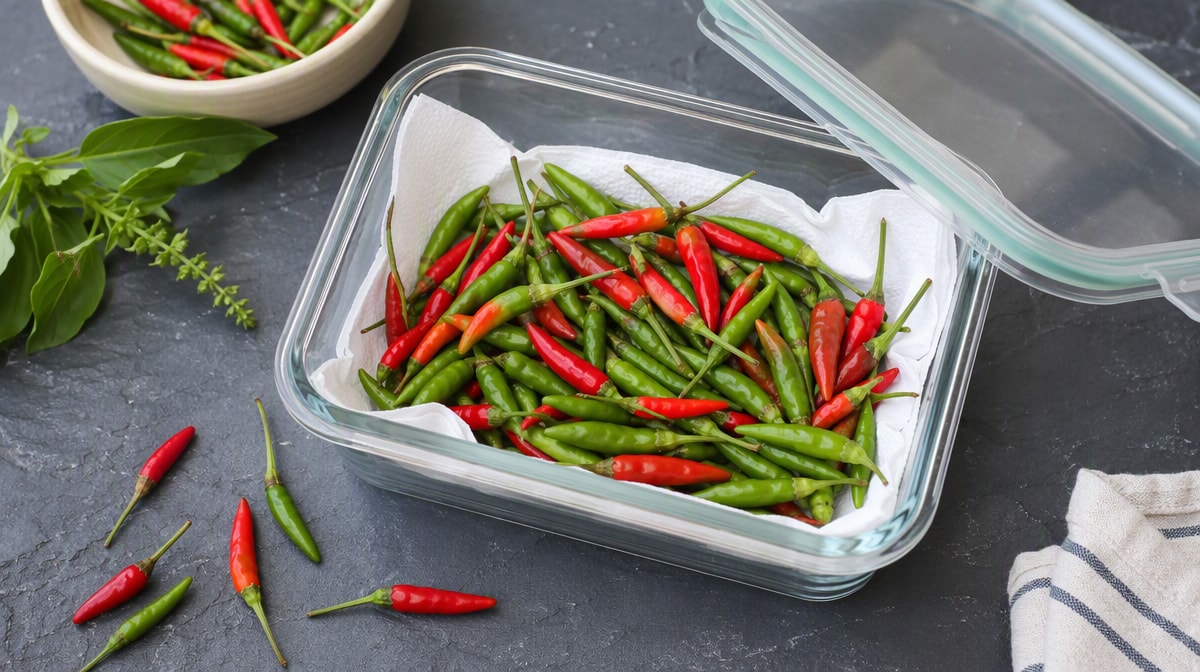
One to two weeks in the fridge, if you store them completely dry. Freeze them and you're looking at six to twelve months.
Two rules do most of the work. Store them dry, and take the stems off. That's it. Skip either and you'll have a bag of soft chillies turning black at the back of the fridge within a week.
Why Thai chillies need a decision at all
Unlike basil, chillies aren't a delicate tropical herb that wilts in a day. They're sturdy and they last. Storage is a question at all only because one market bag holds far more chillies than one cook needs in a fortnight, and Thai cooking uses a remarkable number of them.
It Rains Fishes notes that about two dozen different varieties are used, from tiny ones no larger than watermelon seeds to big ones the size of fava beans, each with its own unique flavour and degree of heat. A single dish may draw on two or three at once, and a paste may need several more.
So the question isn't how to keep a chilli fresh. It's how to stop a bag of them rotting in the back of your fridge while you use three at a time, and the method you pick depends entirely on what you're going to cook.
Pick the method by what you'll do with them
| Plan | Method | Life |
|---|---|---|
| Raw heat, cooking within days | Fridge, dry | 1 to 2 weeks |
| Curries, stir-fries, pastes later | Freezer | 6 to 12 months |
| Flakes, powder, curry paste | Dry | 6 to 12 months |
| A sour, tangy condiment | Pickle | Weeks to months |
| Table condiment, ground | Roast dry, then grind | 6 to 12 months |
This is the bit most storage advice rushes past. There's no single best method, because best depends on the dish.
And drying isn't just preservation. It makes a different ingredient. The same source puts it well: several kinds of chillies are used in their dried form too, which differ in taste from fresh chillies just like sun-dried tomatoes differ from fresh ones. Dried chillies are also roasted and ground for the condiment trays at the table, which is a use fresh chillies simply can't do.
Fridge: store them dry, take the stems off

One to two weeks. Some sources report up to a month with a good method, but plan on two.
Sort the bag first and take out anything bruised, soft or already going. One bad chilli spoils its neighbours within days, and chillies are thin-walled and soft. This is not a trim and save situation.
Take the stems off. This is the step most people skip, and it's the one that roughly doubles how long the bag lasts. Stems carry moisture, and moisture is what rots them. Thirty seconds with a pair of scissors.
Don't wash them. Store them dry, as they came. Washing introduces exactly the moisture you're trying to avoid.
Line a container or bag with a paper towel and put the chillies on it. The towel absorbs condensation.
Crisper drawer, not the door. Below 41F (5C), in a humidity-controlled space.
Some sources recommend a loose or breathable bag rather than an airtight box. The principle is the same either way: moisture is the enemy, air is fine.
Sliced or chopped, three to five days and no more. Cut chillies dry out and go mouldy fast. If you've prepped a batch, freeze it.
Freezer: the answer for most people
Six to twelve months, with the best flavour in the first four to six. For a whole bag of Thai chillies this is the single most useful technique on the page.
No blanching. Unlike basil, chillies don't need it, and several sources confirm it directly.
Wash them and dry them completely. This matters more here than almost anywhere. Moisture freezes into ice crystals and you get a bag of blackened mush instead of chillies.
Flash-freeze in a single layer on a baking tray for one to two hours. This is what stops them freezing into one solid brick.
Transfer to an airtight freezer bag or box, squeezing out as much air as you can.
Label with the date.
A vacuum sealer is the upgrade and it genuinely extends life. Some sources report peppers from over a year old still tasting fresh when properly sealed. Air causes freezer burn, and that's the whole mechanism.
Using frozen chillies
Add them straight to the dish. No thawing, and this is the big practical win. Drop frozen whole chillies into a hot wok or a simmering curry and cook them through. It is the same in pad krapow gai, where the chilli goes into a hot wok before the basil.
They're actually easier to chop frozen than fresh, because the cell walls have softened. A frozen chilli minces more readily than a fresh one.
The texture softens. Perfectly fine in curries, stir-fries, soups and pastes. Not suitable as a raw garnish, or anywhere the shape and bite are the point.
For paste, blend the chopped chilli with a little oil and freeze in ice cube trays. The cubes drop straight into a curry.
Drying: for flakes, powder and paste

Thai chillies are thin-skinned, which makes them some of the easiest chillies to dry. Hang bunches in a dry, ventilated spot, use a dehydrator, or a very low oven.
Drying only works properly if the chillies are completely, absolutely dry before storage. Insufficiently dried chillies go mouldy in the jar, and the mould ruins the batch.
Store sealed, away from light and heat, six to twelve months. Some sources say a year or more. Potency fades steadily, so use within six months for the best heat.
Drying is also the preparation step for roasting chillies into curry paste, which is a different technique from storage. See our guide to dry-roasting chillies for paste.
Pickling and oil: read this before you pack them in oil

Pickling in vinegar is easy and safe. Sliced chillies in rice vinegar with sliced garlic and shallot, refrigerated, keep for weeks and improve as they go. If you want something sharp and fermented alongside a curry, this is the method.
Oil is where the care is needed. Do not pack fresh chillies in oil at room temperature.
Garlic-in-oil and fresh-chilli-in-oil preparations, stored unrefrigerated, are a recognised botulism risk. Oil creates an oxygen-free environment, which is exactly what Clostridium botulinum needs, and the acid that protects you in a vinegar brine isn't present in oil.
If you're going to pack chillies in oil at all, they must be dried first and the jar must be refrigerated.
This isn't a mild caution. If you want a chilli oil, the safe sequence is: dry the chillies completely, cover them in oil, refrigerate, and use within a few weeks.
Troubleshooting the usual failures
A bag that goes slimy in a fortnight is nearly always one of three things: the stems were still on, the bag was washed before storing, or the chillies were bruised when you bought them. All three are avoidable and the first two take thirty seconds between them.
Frozen chillies that turn to mush have been thawed rather than used from frozen, or stored wet. The mush is ice crystals breaking the cell structure, and once that happens there's no recovering it. Dry them properly next time.
Dried chillies that go mouldy in the jar weren't dry enough when they went in. This is the one failure that wastes the whole batch, so err towards leaving them on the dehydrator an extra day rather than trusting the surface.
Chillies that shrivel and look like they've gone off usually haven't. A chilli drying out in the fridge concentrates rather than spoils, and for cooking that's usually an improvement. Look for slime or mould to tell the difference, not for wrinkles.
A whole bag ruined because one went over is why sorting at the point of purchase matters. Chillies touching a soft one go within days, and in a small bag one bad fruit takes the lot. Sort on the kitchen counter before you put anything in the fridge.
Signs they've gone
Slime, or leaking fluid, from a chilli.
Mould, especially white or grey fuzz.
Soft spots and wrinkling that spreads rather than drying out.
Dull, dark patches.
A sour smell when you open the bag.
Chillies can also simply dry out and shrivel in the fridge, and that isn't spoilage. The flavour intensifies as the water leaves, and wrinkled chillies are often better for cooking than plump ones. Shrivelling is fine. Slime is not.
Practical notes
Buy in bulk, then freeze. A large bag of fresh chillies from an Asian supermarket is only worth buying if you're going to freeze or dry them, otherwise you'll find soft black chillies at the back of the fridge in a fortnight. The same bulk-and-portion habit is what makes the hard aromatics worth buying in quantity: how to store galangal, lemongrass and kaffir lime leaves.
Freeze rather than refrigerating if you won't use them within two weeks. There's no sensible middle ground.
Keep two kinds on hand. A small bag in the fridge for this week's cooking, and a frozen bag for everything after. This is how Thai home kitchens actually manage it.
Heat fades in the freezer, though less than you'd expect. Some sources report heat largely retained when frozen correctly, others a noticeable loss after six months. Either way, frozen is far better than a fridge full of soft, dried-out chillies.
Storing the sauce instead
A practical alternative if you use a lot of chillies and can't keep up with the fresh stuff.
Blend sliced chillies in rice vinegar with sliced garlic and shallot, refrigerate, and you have a sharp, tangy condiment that keeps for weeks. Lean it further with fish sauce and a little sugar and it becomes a proper nam prik dip, keeping about a week in the fridge.
Keep them submerged. Anything sitting above the liquid line will eventually spoil, and in a fridge jar the top isn't reliably covered.
Slicing rather than leaving them whole means more surface area, so the brine penetrates quickly. If you want whole chillies that hold their shape, give them a couple of small slits instead.
Frequently asked questions
How long do fresh Thai chillies last in the fridge?
One to two weeks, stored completely dry with the stems removed and a paper towel in the container to absorb condensation. Some sources report up to a month with careful handling but plan for two. Sliced or chopped chillies only last three to five days, so freeze those instead.
Do you need to remove the stems before storing chillies?
It helps a great deal. Stems carry moisture and moisture is what causes chillies to rot. It takes thirty seconds with scissors and roughly doubles how long the bag lasts. Never wash them before storing, because the water is the thing you're trying to avoid.
Can you freeze Thai chillies without blanching?
Yes, and you should. Unlike basil, chillies don't need blanching. Wash and dry them completely, flash-freeze in a single layer for an hour or two, then move to an airtight bag. Complete dryness is the important part, because moisture turns them to black mush.
Do you need to thaw frozen chillies before using them?
No. Add them straight from the freezer to a hot wok or a simmering curry and cook them through. This is the main advantage of freezing over refrigerating. A useful bonus is that frozen chillies mince more easily than fresh ones, because the cell walls have softened.
Is it safe to pack fresh chillies in oil?
Not at room temperature. Oil creates an oxygen-free environment that supports botulism, and vinegar's protective acidity is absent. If you want chilli oil, dry the chillies completely first, cover them in oil, refrigerate the jar, and use it within a few weeks.
How long do dried Thai chillies keep?
Six to twelve months stored airtight and away from light and heat, though heat fades steadily so six months gives the best results. Thai chillies dry unusually easily because of their thin skins. Hang them in a dry ventilated place, or use a dehydrator or low oven.
Why have my chillies gone mouldy in the fridge?
Usually one of three causes: they were washed before storing, they weren't completely dry when you put them away, or the bag was sealed while still damp. Thai chillies must be stored bone dry with the stems off. Mould also appears where chillies were bruised, which is why sorting out damaged ones first is worth the extra minute.
Can I store chillies in oil instead?
You can, but they must be fully dried first and the jar must be refrigerated. Fresh chillies packed in oil and left at room temperature are a recognised botulism risk, because oil excludes the oxygen that Clostridium botulinum needs. Vinegar brines are safe at room temperature for a week or two in the fridge; oil is not.



Comments