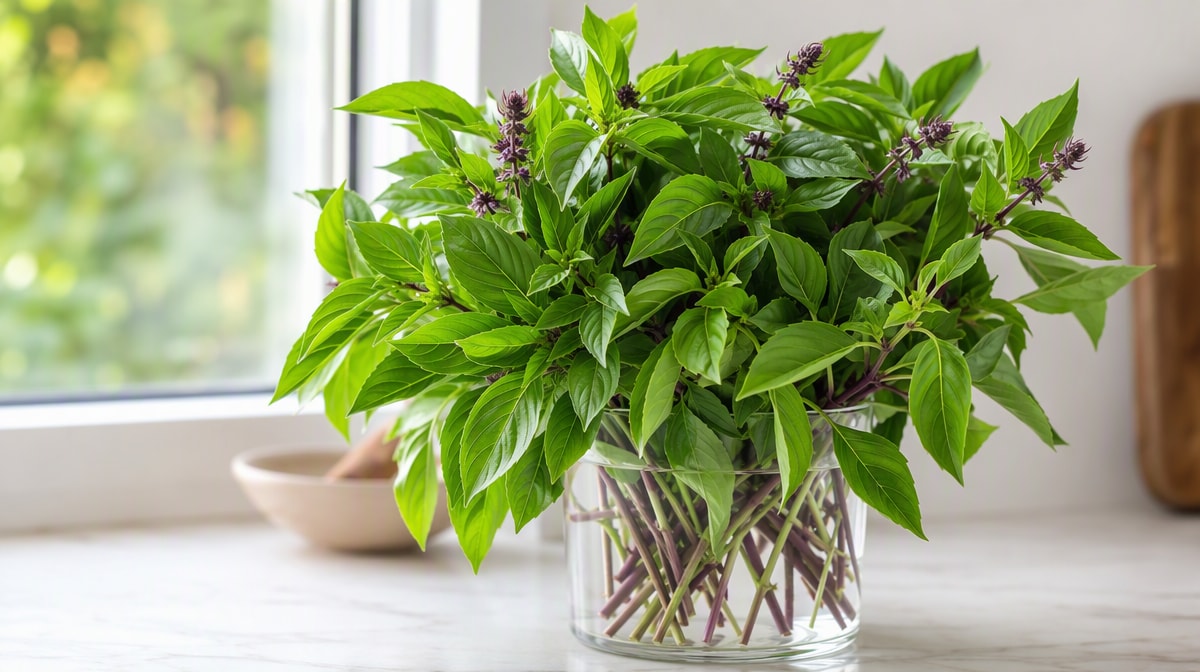
The best way to keep Thai basil isn't the fridge. Stand the stems in a glass of water on the counter, change it every couple of days, and you'll get a week to a fortnight out of a bunch, which is longer than the fridge will give you.
Thai basil is a tropical plant, and refrigeration is something it tolerates rather than enjoys. Below about 10C it suffers chill injury and the leaves blacken. The fridge is a short-term compromise. For anything beyond about a week, freeze it.
Why the fridge isn't the first choice
Most advice on storing basil is written about Italian sweet basil, which collapses in the fridge almost immediately. Thai basil holds up better. It's a tougher, more heat-adapted plant, with purple stems and a more robust anise and pepper flavour.
It's still a tropical herb that doesn't want to be cold though. Chilling injury below 10C turns leaves black, and the blackening is a physical breakdown rather than decay. Once it starts, you can't reverse it.
This is why the advice is so contradictory. The sources that recommend the fridge are generally writing about sweet basil. The sources that say never refrigerate it are generally writing about Thai basil. Both are right about their own plant.
My rule: room-temperature water for up to a fortnight, fridge for the last few days of that, freezer beyond it.
The water glass on the counter

This is the best method and it's almost free.
Trim the stems, about 3cm off the bottom, at an angle, so the cut end is open and takes up water. A clean diagonal cut rather than a flat one measurably improves uptake.
Stand the bunch in a jar of water. An inch or two is plenty. The leaves must stay above the waterline, because submerged leaves rot and go slimy within a day or two.
Cover it loosely with a plastic bag or a large lid. That holds humidity around the leaves without trapping them in condensation.
Keep it out of direct sun but in good light. A windowsill out of harsh midday sun is ideal.
Change the water every two or three days, and top it up in between.
Expect one to two weeks. Some sources report 7 to 10 days, others 14. Trim the stems when you change the water and treat anything past ten days as a bonus rather than a promise.
Don't use the florist's trick of a bag of water in the fridge for this. That's the next method, and it's a different one.
The same glass, in the fridge

If you've bought a big bunch and won't get through it in a fortnight, move the same jar into the fridge. Same setup, same loose cover.
Expect five to seven days, up to a fortnight in the best case. The water keeps the stems hydrated, which is the whole point, and it works far better than putting dry leaves in a bag.
Loose leaves: paper towel, or washed and spun
When you have leaves rather than a bunch with stems, there are two ways.
Damp paper towel is the fallback. Don't wash them first, or pat them very dry if you have, because residual moisture is the single biggest cause of rot. Wrap loosely in a barely damp paper towel, put it in a bag with a little air rather than sealed, and keep it in the crisper. Three to five days. Shorter than the water methods, but far better than a bag of naked leaves drying out, which is the usual default and which doesn't work.
Washed, spun and bagged is the longest-lasting fridge method if you intend to use the basil raw. Soak the leaves for five to ten minutes, then spin-dry them hard, two or three cycles, until they're genuinely dry to the touch. Bag with a paper towel to absorb what's left, and keep them in the crisper. Six days or more, and the leaves come out usable raw.
Andrea Nguyen at Viet World Kitchen insists on this for Thai basil specifically rather than the florist's approach, on the grounds that Thai basil is more fragile than its reputation suggests.
Washing does shorten the life. It's a trade: clean leaves that stay usable, in exchange for a shorter window than not washing at all.
How it compares
| Method | Duration | Notes |
|---|---|---|
| Water glass, counter | 7 to 14 days | Best overall. Do this. |
| Water glass, fridge | 5 to 7 days | Same jar, moved to the fridge |
| Washed, spun, bagged | 6+ days | Best for raw use |
| Damp paper towel | 3 to 5 days | Loose leaves only |
| Airtight container, dry | 5 to 7 days | Airtight is slightly risky |
| Sealed bag, no water | 1 to 3 days | What most people do. Worst option. |
Freezing for months

Freezing is where Thai basil genuinely excels, and it beats drying by a wide margin. Drying turns Thai basil bitter and loses the anise aroma that's the entire point of the plant. Frozen, it keeps it.
Four to six months for best flavour, up to a year technically safe. Use it within six months.
Blanch and freeze, the best method for whole leaves
Blanch for 2 to 10 seconds in boiling water. This is the critical step: heat destroys the enzymes that cause blackening on thawing, and it stops the leaves going black and slimy.
Shock in ice water immediately to halt the cooking.
Pat completely dry. Every method here reduces to this. Residual moisture freezes into ice crystals and turns the leaves to mush.
Freeze flat in a single layer on parchment-lined trays. Flash-freezing stops them clumping into one solid block.
Once hard, transfer to an airtight bag or box, removing as much air as you can.
Label with the date.
Ice cubes, with water not oil
Chop the leaves, pack them into ice cube trays, cover with water, freeze overnight, then tip the cubes into a labelled bag. One cube is roughly a tablespoon, about what a curry for two people needs.
Use water, not olive oil, for anything Thai. Oil is the more popular recommendation in general herb-freezing guides and it does work, but Andrea Nguyen is direct that it doesn't sit well with Southeast Asian dishes. It changes how the herb behaves in a wok.
Using frozen basil
Add it at the end of cooking, in the last few minutes, so the aroma survives. It's excellent in pad krapow gai, in curries, in soups.
It doesn't work raw. Thawed basil collapses and the texture is gone. Never use it as a garnish or in a salad.
Use about a third more than the recipe calls for. Freezing costs some intensity and that's the standard adjustment. It won't offend anyone and you won't notice it in a curry.
The sauce alternative
If you use a lot of basil and can't keep up with the fresh stuff, blend Thai basil with fresh garlic and a little oil into a sauce. Sealed in the fridge it keeps one to two weeks. Swapped to garlic powder instead of fresh garlic, up to six months.
It won't be the same as the raw leaf, but it's genuinely useful in a stir-fry and it beats a bunch that has turned black in the fridge.
What goes wrong
Washing before storing. Moisture accelerates decay more than anything else, and if you wash, spin it properly.
Airtight containers with no air. Basil needs some circulation. A loose bag or a cloth cover beats a sealed box, which traps condensation and rots the leaves.
Fridge doors and drawers near fruit. Apples, bananas and pears give off ethylene gas, which makes leaves yellow and limp.
Overcrowding. Crushed leaves bruise and turn black at the contact points.
Straight from the market into a plastic bag. Whatever the shop sealed isn't going to keep it for two weeks.
Signs it's gone
Yellow or brown leaves, particularly starting at the edges.
A limp, floppy texture. It should still have some structure.
White fuzzy mould, especially at the stem joins.
A foul smell, rather than the normal anise and pepper scent.
Blackening on otherwise healthy leaves, in the fridge, is chill injury rather than spoilage. The leaves aren't dangerous but they won't recover. Trim them back and use what's left.
A note on fresh Thai herbs generally
Vatch's Thai Cookbook makes a point about mint that applies here: it must always be used fresh and cannot be kept for long, and after 24 hours it will begin to wilt. Dried mint is never used in Thai cuisine. The hard aromatics that sit next to the herbs in the basket behave the other way round and keep for weeks: how to store galangal, lemongrass and kaffir lime leaves.
That's the wider attitude. Thai cooking leans on herbs that are bought fresh and used the same day, and it's why the water glass matters more than it would for, say, parsley. The fridge and freezer methods are what let us bridge a supply chain built for something else.
Thai basil is also the one worth the effort of sourcing properly. As Dancing Shrimp puts it, holy basil, the krapow leaf that is the beloved one among Thai cooks, is "decidedly tropical and requiring more heat to grow than Thai basil", and in many markets has to be flown in from Hawaii. If you're keeping it fresh, keep the good stuff.
For what the three varieties actually are, and which to buy, see our guide to Thai basil.
Frequently asked questions
Should I refrigerate Thai basil?
Not as a first choice. Thai basil is a tropical plant and suffers chill injury below about 10C, which turns the leaves black. Stand it in water on the counter for up to two weeks instead, and only move it to the fridge for the last few days of that.
How long does Thai basil last in the fridge?
Five to seven days with the stems in a water jar, six days or more if you wash and spin-dry the leaves first, and only three to five days wrapped in damp paper towel. An airtight container with dry leaves gets five to seven days but risks condensation.
How do I keep Thai basil fresh for weeks?
Trim the stems at an angle, stand the bunch in a jar of water with the leaves above the waterline, cover loosely with a bag, and change the water every two or three days. Keep it out of direct sun. This lasts one to two weeks, longer than the fridge will manage.
Can you freeze Thai basil?
Yes, for four to six months with the best flavour, up to a year technically. Blanch the leaves for 2 to 10 seconds, shock in ice water, dry them thoroughly, then freeze flat before transferring to an airtight box. Or chop and freeze in ice cubes covered with water, not oil.
Should I blanch Thai basil before freezing?
Yes, it's the step that makes freezing work. Blanching for 2 to 10 seconds destroys the enzymes that otherwise turn the leaves black and slimy on thawing. Shock in cold water, dry completely, and the colour holds.
Why are my Thai basil leaves turning black?
In the fridge, that's chilling injury from cold temperatures rather than decay. Thai basil is tropical and doesn't tolerate being kept below about 10C. The damage is irreversible, so trim the black leaves and use the rest, or move your storage method to the counter.
Can I use frozen Thai basil raw or as a garnish?
No. Thawed basil collapses completely and the texture is gone. Use it only in cooked dishes, added at the very end so the aroma survives, in curries, soups and pad krapow. Use about a third more than the fresh recipe calls for to compensate for lost intensity.
Does dried Thai basil work as a substitute for fresh?
Poorly. Drying turns Thai basil bitter and loses the anise aroma that defines it, which is why freezing is strongly preferred if you need to preserve it. If you want a long-lasting concentrate, blend fresh leaves with garlic and oil into a sauce instead. It keeps two weeks in the fridge, or six months with garlic powder rather than fresh.




Comments