First, a naming trap, because the English word "morning glory" gets used loosely and it matters here.
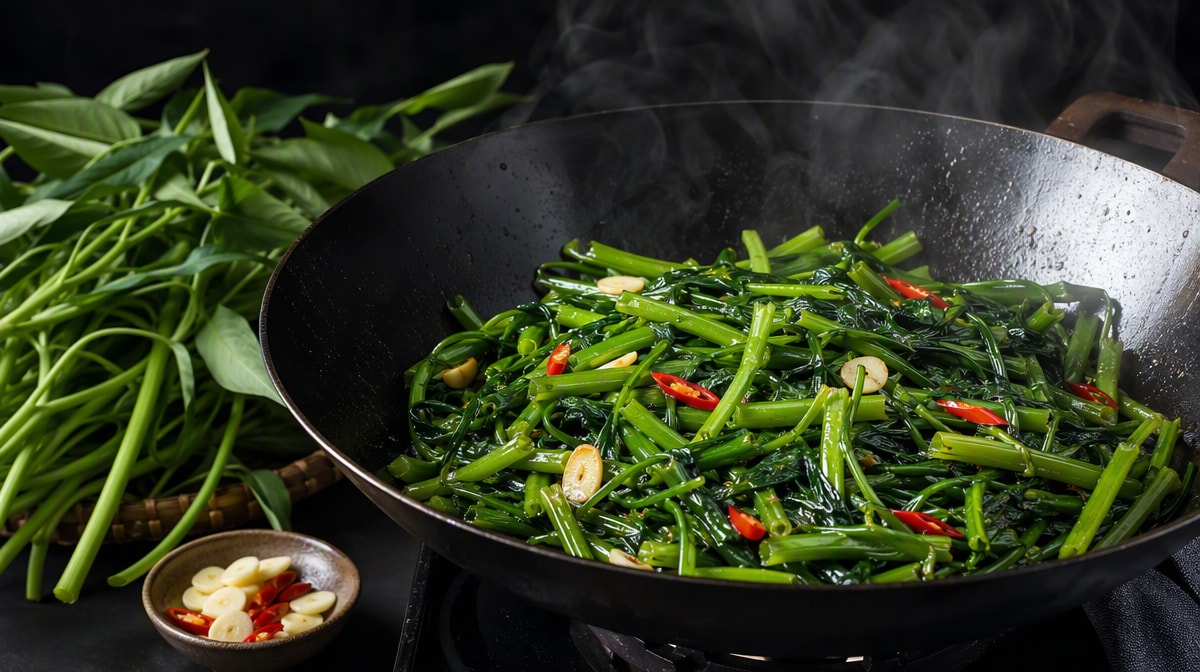
Morning glory is water spinach, called pak boong, kangkong or ong choy depending on where you are. It has hollow stems, dark green leaves, and it's a leafy green. In Thailand it's one of the most common vegetables there is, and in a good week you'll see it in every single market.
It is not a long bean. Thai long beans are tua fak yao, a completely different vegetable: a slender green bean pod, no leaves, closer to a French bean but much longer. If a shop labels something "morning glory" and it's a long thin pod, the labelling is wrong. If it's a bunch of leafy stems, it's right.
The confusion is common enough that it's worth a line in any recipe. I'll cook water spinach here, and mention long beans at the end because the technique is similar enough to be useful.
What it actually tastes like
Water spinach has a mild, slightly sweet flavour with a faint peppery note, and almost no bitterness when it's cooked properly. The stems are the interesting part: they're crisp, hollow, and slightly sweet, and they hold their bite while the leaves go soft.
That combination is the whole point of the vegetable. A dish where the stems and leaves cook together and end up the same texture is a badly cooked dish, and it's the most common way it goes wrong.
Fresh, tender water spinach barely tastes of anything and needs a lot of flavour. Older, tougher stems develop a real mineral, grassy flavour, and hold their texture better, so they're better suited to a curry or a soup where there's liquid to work with.
19 kcal per 100g raw, and rich in vitamins A and C, iron, calcium and magnesium, which is a decent nutritional profile for something that costs almost nothing and appears in every market in the country.
Choosing it

Water spinach is sold in bunches at Asian supermarkets, and freshness is obvious if you know what to look for.
Look for bright green stems and bright green leaves. Yellowing at the leaf edges means it's been sitting, and it'll cook down to nothing.
Do the snap test. Take a stem and bend it. If it snaps cleanly with your fingers, it's tender. If it bends without breaking, it's fibrous, and either the stems need longer or the leaves need to go in first and the stems later.
Discard the woody parts. The thickest ends of the stems and anything that doesn't snap are tough and unpleasant, and there's more usable vegetable in a good bunch than people assume.
Expect sand. Hollow stems that grew upwards trap water and grit in the base of the plant, and this is the single most common complaint about water spinach. It needs proper washing, more than you'd expect for a leafy green.
On that, a note on safety. There have been reports in various countries of water spinach testing high in heavy metals and other pollutants, partly because of where it's grown and partly because it takes up contaminants readily from soil and water. Chinese regulators have repeatedly found levels above national limits in imported water spinach. If you're buying it, buy it from somewhere that turns its stock over, and don't be alarmed by the washing. The washing is worth doing properly regardless, because of the sand.
Washing it properly

This is the step that decides whether the dish is good.
Wash it two or three times in cold water, running water if you can, and work the water through the stems. The grit hides in the hollow sections and at the base of the bunch, and a quick rinse under the tap won't shift it.
Then trim. Cut off the roots and the bottom few inches of the stalks, which are the most fibrous part, and cut the bunch into 2 to 3 inch pieces.
Keep the stems and leaves separate at this point. It's unglamorous and it's the technique that matters. Stems take longer than leaves, and if you throw them in together the leaves overcook to sludge while the stems are still hard. Separating them and cooking the stems first for a few seconds is the entire method.
The dish: pad pak boong fai daeng

Fai daeng means fire red, and it's the canonical way to cook this. Garlic, chilli, oyster sauce, fermented soybean paste, and very high heat.
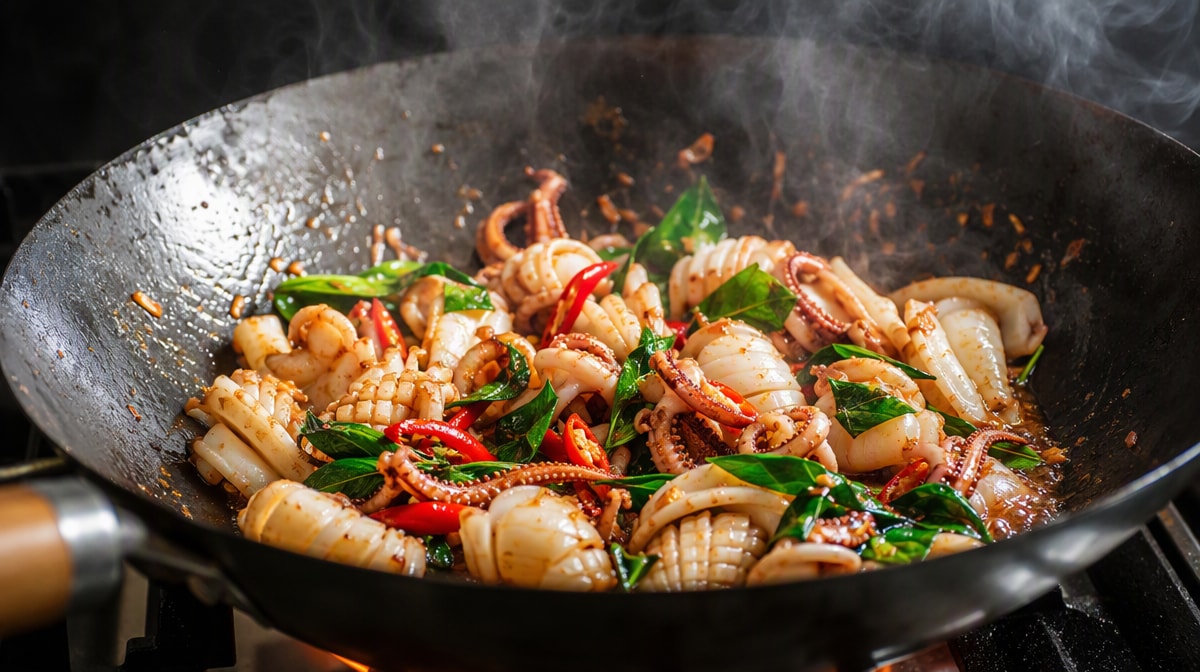
Everything is high heat, and that's not a stylistic flourish. This dish cooks in two to three minutes total and it needs a wok that's genuinely hot, for the same reason a squid stir-fry does. A cool pan steams the leaves, and steamed water spinach is a grey, slimy, unpleasant thing.
Mix the sauce before you start. Oyster sauce, soy sauce, a little sugar, soybean paste, and a splash of water. Having it ready matters more here than in most stir-fries, because the cooking window is so short that measuring things mid-cook means the leaves sit and cook.
Then: hot wok, oil, garlic and sliced chilli first, thirty seconds. Stems in next, still hot, another thirty seconds. Sauce in, then the leaves, and toss hard until the leaves are just wilted and the stems are still bright green and crunchy. Two to three minutes, no more.
Serve it immediately. It does not reheat well and it does not hold. Water spinach is a dish you eat the moment it's off the heat, and that's a bigger constraint than it sounds.
The heat is the technique
Worth stating plainly, because this is the failure point.
A domestic pan on a domestic hob will not get hot enough, and a big pan of water spinach will steam in its own liquid. The leaves go dark and limp, the stems go soft, and you get the grey dish that gives water spinach a bad reputation it doesn't deserve.
Workarounds, in order of preference. Cook less at a time, so the wok isn't crowded. Use a gas hob rather than electric. Dry the greens properly after washing, because water in the pan is steam. And if you have a home oven, heat the pan dry in the oven first, then bring it out and add the oil.
There's a real argument that water spinach is the vegetable most damaged by an inadequate hob, more than any other. If your stir-fries come out limp, the wok is too cool.
The sauce, built properly
The sauce is what makes it a Thai dish rather than cooked spinach, and it's worth understanding the components rather than following a recipe blindly.
Oyster sauce for the savoury and sweet base. Fermented soybean paste, which is salty, funky and savoury, and is the ingredient people most often leave out. Soy sauce for salt. A little sugar, because soy and oyster sauce are not sweet on their own and Thai stir-fry sauces are balanced. Fresh garlic, plenty of it. Chilli, either sliced fresh for heat or nam prik pao for depth and a deeper colour.
Soybean paste does much of the salt work, so be careful with the soy sauce. It's a strong ingredient and it's easy to oversalt a dish with no protein in it to dilute the flavour.
Fish sauce works in place of some of the soy, if you prefer, and many Thai home cooks add a small amount even to a vegetarian version of the sauce, because it adds a savoury depth that soy alone doesn't.
Adapting it
Vegetarian, and it's an easy change. Omit the oyster sauce and add more fermented soybean paste, or use a vegetarian oyster sauce, and add a little more sugar to compensate. The dish is arguably better this way, because the soybean paste's funk is the point.
With protein, and this is common. Minced pork, which is the most typical addition and turns it into a proper one-plate meal. Crispy pork belly. Dried shrimp, which adds a depth that no fresh ingredient replicates. Or a fried egg on top, which is a street food move and very good indeed.
In a curry, water spinach goes in at the end and doesn't get cooked long. Green curry with water spinach is a well-known dish, and the vegetable goes in for the last minute or two. Any longer and it disappears.
The other Thai dishes
Som tam gets shredded morning glory rather than the green papaya more Western cooks expect, and it's a genuinely good use of it, particularly with green mango.
Yad sai kin, clear noodle soup, uses the shoots and young stems, which are the sweetest part.
And there's a hot-weather dish worth knowing about: stir-fried morning glory with chilli and garlic on its own, with almost nothing else. It's the simplest thing on this page and one of the best.
If long beans is what you actually want
A short section, because the two are often confused and because long beans are an excellent vegetable in their own right.
Long beans, tua fak yao, are 30 to 45cm long slender pods. Select them young, 30 to 45cm, slender and flexible, and snap one if you can. The crisper it snaps, the fresher it is. Avoid pods with brown spots or holes, which is insect damage, and avoid bumpy pods with loose air pockets under the skin, which means over-mature and dry.
Cook them by stir-frying at high heat for two to three minutes, cut into 5cm lengths so they cook evenly, until bright green and still crisp. Blanching for a minute first gives a more tender result.
The Thai preparations are the same family as water spinach's. With garlic and oyster sauce. With nam prik pao. With minced pork. Or in a curry, where they go in whole or halved rather than chopped.
And if you can't get either, French beans or snap peas work. The texture is closer and the flavour is less interesting, but the dish works.
Buying it, in the UK
Morning glory is one of the easiest Thai vegetables to find here, which is unusual given how many Thai greens are hard to get.
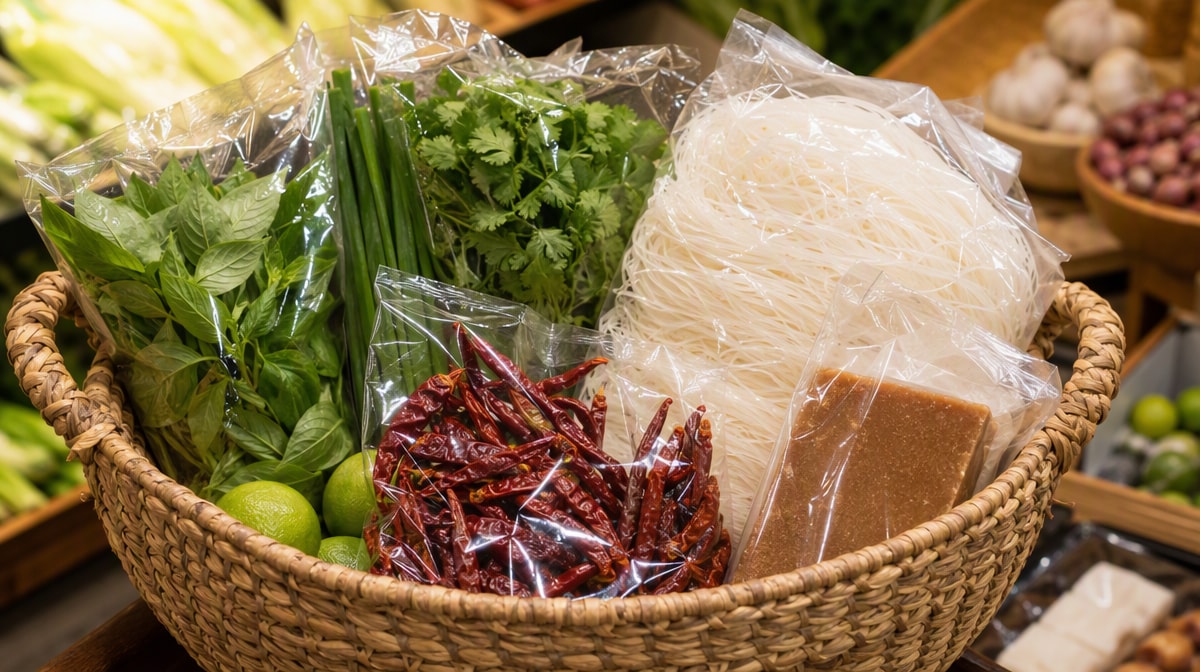
Look in the fresh produce section of any Chinese, Japanese or Vietnamese supermarket. It's usually labelled water spinach, ong choy or kangkong, and it's nearly always sold in large bunches, because it's cheap and it sells by weight. Some shops also stock it loose by the kilo, and in summer a couple of the bigger London shops will have it growing in a trough outside, which is the version that hasn't travelled anywhere.
Expect to use about half a bunch for two people. They lose a good proportion of their weight when trimmed, because you lose the roots, the bottom of the stalks and anything that doesn't snap, and then you lose more again when they cook down.
And check the leaves are still attached and bright. Water spinach is often sold with most of the leaves already picked off, which isn't a problem, but a bunch whose stems have gone pale and rubbery is a bunch that's been sitting.
If a shop is growing it, buy it. It will be the freshest you'll get and it's the best possible introduction to the vegetable.
A note on sources
The selection and cooking material is consistent and practical, and the snap test in particular appears in several independent sources, which is a good sign. The heavy metals material is real and worth reading, though the picture is complicated and the reporting varies by country. The nutritional figures are standard. The dish descriptions come from sources describing a well-known dish rather than from testing, and I'd follow your own judgement on seasoning.
Frequently asked questions
Is morning glory the same as long beans?
No, they're entirely different vegetables despite both being sold under the name. Morning glory, or water spinach, is a leafy green with hollow stems, called pak boong or kangkong. Long beans, or tua fak yao, are slender green bean pods with no leaves, closer to a very long French bean. The English naming overlaps confusingly, so check the shape before you cook.
Why does my stir-fried morning glory go grey and slimy?
Almost always because the pan wasn't hot enough. Water spinach needs genuine high heat and cooks in two to three minutes, and a crowded cool pan steams it instead, which turns the leaves grey and slimy. Cook less at a time, use a gas hob, dry the greens well after washing, and cook in batches rather than one large load.
How do you prepare morning glory before cooking?
Wash it two or three times in cold water, working the water through the hollow stems, because grit traps in the base of the bunch. Trim off the roots and the woody bottom few inches, cut into 2 to 3 inch pieces, and keep the stems and the leaves separate. Cooking the stems first for a few seconds, then adding the leaves, is what stops the dish being half raw and half mush.
Should I add the stems and leaves at the same time?
No, not if you want the dish to work. The stems take longer than the leaves, so adding them together means the leaves overcook to sludge while the stems stay hard. Stems in first for about thirty seconds, then the leaves for another thirty. This is the single technique that separates a good pad pak boong from a disappointing one.
What is nam prik pao and can I use it with morning glory?
Nam prik pao is roasted chilli paste, a staple condiment in Thailand made from chillies, shallots, garlic and shrimp paste. It's an excellent addition to a morning glory stir-fry, giving a deeper colour and more savoury depth than fresh chilli alone. It's widely available in the UK in the Asian aisle and our [roasted chilli paste guide](/how-to-dry-roast-thai-chillies/) covers making it from scratch.
Can I grow morning glory at home?
Yes, it's one of the fastest-growing and most productive vegetables you can grow, and it thrives in heat and moisture. Sow in warm soil, give it sun and water, and harvest the shoots and young stems constantly, which keeps it producing. It's a climber or trailing plant, so it needs support, and it can grow remarkably fast in a season.
Can I freeze or reheat morning glory?
Freezing is possible but not worthwhile, because the texture collapses into mush on thawing. It keeps three to four days in the fridge in a bag or container. Reheating is the bigger problem: cooked water spinach doesn't hold, so it's a dish to cook and eat immediately rather than to make ahead.
What can I use if I can't find morning glory?
Chinese broccoli, or gai lan, is the closest substitute in terms of texture and cooking method. Choy sum, bok choy, tenderstem broccoli and spinach all work, with spinach being the furthest from authentic because it collapses almost immediately. Whatever you use, apply the same rule of cooking the stems before the leaves.

Comments