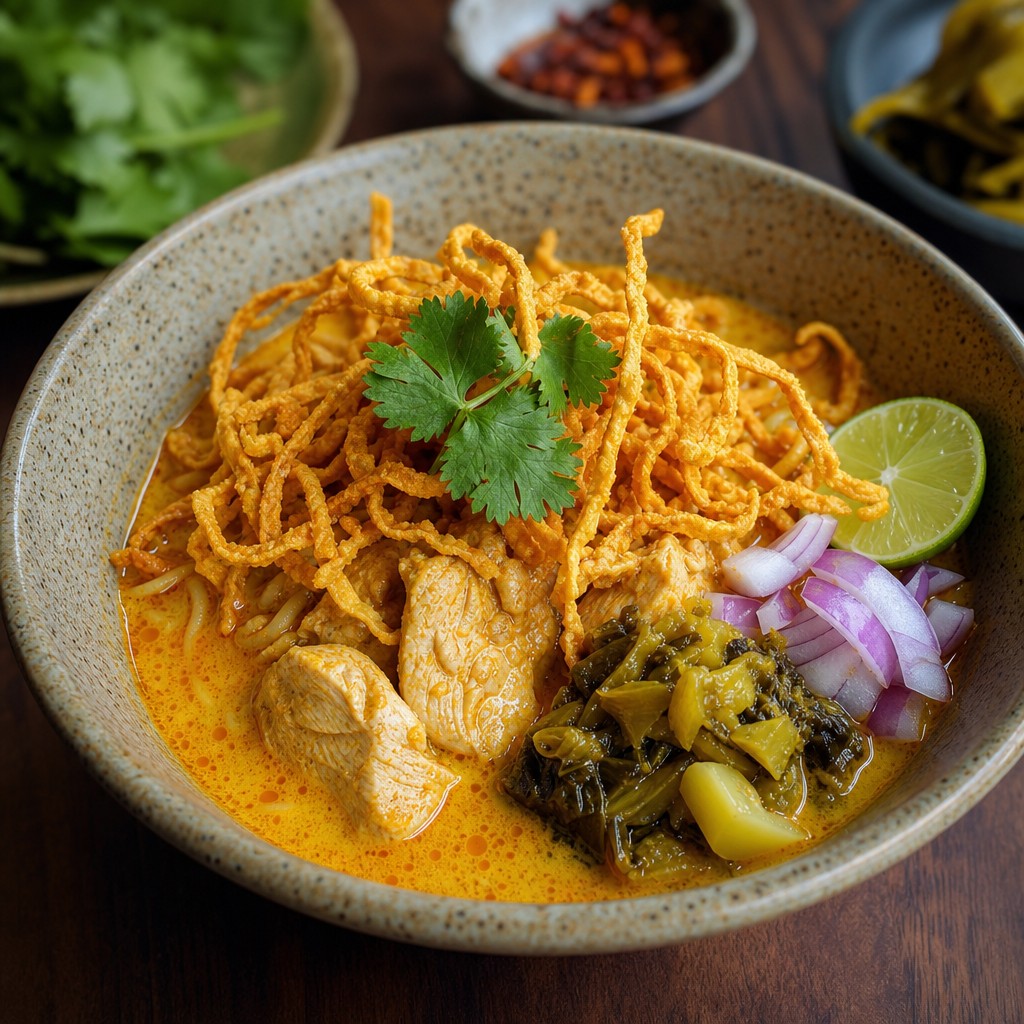
Chiang Mai eats like the north, not like Bangkok. The dishes to know are khao soi, sai ua, nam prik num, nam prik ong and gaeng hang lay, eaten with sticky rice and sold in markets as often as in restaurants. Coconut milk is rare here, the heat is lower than in the south, and the flavour comes from herbs, bitterness, fermentation and dried spice.
That makes Chiang Mai a useful place to eat if you already know central Thai food and want to understand what changes when you go north. The names on the menu will look familiar in places. The cooking behind them will not.
What to Eat in Chiang Mai
Start with the five dishes that define the city's table. Khao soi is the curry noodle soup, rich and mild, with soft egg noodles under a nest of crisp fried ones. Sai ua is the grilled pork sausage packed with lemongrass, galangal, kaffir lime and dried chilli. Nam prik num is the smoky dip of roasted green chillies, shallots and garlic. Nam prik ong is the milder tomato and pork dip. Gaeng hang lay is the slow-cooked pork curry with ginger, tamarind and pickled garlic.
Around those five sits the rest of the northern repertoire: sticky rice, pork crackling, parboiled vegetables, fried banana blossoms, laap khua (the dry-fried northern meat salad), kanom jeen nam ngiao (rice noodles in a tart pork and tomato broth), and the grilled meats sold at every evening market. The cooking leans on pork, vegetables and deep frying, with less sugar and less coconut than the central kitchen.
Chiang Mai is the old capital of Lanna, and the food still carries that court-and-country divide. The market stalls sell the everyday version, cooked in big trays and bagged to take away. The restaurants sell the same dishes in slightly more comfortable surroundings. Neither is more authentic than the other. They are the same kitchen at different prices.
For a cook, the useful thing to notice is the structure of a northern meal: sticky rice, a dip, a grilled or fried item, a vegetable, and perhaps one wet dish, rather than rice plus three curries plus a soup. The dip is the centre, not a condiment. Once you see that, the rest of the menu makes sense.
Khao Soi

Khao soi is the dish most visitors already know by name, and the one that most clearly shows the north's outside influences. It is a coconut curry broth with wheat-and-egg noodles, topped with a handful of the same noodles fried until crisp. On the side go pickled mustard greens, sliced shallots, lime and chilli oil.
The curry is milder than a central Thai curry and more aromatic. Roasted coriander root, ginger, shallots, dried chilli and turmeric go into the paste, and roasted black cardamom gives the broth its faintly medicinal, perfumed edge. Chicken is the common version, beef the other. The side garnishes are there to be added a little at a time, not tipped in at once.
The origin story usually points to Chinese-Muslim traders from Yunnan, the Chin Haw, who worked the caravan routes through Burma, Laos and northern Thailand. The guidebook calls it probably Burmese in origin and says it was likely introduced by travelling Chinese merchants. Both versions agree on the shape of the dish: a curry noodle soup that arrived from outside and became the north's own.
Khao soi is the exception in the northern kitchen, not the rule. It uses coconut milk, which most northern dishes avoid, and it uses wheat noodles in a region that eats rice. Think of it as the city's most travelled dish rather than its most typical one. For the full history and method, see the khao soi page.
Sai Ua
Sai ua is a grilled pork sausage, and it is the snack you will smell before you see it. The meat is mixed with lemongrass, galangal, kaffir lime leaf, garlic, shallots, dried chilli and fish sauce, then packed into a casing and grilled over charcoal. The herbs are fresh and generous. The chilli is present but rarely brutal.
It is not the same sausage as Isaan sai krok. Sai krok is fermented, sour and small, made for the northeast's sticky-rice meals. Sai ua is fresh, coarse and herbal, and it belongs to the north's grilled-meat tradition. In Chiang Mai it is sold by the link at markets, sliced into a nam prik platter, or eaten with sticky rice and raw cabbage.
The texture matters. A good sai ua is coarse enough to taste the pork, moist enough to hold together, and fragrant all the way through rather than perfumed at the edge. It is usually eaten warm, not hot, and it improves with a dip of nam prik num and a piece of raw ginger or cabbage.
If you are shopping for it rather than eating it on the spot, buy it from a stall with a fast turnover. The sausage is fresh, not cured, and it does not keep like salami. It will sit happily in a fridge for a day or two and it freezes, but the herbs fade. This is a food to eat close to where it was made.
Nam Prik Num and Nam Prik Ong
The two northern dips are often served together, and they do different jobs. Nam prik num is the hot, smoky one. Green chillies, shallots and garlic are grilled until blistered, then pounded with salt or fish sauce. The result is sharp, bitter-edged and fragrant, with the heat of the green chilli rather than the sweetness of a ripe one.
Nam prik ong is the mild one. Minced pork and tomatoes are cooked down with a dried-chilli paste until the mixture is thick and sweet-sour, closer to a ragu than a sauce. The guidebook calls it a chilli dip of Shan origin and a "northern Thai bolognese of sorts", which is a fair description of both its texture and its job. It is the dip to start with if nam prik num is too much.
Both are eaten with sticky rice, parboiled or raw vegetables, and pork crackling. The rice is rolled into a ball, dipped, and eaten. The vegetables are for scooping and cooling. The crackling is for salt and crunch. A northern table will often have one dip and a plate of vegetables rather than several curries.
For the wider family of Thai dips, including the central and southern versions, the nam prik family guide covers the rest. It is not linked here because it is not yet published.
Gaeng Hang Lay
Gaeng hang lay is the festival curry. It is a rich pork curry, usually made with belly, cooked slowly with ginger, turmeric, tamarind, pickled garlic, peanuts and a dried-spice paste. The guidebook traces the name to Burma: hang is a corruption of the Burmese hin, meaning curry. It is the dish you see at ceremonies, temple fairs and family gatherings rather than at an everyday stall.
Unlike most Thai curries, it is not built on coconut milk. The north rarely uses coconut, and hang lay gets its richness from the pork fat, the peanuts and the long cooking. The flavour is sour, savoury and gently sweet, with the ginger and pickled garlic doing more work than chilli. It is mild by Thai standards and deeply savoury by any standard.
The curry is often served with sticky rice and pickled vegetables. The sauce is thick enough to coat the rice without turning it to porridge. If you see it on a menu in Chiang Mai, order it. It is one of the clearest tastes of the north's Burmese and Shan connections, and it is not a dish that travels well outside the region.
The recipe and method belong on the gaeng hang lay page. It is not linked here because it is not yet published.
Khao Soi and Other Northern Noodles
Khao soi is not the only noodle in Chiang Mai, but it is the only one most visitors learn. The others are worth knowing because they show what the north does when it is not borrowing from Burma or China.
Kanom jeen nam ngiao is the main alternative. It is thin rice noodles in a tart, dark broth of pork or beef and tomatoes, flavoured with the dried kapok flower, dok ngiew. The broth is sour and faintly bitter, and the dish often includes cubes of set pork blood. It is a breakfast noodle in many parts of the north, and it tastes quite unlike khao soi: no coconut, no curry powder, no crisp noodle nest.
Then there is the family of rice-noodle bowls that belong to the centre rather than the north. Boat noodles, the intense pork or beef bowls once sold from canals, are a central Thai dish. So is the ordinary kuay teow nam, the clear-broth noodle soup sold everywhere. In Chiang Mai you can eat all of them, but only kanom jeen nam ngiao and khao soi are the local argument.
The practical difference is the broth. Khao soi is rich, mild and coconut-based. Nam ngiao is sour, thin and herbal. Boat noodles are dark, strong and medicinal with herbs and blood. If you order by name and expect the same bowl you had in Bangkok, you will be surprised. Order by the description instead.
Northern Thai Food Markets

The market is where the northern kitchen is most itself. The guidebook makes the point that outside the big cities, most authentic local food is sold from stalls in "to go" bags, and Chiang Mai is the place where that habit is easiest to see. The morning markets sell the ingredients; the evening markets sell the cooked food.
Look for the curry trays first. A rice-and-curry shop, a raan khao kaeng, sets out a dozen metal trays of curries and stews and serves them over rice. You point at what you want. There is no menu and no explanation, which is the point: the food is cooked ahead, kept warm, and eaten fast. The guidebook describes exactly this arrangement in Chiang Mai, with meat and vegetable curries, stews and pork ribs in dry northern curry.
Then look for the components of a northern meal sold separately: sai ua by the link, nam prik in tubs, pork crackling in bags, sticky rice in baskets, parboiled vegetables, fried banana blossom, and the raw herbs and leaves that go with the dips. Warorot, the main covered market by the Ping, is the obvious place to see the whole set in one go. It is a public market, not a restaurant, and it is where local cooks shop rather than where visitors are sent.
The market is also the best place to understand price and portion. Northern food is sold in small amounts: one link of sausage, one bag of rice, one tub of dip. A meal is assembled from several stalls rather than ordered from one kitchen. That is how the city eats lunch, not a tasting menu.
For the regional argument behind these dishes, see northern Thai food.
Vegetarian and Vegan Options in Chiang Mai
Chiang Mai is easier for vegetarians than most Thai cities, but the northern repertoire is not naturally meat-free. Sai ua is pork. Gaeng hang lay is pork. Nam prik ong usually contains minced pork. Khao soi broth is often chicken or beef, and the curry paste may contain shrimp paste. The vegetables and dips are the safe ground; the meat dishes need asking.
The city's advantage is the jay tradition. Jay, เจ, is the Thai-Chinese strict vegetarian diet tied to Buddhist and Taoist observance. It excludes meat, fish, eggs, dairy and animal fats, and also garlic, onion, shallots, chives and other pungent vegetables. Stalls and kitchens that serve it fly yellow flags with the red เจ character. The Vegetarian Festival, which falls in the ninth Chinese lunar month, usually September or October, turns the city's Chinese-Thai food culture into a plant-based food fair for nine days.
Outside the festival, jay kitchens and dedicated vegetarian restaurants operate year-round. The practical ordering rules are the same as anywhere in Thailand: say "jay" if you want the strict version, say "mangsawirat" for vegetarian, and ask separately about fish sauce, shrimp paste and egg. A dish described as vegetarian on a tourist menu may still be seasoned with fish sauce. A dish described as jay should not be.
For a northern meal, the realistic vegetarian plate is sticky rice, nam prik num or a jay version of nam prik ong, parboiled vegetables, fried tofu, and a mushroom or tofu khao soi if the kitchen makes one. The flavours still work without the pork. The smoke, the chilli and the herbs are doing most of the work.
Northern Thai Food vs Central Thai Food
The same words do not mean the same food. Central Thai cooking, the cooking most visitors meet in Bangkok, is built on jasmine rice, coconut milk, fresh curry pastes, palm sugar and a balance of sweet, sour, salty and hot. Northern cooking is built on sticky rice, little or no coconut, dried spices, herbs, bitterness and fermentation. The guidebook calls the north the country's most seasonal and least spicy regional school, and says coconut milk rarely makes its way into the northern kitchen.
The difference shows up in the dishes. A central green curry is coconut-rich and sweet. A northern gaeng hang lay is a pork curry without coconut, sour with tamarind and fragrant with ginger. Central larb is a fresh minced-meat salad with lime and herbs. Northern laap khua is the same meat fried with dried spices until dry and intense. Central som tam uses green papaya. The northern tam som o uses pomelo. Even the rice changes the meal: jasmine rice is spooned, sticky rice is rolled.
The chilli level is not the main difference, although the north is generally milder. The main difference is the flavour route. Central food arrives through fresh paste, coconut and sugar. Northern food arrives through grill, fermentation, dried spice and the bitter edge of leaves and vegetables. That is why a northern meal can taste strong without tasting hot.
If you want the central side of the comparison, see exploring central Thai food. If you are cooking northern dishes in the UK, the shopping list is shorter than you think: sticky rice, dried chillies, galangal, lemongrass, tamarind and fish sauce will get you most of the way. The rest is in Thai ingredients in England.
Frequently Asked Questions
Is Chiang Mai food spicy?
Generally less spicy than southern or Isaan food. The heat is there in nam prik num and laap khua, but khao soi, gaeng hang lay and most market curries are mild to medium. Ask for "mai phet" if you want it mild, and add the chilli oil yourself.
What is khao soi?
A northern curry noodle soup made with wheat-and-egg noodles in a coconut curry broth, topped with crisp fried noodles and served with pickled mustard greens, shallots, lime and chilli oil. Chicken and beef are the usual versions. It is the signature dish of Chiang Mai and the north.
What is the difference between northern and central Thai food?
Northern food uses sticky rice, little coconut milk and more dried spice, herbs and bitterness. Central food uses jasmine rice, coconut milk, fresh curry paste and palm sugar. The north is generally milder and more seasonal. The same dish names can mean different things in each region.
What is sai ua?
A grilled northern pork sausage seasoned with lemongrass, galangal, kaffir lime, garlic, shallots and dried chilli. It is fresh and coarse, not fermented like Isaan sai krok, and is sold by the link at markets or sliced into a nam prik platter.
Is gaeng hang lay Burmese?
The name comes from Burmese, and the dish shows the north's Burmese and Shan connections. It is a slow-cooked pork curry with ginger, tamarind, pickled garlic and peanuts, usually made without coconut milk. In Thailand it is a northern festival dish, not a Burmese restaurant dish.
Can vegetarians eat northern Thai food?
Yes, with care. Sticky rice, vegetables, nam prik num and jay food are safe. Sai ua, gaeng hang lay and nam prik ong usually contain pork, and khao soi broth is often chicken or beef. Ask about fish sauce and shrimp paste, and look for the yellow jay flags.
What is nam prik ong?
A mild northern chilli dip made from minced pork, tomatoes and dried chilli, cooked down to a thick, sweet-sour mixture. It is often described as a northern bolognese. It is eaten with sticky rice, vegetables and pork crackling, and it is the gentler of the two northern dips.
What should I eat for breakfast in Chiang Mai?
Kanom jeen nam ngiao is a common breakfast noodle, and market stalls sell rice, curries and grilled items from early morning. The city eats earlier than visitors expect, so the best breakfast is usually an early one, before the heat builds.
Is Chiang Mai food like Bangkok food?
No. Bangkok is central Thai cooking, with coconut curries, jasmine rice and more sugar. Chiang Mai is northern cooking, with sticky rice, dips, grilled sausage and less coconut. You can find central dishes in Chiang Mai, but they are not what the city is known for.
Do I eat sticky rice with every northern dish?
With most of them, yes. Sticky rice is the staple and it is eaten with dips, curries, grilled meat and fried items. Noodle dishes are the exception, because the noodles are the carbohydrate. A northern meal without rice is usually a noodle meal, not a full northern meal.