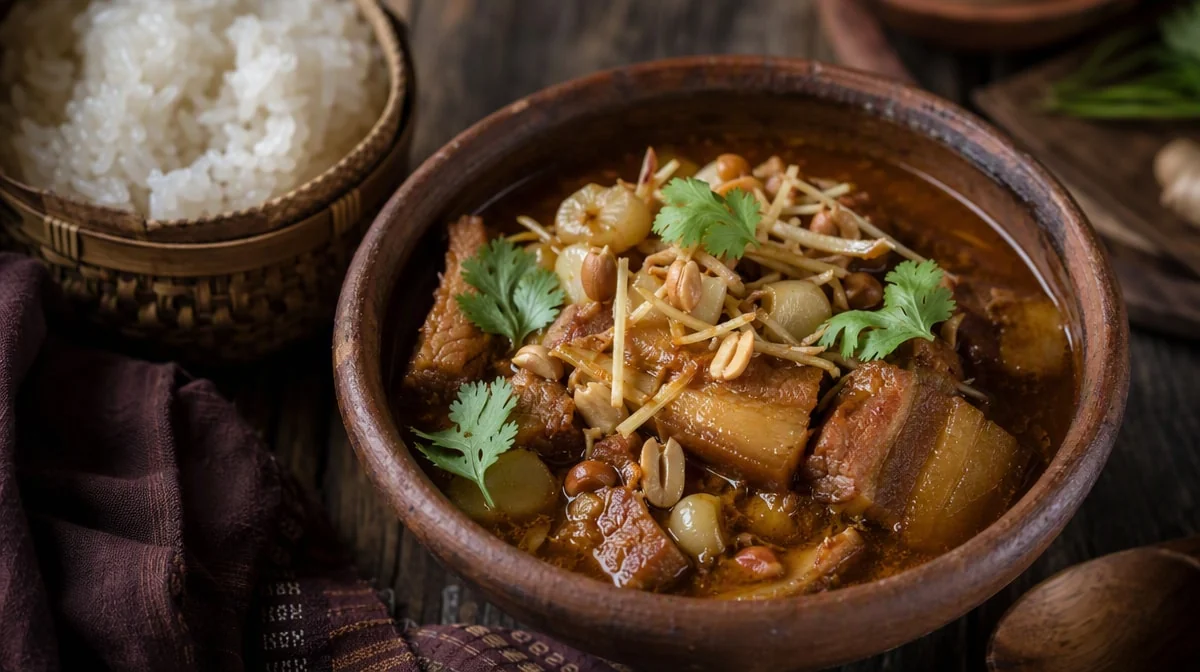
Gaeng hang lay, also written gaeng hung lay or hang lay curry, is a northern Thai pork curry. Pork belly is braised slowly with a paste of dried chillies, garlic, shallots, lemongrass, galangal, turmeric and shrimp paste, then finished with ginger, pickled garlic, peanuts, dark soy and a warm spice blend. There is no coconut milk in the classic version. The sauce is rich, sour-sweet and deeply savoury, and the pork should be soft enough to cut with a spoon.
It is a festival dish in the north, the kind of thing that appears at ceremonies and family gatherings rather than on a weeknight. It is not khao soi, the northern curry noodle soup; that is a different bowl, and the khao soi page covers it. It is also one of the clearest examples of how northern Thai food differs from the central repertoire: no coconut milk, more dried spice, a slower braise and a sour edge instead of a sweet one.
What Is Gaeng Hang Lay?
It is a northern Thai pork curry, and the guidebook is direct about it: "Gaang hang·lair Burmese in origin (hang is a corruption of the Burmese hin, meaning curry), this rich pork curry is often seen at festivals and ceremonies." That is the short definition, and it explains most of the dish: northern, pork, rich, ceremonial, Burmese-linked.
The cooking-school recipe calls its version "Northern Style Local Chicken Curry with Ginger" and prints it as Gaeng Hang Lay Gai. It uses local chicken, a hang lay paste, ginger, pickled garlic, peanuts, fish sauce, sugar cane, black sweet soy, mushroom sauce and a hang lay curry powder, with chicken stock rather than coconut milk. The chicken version is a restaurant adaptation; the classic is pork belly, and the pork version is the one to learn first.
The dish belongs to the northern table, not the central one. The regional pantry and the rest of the repertoire are on the northern Thai food page. The guidebook says northern Thai food rarely uses coconut milk, is seasonal and is "probably the most seasonal and least spicy of Thailand's regional schools of cooking, often relying on bitter or other dried spice flavours." Hang lay is the pork-and-dried-spice expression of that.
The Spelling: Hang Lay, Hung Lay or Gaeng Hang Lay
You will see four spellings in English: gaeng hang lay, gaeng hung lay, hang lay curry and hung lay curry. They are the same dish. The Thai is แกงฮังเล. The first word, gaeng, is the same curry word you see in green curry and massaman; the second is the name of the dish.
The spelling split is a search problem, not a cooking problem. The searched forms are gaeng hung lay recipe,
hung lay curry recipe and hang lay curry recipe; the form used in Thai restaurant menus is often gaeng hang
lay. The page uses gaeng hang lay in prose and acknowledges hung lay in the title and the first paragraph, so
a reader who knows either spelling lands in the right place.
The URL should probably be the gaeng hang lay recipe, because it matches the Thai romanisation and the site's existing style, but that is the owner's call. The H1 can carry the searched variant without changing the URL.
Gaeng Hang Lay Recipe (Pork Belly)
This version follows the cooking-school method, with pork belly in place of the chicken. It serves six to eight with rice. The cooking-school recipe is written at banquet scale; this is the home version.
For the paste
- 10-12 dried red chillies, soaked and deseeded if you want less heat
- 10g garlic, chopped
- 20g shallots, chopped
- 5g coriander root, chopped
- 5g galangal, chopped
- 10g lemongrass, chopped
- 5g turmeric, chopped
- ½ teaspoon shrimp paste
- Salt, to taste
For the curry
- 1kg pork belly, cut into 4cm chunks
- 50g hang lay paste (above)
- 20g ginger, shredded
- 30g pickled garlic
- 20g garlic, sliced
- 30g shallots, sliced
- 20g roasted peanuts
- 10g fish sauce
- 20g palm sugar or sugar cane
- 10g dark sweet soy sauce
- 10g mushroom sauce
- 5g hang lay curry powder
- 1.5 litres chicken stock
- Coriander, sliced ginger, sliced red chilli and pickled garlic, to garnish
Method
- Pound the paste ingredients in a mortar, or blend them to a coarse paste. Do not make it a smooth purée; the texture should still have some grip.
- Put the pork, paste, ginger, pickled garlic, sliced garlic, shallots, peanuts, fish sauce, palm sugar, dark soy, mushroom sauce, curry powder and stock into a heavy pot. Stir to mix.
- Bring to a simmer, then cook gently for 1½ to 2 hours, until the pork is tender and the sauce has reduced and thickened. Stir now and then and skim if needed.
- Taste. It should be salty, sweet, sour and warm-spiced, with the pork fat carrying the sauce. Adjust with fish sauce, palm sugar or a little tamarind if you want more sourness.
- Garnish with coriander, ginger, chilli and pickled garlic. Serve with sticky rice or jasmine rice.
The cooking-school version uses chicken and a shorter cook. If you use chicken, brown it first, then simmer for about 40 minutes, and add the stock gradually so the sauce does not become thin. The pork version is more forgiving and more traditional.
How to Make Gaeng Hang Lay Paste

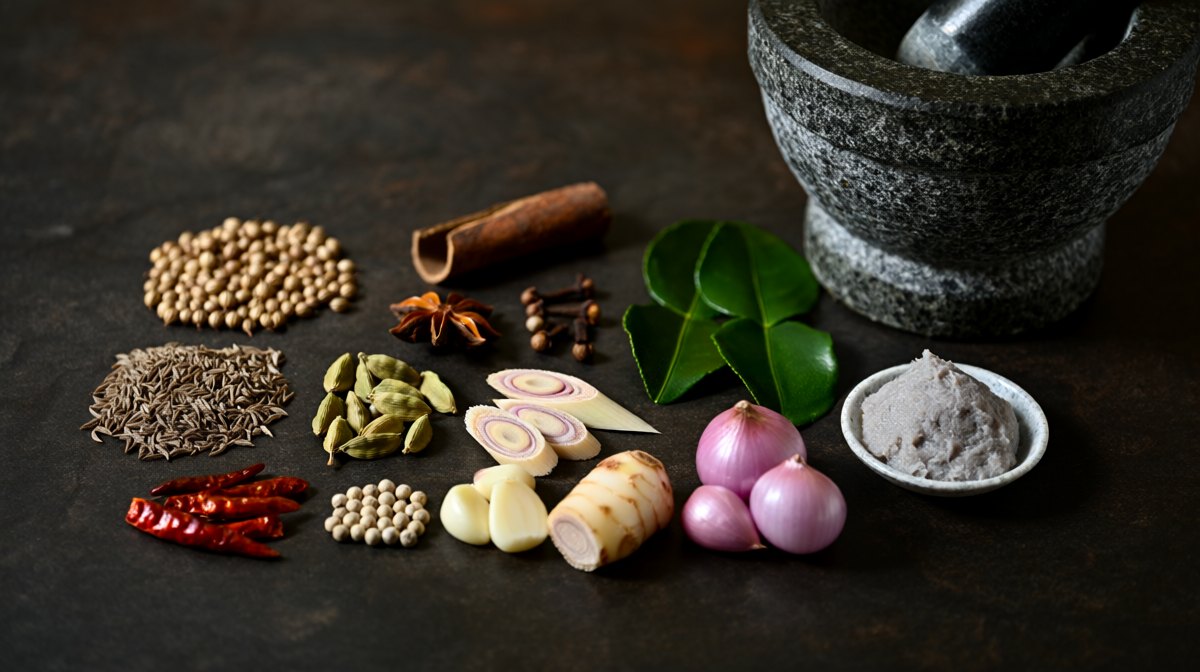
The paste is the whole dish. The cooking-school recipe uses dried chillies, garlic, shallots, coriander root, galangal, lemongrass, turmeric, salt and shrimp paste. Hot Thai Kitchen adds a dry-spice blend: cinnamon, peppercorns, cardamom, cumin, coriander seed, star anise, cloves, nutmeg and fennel. That blend is what makes hang lay taste different from a red curry.
You can make the paste in a mortar or a small food processor. A mortar gives a coarser, more uneven paste, which is what you want; a processor can turn it into a smooth purée if you let it run. Pulse, scrape down, and stop while it still looks like a paste rather than a sauce.
The dried chillies should be soaked in hot water until soft, then drained. Keep the soaking water; if the paste is too dry, add a spoonful. Do not add so much that the paste becomes wet. The aim is a thick paste that fries in the pot rather than boils.
If you cannot find hang lay curry powder, use a garam masala or a mild curry powder, or make the dry-spice blend yourself. The guide to buying Thai ingredients in England covers the shop types if you are starting from scratch. Hot Thai Kitchen gives both routes and also a "cheat": three to four tablespoons of store-bought red curry paste plus two tablespoons of hang lay powder or garam masala. That is a weeknight shortcut, not the traditional method, and the page says so.
Gaeng Hang Lay Without Coconut Milk
There is no coconut milk in the classic recipe. The liquid is stock, and the richness comes from the pork belly, the paste and the slow braise. The guidebook says coconut milk rarely makes its way into the northern kitchen, and the cooking-school recipe uses chicken stock, not coconut milk.
This is the biggest difference between hang lay and the central curries most UK cooks know. Green curry, red curry and massaman are coconut-based; hang lay is not. If you add coconut milk, you are making a different dish, closer to a Burmese pork curry with coconut. It will taste good, but it will not be hang lay.
The sauce gets its body from the pork collagen and the reduced stock. That is why the pork belly cut matters: a lean cut will give you dry meat and a thin sauce. If you want less fat, use pork shoulder and add a little gelatinous stock or a pig's trotter, but do not expect the same richness.
Hang Lay Curry vs Massaman Curry

They are both rich, both pork-friendly and both built on warm spices, which is why people confuse them. The differences are regional and technical.
Massaman is a southern Thai-Muslim curry. The guidebook calls it a "rich coconut-milk-based dish" that gets much of its flavour from dried spices and leans sweet. It usually has potatoes and peanuts, and it is mild. Hang lay is a northern Thai pork curry, with no coconut milk, a sour-savoury sauce, pickled garlic, ginger and a deep Burmese-influenced spice paste.
If you want a mild, creamy, potato-and-peanut curry, make massaman. If you want a sour-sweet pork braise with ginger and pickled garlic, make hang lay. They are not substitutes for each other, and the page does not pretend they are.
The one thing they share is the spice route. Both use dried spices that came to Thailand through trade and neighbouring cuisines. That is why both taste "warm" rather than "herbal", and why both are good with rice.
What Does Gaeng Hang Lay Taste Like?
It tastes rich, savoury and sour-sweet, with a warm dried-spice background and a slow chilli heat. The pork fat carries the paste, the tamarind or palm sugar gives the sour-sweet edge, and the ginger and pickled garlic cut through the richness. It is not a coconut curry, so it does not taste creamy; it tastes concentrated.
The heat level is moderate. The dried chillies give a background warmth rather than a sharp burn, and the spice blend adds aroma rather than heat. If you want it hotter, add more dried chillies to the paste; if you want it milder, deseed them.
The texture should be thick enough to coat the pork, not soupy. If it is thin, reduce it uncovered for the last 20 minutes. If it is too thick, add a little stock. The sauce is the point; do not serve it swimming.
Serve it with sticky rice, jasmine rice or rice noodles. The northern table would use sticky rice; a UK table can use either. A plain vegetable or a cucumber salad is a good contrast.
Is Gaeng Hang Lay from Burma?
Lonely Planet suggests it is Burmese in origin, and says hang is a corruption of the Burmese hin, meaning
curry. Hot Thai Kitchen says it is "believed to have come to Northern Thailand via Myanmar" and that hung lay
comes from the Burmese language. That is two sources saying the same thing, but the second is a recipe writer
repeating the first rather than independent evidence, so the page attributes the claim rather than treating it as
settled.
What is not in doubt is the style. The dish uses more dried spices than a typical Thai curry, which is the Burmese-Indian influence the sources describe. It is a northern Thai dish with a Burmese accent, not a Burmese dish served in Thailand.
The honest answer to "is gaeng hang lay from Burma?" is: the name and the spice logic point that way, and the guidebooks say so, but the dish as cooked in Chiang Mai is northern Thai. Both things are true.
Gaeng Hang Lay (Northern Thai Pork Curry)
Ingredients
- 10-12 dried red chillies, soaked
- 10 g garlic
- 20 g shallots
- 5 g coriander root
- 5 g galangal
- 10 g lemongrass
- 5 g turmeric
- ½ tsp shrimp paste
- Salt, to taste
- 1 kg pork belly, cut into 4 cm chunks
- 50 g hang lay paste
- 20 g ginger, shredded
- 30 g pickled garlic
- 20 g garlic, sliced
- 30 g shallots, sliced
- 20 g roasted peanuts
- 10 g fish sauce
- 20 g palm sugar
- 10 g dark sweet soy sauce
- 10 g mushroom sauce
- 5 g hang lay curry powder
- 1.5 litres chicken stock
Instructions
- Pound or blend the paste ingredients to a coarse paste.
- Put the pork, paste, ginger, pickled garlic, sliced garlic, shallots, peanuts, fish sauce, palm sugar, dark soy, mushroom sauce, curry powder and stock into a heavy pot. Stir.
- Bring to a simmer and cook gently for 1½-2 hours until the pork is tender and the sauce has thickened.
- Taste and adjust with fish sauce, palm sugar or a little tamarind.
- Garnish with coriander, ginger, chilli and pickled garlic. Serve with sticky rice.
Frequently asked questions
What is gaeng hang lay?
A northern Thai pork curry made with a dried-chilli and warm-spice paste, pork belly, ginger, pickled garlic and peanuts, braised in stock without coconut milk. It is rich, sour-sweet and savoury, and it is often served at festivals and ceremonies. The spelling varies: hang lay, hung lay, gaeng hang lay.
Is gaeng hang lay spicy?
Moderately. The dried chillies give a background warmth, and the warm spices add aroma rather than heat. It is not as hot as a green curry or a southern curry. If you want more heat, add more dried chillies to the paste; if you want less, deseed them.
What do you serve with gaeng hang lay?
Sticky rice or jasmine rice, a plain vegetable, and something cool and crunchy such as cucumber or a simple salad. The northern table would use sticky rice. Rice noodles work too. Do not serve it with coconut rice; the dish is rich enough.
Can I make gaeng hang lay ahead?
Yes. It tastes better the next day, and it freezes well. Cool it quickly, keep it in the fridge for three to four days, and reheat gently with a splash of stock. The pork should soften further on reheating, not dry out.
What is hang lay curry powder?
A ready-made dry-spice blend used in northern Thai cooking, also called hung lay powder. It usually contains warm spices such as cinnamon, coriander seed, cumin, star anise, cloves and cardamom. If you cannot find it, use garam masala or make the blend yourself.
Can I use red curry paste instead of making the paste?
As a shortcut, yes. Hot Thai Kitchen suggests three to four tablespoons of store-bought red curry paste plus two tablespoons of hang lay powder or garam masala. It will not be the same as a from-scratch paste, but it is a weeknight version. Do not use red curry paste alone and call it hang lay.
Is gaeng hang lay gluten free?
It can be. The core ingredients are gluten free, but soy sauce, mushroom sauce and some curry powders are not. Use a gluten-free soy sauce and check the labels. The cooking-school recipe uses dark sweet soy and mushroom sauce, so those are the two to check.
How long does gaeng hang lay keep?
Three to four days in the fridge, and up to three months in the freezer. Reheat gently with a little stock. The flavour deepens overnight, so it is a good dish to make ahead. Label the container with the date, and do not reheat it repeatedly.
Can I make gaeng hang lay with chicken?
Yes. The cooking-school recipe does exactly that: Gaeng Hang Lay Gai. Brown the chicken, simmer for about 40 minutes, and add the stock gradually. It is lighter than the pork version and less traditional, but it works. It is a useful weeknight version if pork belly is too rich.
Why is my gaeng hang lay bitter?
The paste was probably fried too hard or the dried chillies were scorched. Toast and soak the chillies gently, and cook the paste over medium heat, stirring constantly. If the dish is already bitter, a little palm sugar and tamarind will balance it, but it will not disappear.



Comments