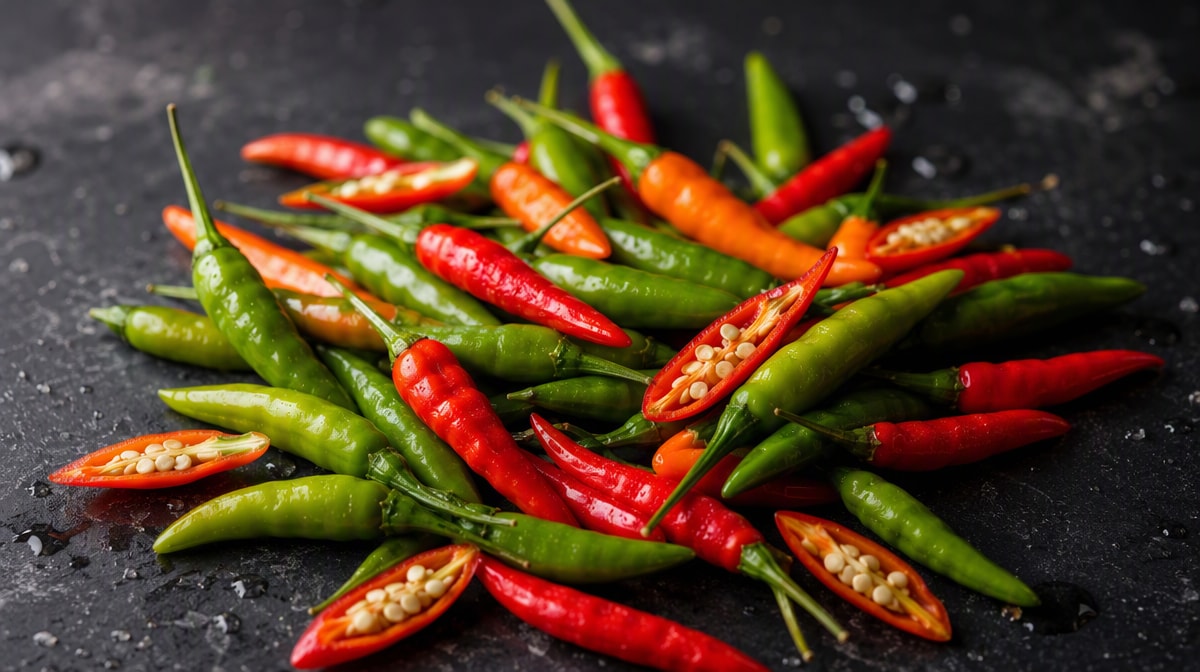
Prik kee noo, which translates as "mouse dropping chilli", is the default fresh chilli of Thailand. Small, about the length of your thumb, fiercely hot, and in daily use in essentially every Thai kitchen.
It's roughly 10 to 20 times hotter than a jalapeño, on the same measure most recipes will be comparing it against.
The name, which is worth knowing
The English name is the odd one out. There's a folk story that birds ate the seeds and spread them, or that the stem end looks like a bird's eye. The Thai name is more reliably explained: the chillies are about the size of mouse droppings.
It Rains Fishes has a whole chapter on this and takes some care with it. The word kee is not an impolite, dirty or obscene swear word like "shit". It simply means excrement, and it's used widely in Thai to form compound words implying some kind of waste or residue. So "droppings" works as a translation, though it's a weaker way to define kee, which carries metaphorical weight that "droppings" doesn't.
You'll also see prik kee nu, which is just a different romanisation of the same word. Thai chilli or Thai chile is the Western supermarket label. Thai dragon pepper is occasional Western market usage. And piri piri is shared with the African bird's eye, which is a common source of confusion.
On a Thai shop label, look for the tiny pointed chillies. They're usually 3 to 5cm, thin, and hang downwards. Dried chillies sold as "bird's eye" in the UK are frequently cayenne, which is a different pepper entirely and considerably different in flavour.
Heat, and what the number actually means

50,000 to 100,000 Scoville Heat Units. It's the most widely cited range across the sources, and you'll see figures up to 150,000 for particularly hot specimens.
| Pepper | Scoville | Relative |
|---|---|---|
| Jalapeño | 2,500 to 8,500 | baseline |
| Serrano | 10,000 to 25,000 | 2 to 3x jalapeño |
| Cayenne | 30,000 to 50,000 | 5 to 8x |
| Bird's eye | 50,000 to 100,000 | 10 to 20x |
| Habanero, Scotch bonnet | 100,000 to 350,000 | 20x+ |
The number is a range for a reason. Scoville is measured by diluting a pepper's capsaicinoids until the dilution can no longer be tasted, so it's a laboratory average rather than a property of the individual chilli in your hand. Heat varies substantially between plants, between fruits on the same plant, and with growing conditions and ripeness.
And heat isn't linear. A 100,000 SHU chilli doesn't taste twenty times hotter than a 5,000 SHU one. It tastes categorically different. A jalapeño builds slowly and mildly. A bird's eye is instant, sharp and searing, and it fades quickly rather than lingering. Habanero is the opposite, a slow building burn that stays. Bird's eye sits in between, arriving immediately.
Which is why a single one is usually enough. In som tam, one chilli per mortar-load is normal and gives a clear tingle rather than pain. It's a different relationship with heat from a Western chilli, where you often add many.
A New World chilli in an Old World kitchen
There's something genuinely interesting about this pepper's history, and it comes straight from our sources.
It Rains Fishes notes that the many varieties used in Thailand are not indigenous to Asia but have migrated from the New World, to fulfil their destinies in Thai kitchens. And that the path of these chillies parallels the history of the Thai people themselves, whose ancestors migrated from Yunnan province in southern China to find a place they could call home.
Chilli arrived in Thailand via Portuguese traders in the 1500s, and the same source describes how thoroughly it was absorbed. They were warmly received and eagerly sampled in royal kitchens, and some of the foreign gems were swiftly adopted and skillfully incorporated into the country's cuisine.
And it draws out the general principle, which is a good one. It is very much in line with Thai character to take an ingredient that is alien to the culture and combine it with native herbs, spices and condiments to create an end product distinctly Thai.
That's a reasonable description of how a New World pepper became the default chilli in a Southeast Asian cuisine. It was adopted, then made Thai.
Fresh, dried, green, red

Green is unripe: sharper, snappier, more herbal and grassy. Red is fully ripe: sweeter, mellower, and with warmth that lasts longer.
Cooks mix both in the same dish for layered heat, and it isn't a compromise. The green gives the bright top note and the red gives the base.
And a genuinely Thai technique: pound the chilli with garlic. Thai cooks routinely bruise or pound fresh green bird's eye with garlic before it goes anywhere near the pan. It emulsifies the oils and distributes the heat evenly, so you get heat spread through the whole dish rather than in a single fierce point.
Which dishes use them
Almost all of them. This is the default, not a specialist ingredient.
Som tam, green papaya salad, pounded in the mortar. The classic use, and where a single chilli does the work.
Curry pastes. Red curry paste, panang, and many others are built on it.
Tom yum, and it's one of the main reasons tom yum is as hot as it is.
Pad krapow, the stir-fried holy basil, where heat and fragrance arrive together.
Stir-fries generally, and as a table condiment.
Nam prik, the pounded chilli dips that sit on the table.
Vinegar and salted fish dipping combinations, where fresh heat balances the richness.
If you cook Thai food at all, you're cooking with them. That's worth knowing before worrying about substitutes.
If you're new to this, start somewhere else first
Worth saying plainly, because bird's eye is genuinely a strong place to start and it doesn't have to be your first.
There is no single "Thai chilli". At least 79 distinct varieties are documented, and they run from no heat at all to genuinely fierce. The label on a jar tells you almost nothing. The ladder looks roughly like this.
Prik yuak, the sweet or banana chilli, at 0 SHU. No heat whatsoever, mildly sweet, eaten raw, pickled, or stuffed. This is the answer for anyone who wants the flavour and none of the burn.
Prik noom, the northern Thai green chilli, 500 to 600 SHU. Long, crunchy, used raw or pickled, and the base of nam prik noom.
Prik chee fah, the spur chilli, whose Thai name means "points to the sky" because of the way it grows. Sources disagree wildly on its heat, from 900 to 1,100 SHU up to 5,000 to 30,000, which is itself a useful warning about how much these figures vary. Traditionally the introductory chilli in a Thai kitchen.
Prik kee noo, bird's eye, 50,000 to 100,000. Where you are now.
Prik jinda, the Thai hot chilli, 70,000 to 100,000, so genuinely comparable to bird's eye and dried as prik haeng for curry pastes.
So the honest advice is to buy a bag of mixed Thai chillies and see which ones you actually like. It costs very little and the "which Thai chilli" question genuinely has no single answer.
If what you want is a milder curry rather than a milder chilli, that's often the better lever. More coconut milk and more potato dilute heat without removing it, and a yellow curry is built to be gentle from the start.
Substitutes, ranked by how close they actually are

Best is the same pepper under another name. Thai chilli and bird's eye are largely interchangeable, and Thai Dragon, cabe rawit and siling labuyo are the same family. African bird's eye is very close, a different species with similar heat and a similar role.
Serrano, one to one or two to one, slightly milder so add more if you need the heat. Genuinely good in tom yum, salads and curries. The most practical swap.
Fresh cayenne, hotter than jalapeño, works in massaman, pastes and dry rubs.
Jalapeño, much milder. Use about half the quantity and remove the seeds and pith for a family-friendly version. It's a flavour compromise as much as a heat one.
Habanero or Scotch bonnet, hotter, so about a quarter of the quantity. But several sources warn against it for authenticity. The fruity notes don't belong in a Thai dish.
Dried and powdered: red pepper flakes at about a third of the volume, cayenne powder at a quarter, and Kashmiri chilli for colour with almost no heat. Chipotle adds smokiness that isn't Thai at all.
For rehydrating dried chillies, 5 to 10 minutes in warm water, and roughly one dried to two fresh.
Not recommended, and worth knowing before you try them: gochujang and gochugaru bring a distinctly Korean fermented sweetness, and sambal oelek is salty and tangy in a way that pulls a Thai dish somewhere else entirely. They will make something tasty. It won't be Thai.
If you're missing something else in the dish
The flavour of bird's eye has a bright, almost citrusy top note that cuts through coconut milk, and powder can't give you that no matter how hot it is.
If you're substituting and the dish tastes flat, add a torn kaffir lime leaf when you toast the substitute. That restores the aromatic register the chilli was contributing. And if the balance is off afterwards, a little lime juice puts the acidity back where it belongs.
Heat also concentrates in the seeds, so de-seeding and removing the white membrane cuts the heat substantially. Most of the capsaicin is in the pith rather than the flesh, so a deseeded bird's eye is a much milder ingredient than a whole one, and it's the easiest way to make an existing dish milder without changing anything else.
One last naming trap
Bird's eye and African bird's eye are different species, and the market conflates them.
The Thai bird's eye is almost universally given as Capsicum annuum. The African bird's eye and siling labuyo are Capsicum frutescens, and they're also sold as piri piri or bird's eye depending on where you are.
The reliable way to tell them apart is which way the fruit points. Capsicum annuum bird's eye hangs down. Capsicum frutescens points upward.
In practice, if you're in a UK Asian supermarket buying small pointed chillies for a som tam, what you want is the small downward-pointing ones. If a shop has labelled something piri piri, it's more likely the African variety. Perfectly usable, similar heat, but not what a Thai recipe means.
Working with them safely
They're small and deceptively mild-looking, which is exactly how people get surprised. A chilli under 2cm long, sitting in a pile with nothing to compare it to, reads as far less serious than a jalapeño of the same apparent size, and the Scoville figures don't translate into intuition from appearance. This is the single most common way people burn themselves with bird's eye: they handle it as if it were mild because it looks like it.
One useful mental model: treat one bird's eye as roughly one to one-and-a-half jalapeños in a dish, but expect the heat to arrive faster and clear sooner. If you're converting a recipe, start at one bird's eye per two jalapeños, taste, and adjust upward. Going the other way, roughly three to five jalapeños stand in for one bird's eye.
Count them rather than judging by sight. A single bird's eye is a meaningful quantity in a dish for two.
Wear gloves if you're working through a large quantity, and if you touch your face afterwards. The capsaicin sits in the skin and transfers.
Milk and yoghurt are the best relief, because capsaicin is fat-soluble and dairy carries it away. Water does almost nothing, which is why water makes it worse. Alcohol helps a little. Carbonated drinks don't.
Removing the seeds and the inner pith cuts the heat substantially, because most of the capsaicin is in the white pith rather than the flesh.
Storage
One to two weeks in the fridge, stored completely dry with the stems removed. The stems carry moisture and moisture is what rots them. A paper towel in the container absorbs condensation, and the crisper is better than the door.
Freeze for six to twelve months without blanching, and add frozen straight to a hot dish with no thawing.
Full detail, including the botulism warning about packing fresh chillies in oil, is on our chilli storage page.
Buying them
The thing to watch for in the UK is that a lot of what is sold as bird's eye isn't, particularly in the dried form.
In a shop with a proper Thai section, fresh bird's eye is small, thin, and hangs downwards. Dried, it should be slender and curved, under about 6mm across. If a jar says "bird's eye chilli" and the pieces inside look like broad flat red flakes, that's cayenne and it'll behave quite differently in a paste.
Fresh, buy loose where you can rather than from a sealed plastic bag. You can see whether they're wrinkled, which means they've been sitting, and you can pick out the soft ones.
And buy in quantities you'll use, because a bag of them either gets frozen or gets forgotten. Frozen, they keep six to twelve months and there's no decision to make.
A note on sources
The Scoville figures are consistent across sources and reasonably well documented. The brand comparisons and market observations are accumulated cook experience rather than testing, and individual chillies vary more than any of that suggests. The historical detail is from published books and the Chilli Pepper Madness lineage of pepper history, and it's consistent between them. If you're after a figure to argue from, use the Scoville numbers and treat everything else as guidance.
Frequently asked questions
How hot are Thai bird's eye chillies compared to jalapeños?
Roughly 10 to 20 times hotter, at 50,000 to 100,000 Scoville against 2,500 to 8,500 for a jalapeño. But the numbers understate it. Jalapeño heat builds slowly and mildly, while bird's eye heat is immediate and sharp, then fades. It feels categorically different rather than proportionally stronger.
What does prik kee noo mean?
It's the Thai name and it literally means "mouse dropping chilli", which is a fairly accurate description of the size. The English name "bird's eye" comes from a folk story about birds spreading seeds. You'll also see it written prik kee nu, and sold in the UK as "Thai chilli" or occasionally "Thai dragon pepper".
Is a bird's eye hotter than a habanero?
No, and they aren't close. Habanero and Scotch bonnet run 100,000 to 350,000, several times hotter than bird's eye at 50,000 to 100,000. The two are also different in character: bird's eye hits fast and fades, habanero builds slowly and lingers. We have covered the habanero side in detail on Thai chilli vs habanero.
What is the best substitute for bird's eye chillies?
Serrano is the most practical, used one to one or two to one since it's slightly milder. Fresh cayenne works well in curries and pastes. Jalapeño is much milder so use about half and remove the seeds, and avoid habanero in Thai dishes because its fruity notes aren't Thai. Thai Dragon, cabe rawit and African bird's eye are the same pepper under other names.
How many bird's eye chillies should I use?
Fewer than you would think. One per mortar-load in som tam is normal, and a couple in a curry serving two or three is plenty. They're small and deceptively unassuming, and Scoville figures are averages, so taste as you go. Pound them with garlic to distribute the heat evenly rather than getting one fierce point.
Are green or red bird's eye chillies hotter?
Neither is hotter. Ripeness changes the character. Green, which is unripe, is sharper and more herbal. Red, fully ripe, is sweeter, mellower and its warmth lasts longer. Thai cooks mix both in the same dish for layered heat, and it's a deliberate choice rather than a compromise.
Are dried chillies labelled "bird's eye" actually bird's eye?
Often not. In the UK they're frequently cayenne, which is a different pepper with a different flavour and different heat. Genuine fresh bird's eye is small, thin, pointed and hangs downwards. Genuine dried bird's eye is slender and curved, under about 6mm across. Check the ingredients list if you can, and expect dried "Thai chilli" in a Western supermarket to be mild and dusty rather than pungent.
Where did chillies come from in Thai cooking?
The Americas, brought to Thailand by Portuguese traders in the 1500s and fully absorbed within about a century. One of our sources puts it neatly: the migration of chillies from the New World parallels the migration of the Thai people themselves from Yunnan, and a foreign ingredient was combined with native herbs and spices to make an end product distinctly Thai.



Comments