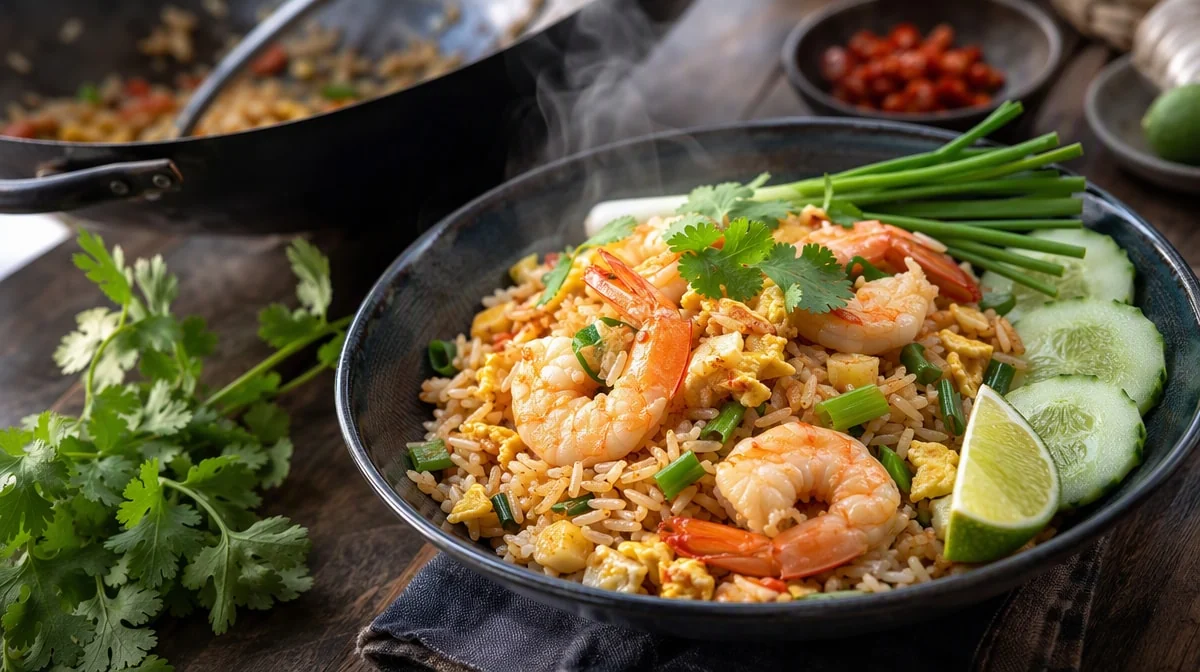
Khao pad is Thai fried rice: jasmine rice fried in a wok with onion or garlic, an egg, whatever protein is to hand, and a seasoning led in a Thai kitchen by fish sauce rather than soy. It arrives with a wedge of lime and slices of cucumber. That combination, not any one ingredient, is what makes it Thai.
It is a leftover dish and a fast one, because the rice is cooked the day before. The fullest version in the Thai books on my shelf opens with the instruction that decides everything else. "You will get the best results if the cooked rice is still slightly firm with very separate grains" (Charmaine Solomon, The Complete Asian Cookbook, "Khao Phat").
Contents
- What Is Khao Pad?
- Thai Fried Rice vs Chinese Fried Rice
- How to Make Thai Fried Rice at Home
- What Sauce Is Used in Thai Fried Rice?
- Day-Old Rice and the Food Safety Question
- Types of Thai Fried Rice
- Khao Pad Rot Fai: It Is the Train, Not the Flame
- Thai Fried Rice with Pineapple (Khao Pad Sapparot)
- A Note on the Sources
- Frequently asked questions
What Is Khao Pad?
ข้าวผัด reads straight through: ข้าว khao, rice, and ผัด phat, to stir-fry. The grammar matters: the main ingredient goes after the name. Khao pad gai (ข้าวผัดไก่) is rice with chicken, khao pad sapparot (ข้าวผัดสับปะรด) with pineapple. I write khao pad because that is how this page is found; khao phat is the official romanisation and the spelling of the Thai cookbooks in English.
The seasonings are an argument. Wikipedia's list is deliberately wide: they "may include soy sauce, sugar, salt, possibly some chili sauce, and the ubiquitous nam pla". The Thai Food Encyclopedia's plainest version uses fish sauce and soy together.
The technique is documented, and it is not Thai. Lonely Planet's chapter: "The simplest dishes in the Thai culinary repertoire are the various pàt (stir-fries), introduced to Thailand by the Chinese" (printed p. 735). The Thai part is the rice, the seasoning and the lime.
Thai Fried Rice vs Chinese Fried Rice

The rice. Wikipedia is direct: Thai fried rice "differs from Chinese fried rice in that it is prepared with Thai jasmine rice instead of regular long-grain rice". In a British cupboard that means Thai jasmine versus plain long-grain (the main types of rice in Thailand).
The seasoning. The sources disagree, and that is the useful part.
- Solomon uses 2 tablespoons of fish sauce for four portions of rice, and records the swap beside it: "The fish sauce and light soy sauce are interchangeable as far as adding salt to this dish, but the fish sauce imparts an additional interesting flavour" (The Complete Asian Cookbook).
- Elizabeth David's Thai book uses light soy, sugar and pepper in both its fried rice recipes, and no fish sauce in either (printed pp. 223 and 227).
- RecipeTin Eats, a Thai-Australian cook, states the purist line and withdraws it: "Purists will tell you that if you use soy sauce, it becomes Chinese Fried Rice," then "the reality is that soy sauce is sometimes used in Thai Fried Rice, both in Thailand and in restaurants outside of Thailand." She labels soy with oyster as "more akin to Thai home cooking" (RecipeTin Eats).
- On the Chinese side, Red House Spice: "Soy sauce is the single most important condiment for this dish," with dark soy for colour, sugar, white pepper and sesame oil. Sesame oil is the reliable tell: it is in the Chinese recipe and in none of the Thai ones above (Red House Spice, "Soy Sauce Fried Rice").
A Thai fried rice is seasoned with fish sauce, and soy is common in it too. Our page on the ten most popular Thai dishes gives the other half, from the kitchen side: for khao pad, "The seasoning is fish sauce and Thai seasoning sauce rather than soy sauce, giving it a more savoury, slightly fermented character" (the-10-most-popular-thai-dishes). If yours is to read as Thai rather than as takeaway Chinese, change one bottle and add one fruit: fish sauce, and lime on the plate.
And the part nobody searches for: Thai kitchens put curry paste in the wok. Lonely Planet, same page: some stir-fries are "Thai-Chinese hybrids, such as pàt pèt", in which meat or fish are stir-fried with red curry paste (printed p. 735). Solomon's chilli fried rice is that dish with rice in it: chillies and a tablespoon of red curry paste fried until the oil separates, then meat, then rice. Chinese fried rice has no step like it; the paste keeps for weeks once opened (how long Thai curry paste lasts).
How to Make Thai Fried Rice at Home
The recipe is Solomon's Khao Phat, the fullest in the English-language Thai books, with three changes: chicken thigh for her pork chop, a stated weight of rice for her "1 quantity cold steamed white rice", and batches. Serves four as part of a meal.
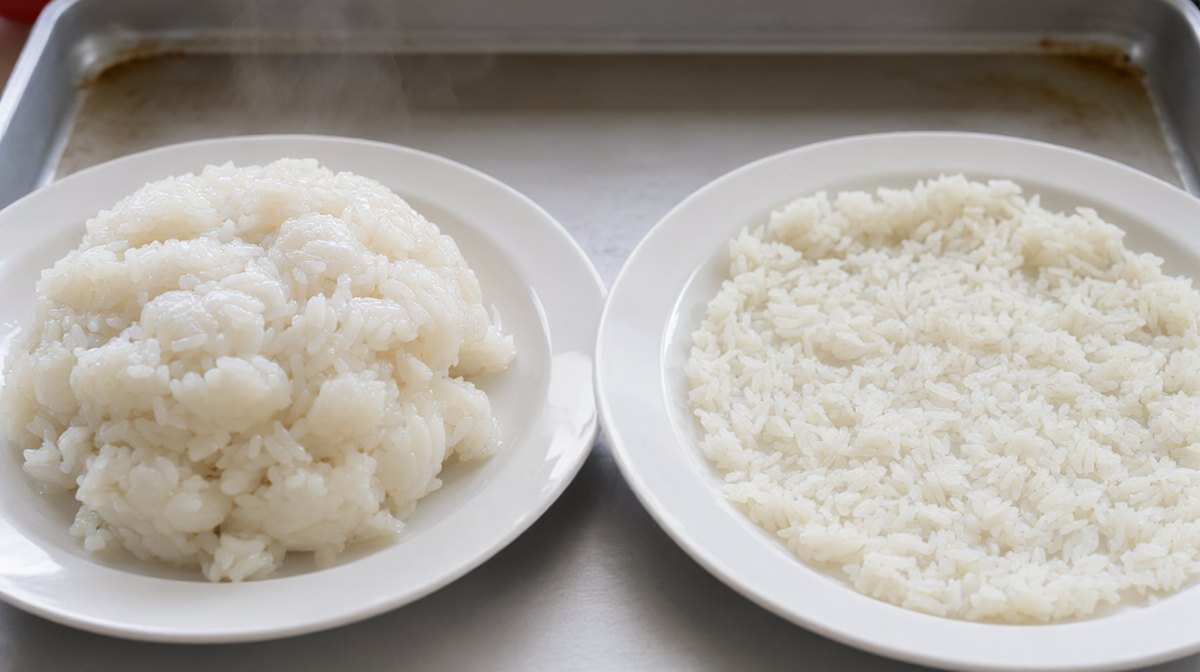
- 550-600 g cold cooked jasmine rice, cooked the day before: about her "one quantity", which is also RecipeTin Eats's "3 cups cooked jasmine rice, cold (preferably refrigerated overnight)". Break the clumps apart with wet hands.
- 60 ml peanut or vegetable oil; 3 eggs, beaten, salted and peppered; 2 medium onions, finely chopped.
- 250 g chicken thigh in 1 cm pieces. Her pork chop, prawns and crabmeat work too.
- 2 tablespoons fish sauce; 2 tablespoons tomato paste; 1 tablespoon Thai chilli sauce such as Sriracha, optional in her text.
- 65 g spring onion in 2 cm lengths; coriander; 2 limes in wedges; a cucumber sliced thickly; a small dish of fish sauce with sliced chilli and lime, which is how it is eaten.
Do not cook four portions at once. Our troubleshooting page why Thai fried rice goes mushy puts the limit at "no more than 200-250g of cooked rice per batch" on a home hob, so this is two batches.
- Warm 2 tablespoons of the oil in a wok or the largest frying pan you own over medium heat. Cook the onion until soft and sweet, 5-8 minutes, then turn the heat up.
- Add the chicken; stir-fry about 3 minutes and push it to one side, or lift it out if the pan is small. Add prawns and crab if using them; 3 minutes more, until the prawns turn pink.
- Push everything aside, pour the beaten egg into the clear half of the pan, stir until it has just begun to set, then mix it through. RecipeTin calls this "a classic Thai method".
- Add the rice. Toss it, then press it flat against the pan and leave it alone for 30-60 seconds before tossing again, two or three times, at the highest heat your hob allows, until it is hot through and sounds dry, not damp, 4-6 minutes. The why of it belongs to why Thai fried rice goes mushy.
- Add the fish sauce around the edge of the pan, then the tomato paste and chilli sauce; toss until the rice is an even pale red. Solomon and our own page both put seasoning into a hot pan, not onto cool rice.
- Off the heat: spring onions, most of the coriander, one toss, taste. More fish sauce if needed.
- Serve at once with lime wedges, cucumber and the rest of the coriander. The lime goes over the rice at the table: seasoning, not decoration.
The advice in this house and the advice in the books differ. Our troubleshooting page says to preheat the wok "until visibly smoking" before anything goes in, which assumes a wok that gets its heat back quickly. A British hob cannot: the largest burner on a 60 cm Bosch gas hob is 3.0 kW, and a typical 60 cm induction hob rates its main zones at 2.2 kW, boosting to 3.7 kW (Bosch UK specification sheets). Against the 15 to 29 kW that page gives for restaurant wok burners, no pan or technique closes the gap. Soften first on medium, then go to full heat.
What Sauce Is Used in Thai Fried Rice?
There is no separate sauce. The seasoning goes into the wok in two or three spoonfuls and fries into the rice. Four patterns are documented.
Fish sauce, alone or with a little oyster sauce and sugar: Solomon's 2 tablespoons for four portions, and the combination RecipeTin says purists call the real one. At that quantity fish sauce does not taste fishy; it tastes savoury.
Light soy and sugar, with pepper: what both of David's recipes use (printed pp. 223, 227).
A hybrid, which is what readers in Britain meet. Our what seasoning sauce is page, from a working kitchen: seasoning sauce "is also one of the core sauces in a good fried rice (khao pad), alongside a little oyster sauce and light soy". Golden Mountain, the brand that page is about, is fermented soya with sugar, and around 1,200 mg of sodium in a tablespoon. Takeaway fried rice gets the same effect from seasoning powder, the route does Thai food have MSG traces. For gluten-free, ask for fish sauce: our gluten-free Thai dishes page says takeaway fried rice is "almost always cooked with soy sauce, and the soy is what gives it its colour".
Curry paste or chilli jam. Solomon's chilli fried rice starts from a tablespoon of red curry paste fried until the oil separates. The royal cookbook's nam phrik long ruea, "Chili Paste for the River", is pounded coriander root, red chillies, garlic and shrimp paste, seasoned with fish sauce and lime and cooked with pork in caramelised palm sugar (royal_palace_recipes, anchors 22-23).
Colour comes from tomato paste with Thai chilli sauce (Solomon's route, and why British takeaway fried rice reads pink) or from dark soy and red fermented bean curd, the railway version below. Pale, flat, salty rice means the seasoning went into a pan that was not hot enough to fry it.
Day-Old Rice and the Food Safety Question

Every source says use yesterday's rice; none explains why in terms a British reader can act on. The British reason is food poisoning, and the national advice is stricter than any cookbook.
Uncooked rice carries spores of Bacillus cereus that "can survive being cooked"; left warm after cooking, the bacteria grow and produce toxins, and "it's not the reheating that causes the problem, but the way the rice has been stored before it's reheated" (Food Standards Agency, Home food fact checker). The agency's catering guidance is to chill cooked rice "within one hour", spread on a shallow tray or in small portions, then "use within 24 hours or throw it away" (Safe Method: Rice), reheating once, until steaming hot. Its consumer guidance adds a line worth reading twice: "don't leave rice in the rice cooker, steamer or pan to cool down".
Most British households do the opposite. Our own review of the Yum Asia cooker (the Yum Asia rice cooker review) notes that after its cycle "it holds at warm for hours", which is a comfortable temperature for exactly those bacteria. Cool tomorrow's rice on a tray within the hour, which is also how you get the dry, separate grains this dish needs. And, per the same agency, a takeaway may have cooked its rice earlier and held it hot or reheated it before serving.
Types of Thai Fried Rice
The name tells you what is in the wok. These names are Wikipedia's list.
- Khao pad gai (ข้าวผัดไก่), chicken: the one most people in Britain mean, and the one the recipe above is written for. Khao pad moo (ข้าวผัดหมู) is pork, khao pad kung (ข้าวผัดกุ้ง) prawns, khao pad thale (ข้าวผัดทะเล) seafood, khao pad khai (ข้าวผัดไข่) is egg only.
- Khao pad pu (ข้าวผัดปู), crab: 450 g of rice with 110 g crab meat, "drained well if tinned", plus onion, water chestnuts and ginger in David's version (printed p. 227). Our the-10 page calls it "the premium version"; tinned brown crab works.
- Khao pad kaphrao (ข้าวผัดกะเพรา), holy basil: the fried-rice form of pad krapow, which is a different plate (FAQ). The dish is pad krapow gai; keeping the herb is how to store Thai basil.
- Khao pad sapparot (ข้าวผัดสับปะรด), pineapple, below. Khao pad che (ข้าวผัดเจ) is vegetarian, substitution in the FAQ.
- The paste family: khao pad prik, Solomon's chilli fried rice; khao pad kaeng khiao wan (ข้าวผัดแกงเขียวหวาน), green curry paste; khao pad tom yam; khao pad nam phrik long ruea (ข้าวผัดน้ำพริกลงเรือ), the royal chilli jam. One method: fry the paste until the oil separates, then protein, then rice.
- Cupboard versions: khao pad pla krapong (ข้าวผัดปลากระป๋อง), tinned sardines in tomato sauce, follows the recipe above; khao pad kak mu (ข้าวผัดกากหมู), pork cracklings; khao pad amerikan (ข้าวผัดอเมริกัน), rice with ketchup.
The royal cookbook has no khao pad recipe at all, only cooked rice made into pastry-wrapped khao thot (royal_palace_recipes, anchors 11-12).
Thai Fried Rice with Pineapple (Khao Pad Sapparot)
ข้าวผัดสับปะรด is the fried rice British readers mean when they ask for the restaurant one, because it arrives in a boat made from the pineapple. It is also the one home cooks get wrong, and the failure is water.
Elizabeth David's version, at p. 223 of An Introduction to Thai Cooking, deals with the water first. Having halved a small pineapple and scooped out the flesh, she bakes the empty shells for 10 to 15 minutes: "This will seal in the juice and prevent it leaking into the fried rice when it is placed in the shells." That is the step people skip, and the dish turns wet when they do. One egg is then cooked as a thin omelette, cooled, rolled and cut into fine ribbons, hence the yellow strands in restaurant photographs. The stir-fry is garlic, prawns, ham, sweet corn, peas, capsicum and ginger, then 280 g of cooked jasmine rice "refrigerated in a covered bowl overnight", light soy and the raw pineapple, tossed "over a medium heat for 5 to 7 minutes", and served in the shells under cashews and the egg ribbons. Those quantities make one small pineapple as one of several dishes, so scale the rice by the recipe above instead.
Two adjustments. Fresh pineapple is best; canned works but must be drained and then dried on paper, or you are frying soup. And the raisins that British pineapple fried rice carries belong to what Wikipedia calls "a more elaborate version known as khao op sapparot"; David's has cashews and no raisins, and I would keep it that way.
A Note on the Sources
Wong Chi Au's Wok Cuisine: Thailand has no fried-rice recipe at all: "fried rice", "khao phat" and "khao pad" return zero hits. David's Thai book has two, both soy-seasoned. The seasoning is the one thing the sources cannot settle; they agree on rice. Any date or origin claim for khao pad is refused for lack of a source.
Thai Fried Rice (Khao Pad)
Ingredients
- 550-600 g cold cooked jasmine rice
- 60 ml peanut or vegetable oil
- 3 eggs, beaten
- 2 medium onions, finely chopped
- 250 g chicken thigh, cut into 1 cm pieces
- 2 tbsp fish sauce
- 2 tbsp tomato paste
- 1 tbsp Thai chilli sauce (optional)
- 65 g spring onion, cut into 2 cm lengths
- Coriander, lime wedges and cucumber, to serve
Instructions
- Warm 2 tbsp oil in a wok over medium heat and cook the onion for 5-8 minutes until soft and sweet.
- Turn up the heat, add the chicken and stir-fry for about 3 minutes. Push it to one side.
- Pour the beaten egg into the clear side of the pan, let it just set, then mix it through.
- Add the rice, toss, press it flat and leave for 30-60 seconds. Repeat two or three times until hot and dry.
- Add the fish sauce around the edge, then the tomato paste and chilli sauce. Toss until evenly pale red.
- Off the heat, stir through the spring onion and most of the coriander. Taste and adjust.
- Serve at once with lime, cucumber and the remaining coriander.
Frequently asked questions
Does Thai fried rice have egg?
Yes. Every Thai recipe checked here has egg in it, cooked in the wok and mixed through the rice rather than served on top; our the-10 page says the same ("Egg is mixed through during cooking, not laid on top"). The pineapple version uses an omelette cut into ribbons at the end instead.
Can I make Thai fried rice without egg?
Yes. Add a little extra oil, since the egg carries fat into the grains, and expect a drier, paler result. Some cooks add a spoonful of water instead to keep the rice moist. Either way, taste for salt at the end, because the egg also carries seasoning.
How do I make Thai fried rice without fish sauce?
Use light soy with a pinch of sugar, which is what the Thai cookbooks that omit fish sauce do. Solomon notes that fish sauce and light soy are "interchangeable as far as adding salt", though fish sauce adds flavour. For khao pad che (ข้าวผัดเจ), the vegetarian version, put the effort into heat and colour rather than more sauce.
What is the difference between pad krapow and khao pad krapow?
Pad krapow is minced meat stir-fried with holy basil and served over rice. Khao pad krapow is rice cooked in the wok with the herb and whatever protein is in it, seasoned, and served on its own. Same herb, same heat, different plates; the dish itself is on pad krapow gai.
Is Thai fried rice gluten free?
In Thailand, usually, because the seasoning is fish sauce. In a British takeaway, no: our gluten-free Thai dishes page says fried rice there is "almost always cooked with soy sauce", and soy contains wheat. Ask for fish sauce and a clean wok, and treat seasoning powder as a second route gluten gets in.
Can I eat fried rice the day after it was cooked?
Yes, if the rice was cooled quickly and kept covered in the fridge. The Food Standards Agency's limit for refrigerated cooked rice is 24 hours, and rice is reheated once, until steaming hot. Fried rice that has sat in a warm wok since lunch is the problem, not the one that has been chilled.
Why is takeaway fried rice pink or orange?
Usually tomato paste, often with a chilli sauce, which is the reddish version in the recipe above. The other routes are a dark soy or the red fermented bean curd of the railway version. The same shortcut in Pad Thai is on why restaurant pad thai is orange.
Can I make khao pad pu with tinned crab?
Yes, and David's recipe says so: fresh crab meat or tinned, "drained well if tinned" (printed p. 227). Use tinned brown crab rather than white, because it carries more flavour. Add it late, once the rice is hot, so it warms through without breaking up.
Do I need a wok for Thai fried rice?
No. A wide heavy frying pan is often better on a home hob, and on induction a flat-based carbon-steel pan beats a round wok. What matters is heat and a small batch; why Thai fried rice goes mushy covers pan choice and the two-batch limit.
Is khao pad a Thai dish or a Chinese one?
Both halves are true. Stir-frying came from China: Lonely Planet's Thailand chapter says the stir-fries were "introduced to Thailand by the Chinese" (printed p. 735). What makes khao pad Thai is jasmine rice, a fish-sauce-led seasoning, and lime, cucumber and chilli on the plate.

Comments