Written by Manaow Prasatthong, 3rd Generation Thai Chef
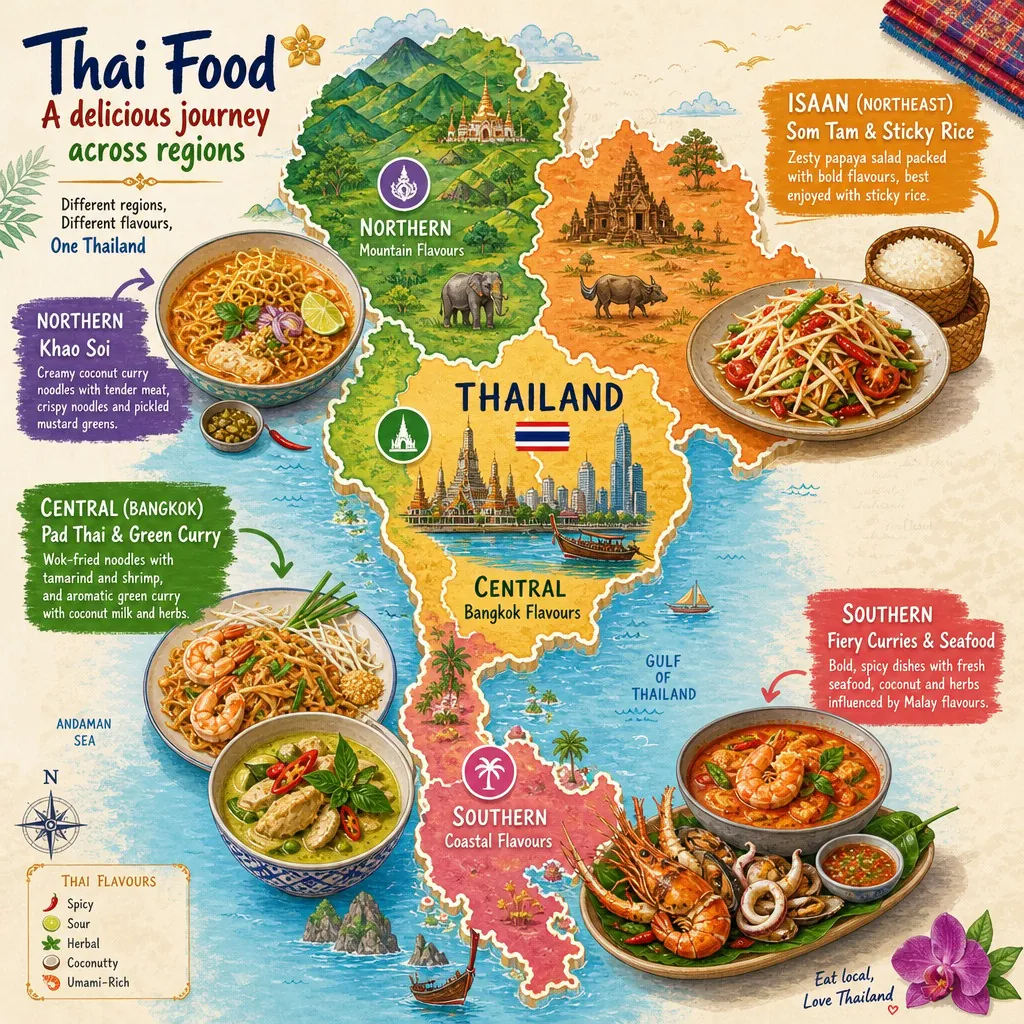
Most people think of Thai food as a single cuisine, but Thailand has four distinct regional styles, each shaped by climate, geography, neighbouring countries and local ingredients. What's served in a noodle shop in Chiang Mai is very different from what you'd find at a market stall in Hat Yai. The north uses almost no coconut milk; the south uses it constantly. Northerners eat sticky rice at every meal; central Thais eat jasmine. The south will blow your head off with chilli; the north is comparatively mild. Here's what sets each region apart.
Northern Thai food (Lanna)

The north (historically the Lanna kingdom) sits in a cooler, mountainous terrain and shares long borders with Myanmar and Laos. Both neighbours have left a clear mark on the food.
Northern Thai food is milder than you might expect if central Thai cooking is your reference point. The region historically had less access to fresh seafood, and the cooking leans on earthy, herbal flavours rather than the bright heat of the south. Coconut milk rarely appears; curries here tend to use stock-based broths, giving them a leaner, more brothy character. Fermented ingredients and local greens add a slight bitterness that is very specific to the region.
The staple carb is sticky rice, eaten with the hands. Jasmine rice is not typical here.
The dishes that define northern Thai cooking: Khao Soi is the most famous, a coconut curry noodle soup with crispy deep-fried noodles on top, somewhere between a curry and a soup. It is the dish Chiang Mai is best known for. Sai Ua is a northern Thai sausage packed with lemongrass, kaffir lime leaves and galangal. Nam Prik Noom is a roasted green chilli dip eaten with raw vegetables and sticky rice. Gaeng Hung Lay is a Burmese-influenced braised pork belly curry with tamarind and ginger, slow-cooked and deeply savoury, nothing like a central Thai curry.
For a full breakdown of the region's food, dishes, and what to order, see the Northern Thai Food guide.
Northeastern Thai food (Isaan)

Isaan covers the large northeastern plateau of Thailand, bordering Laos along most of its length. The relationship between Isaan food and Lao food is close; many dishes are identical on both sides of the Mekong, and the two cuisines share the same cultural roots.
The climate is hot and dry, the soil less fertile than the rest of Thailand. The food reflects this: ingredients tend to be simple and direct, with no elaborate sauces. What Isaan cooking does instead is use fermentation and raw intensity to build flavour. Pla ra (fermented freshwater fish) is the defining condiment of the region: deeply funky, pungent, rich in umami. It appears in som tam, in dipping sauces, in larb. Once you have encountered it, you will not mistake it for anything else.
Sticky rice is, again, the staple. Isaan food is not eaten with jasmine rice.
The flavour profile is direct: sour from lime, fiercely spicy from fresh and dried chillies, funky from fermented fish, with very little sweetness. It is one of the least sweet regional cuisines in Thailand.
The signature dishes: Som Tam (green papaya salad pounded to order in a clay mortar) is the most famous Isaan dish and is now eaten across all of Thailand and beyond. Larb is a minced meat salad dressed with toasted rice powder, mint, shallots, and a sharp lime dressing. Gai Yang is grilled chicken marinated in lemongrass and coriander root, served with sticky rice and som tam as the complete Isaan meal. Crying Tiger is grilled beef with a roasted chilli dipping sauce.
Can't decide what to eat tonight?
Take our 60-second quiz and we'll pick for you
See the full Isaan Food guide for more on the region's dishes and ingredients.
Central Thai food
Central Thailand (including Bangkok) is the heartland, and central Thai food is what most of the world knows as "Thai food." It is the cuisine that spread internationally through Thai restaurants and is the most codified of the four regional styles.
Central Thai cooking was shaped significantly by royal court cuisine. The emphasis is on balance, visual presentation, and the deliberate interplay of the four core flavours: sweet, salty, sour, and spicy. No one flavour dominates; the goal is harmony. Fish sauce, palm sugar, fresh lime, and chilli appear in almost every dish in calibrated proportions.
Coconut milk is used heavily: in curries, soups, and desserts. Fresh aromatic herbs (lemongrass, galangal, kaffir lime leaves) underpin the curry pastes. The staple carb is jasmine rice.
The signature dishes span the most recognisable names in Thai food: Pad Thai (stir-fried rice noodles, originally promoted as a national dish in the 1940s), Tom Yum Goong (hot and sour prawn soup; see the tom yum soup recipe), Thai Green Curry (see the green curry recipe), Thai Red Curry, and Pad Krapow Gai, stir-fried minced chicken with Thai basil and a fried egg.
Central Thai food is the default for Thai restaurants outside Thailand. If you have eaten Thai food abroad, you have eaten central Thai food.
Southern Thai food
The south is the spiciest of all four regions, and it is not close. If you think green curry is hot, southern Thai food will reframe your reference point entirely.
Southern Thailand extends down the Malay Peninsula and is bordered by Malaysia. This proximity brings a strong Muslim influence, particularly in the deep south, which is why pork appears less frequently in southern Thai dishes than elsewhere. Seafood is abundant (the region sits between the Andaman Sea to the west and the Gulf of Thailand to the east), and coconut palms grow everywhere.
The flavour profile is intensely spicy, salty, and slightly sour, with significantly less sweetness than central Thai food. Turmeric gives many southern dishes a distinctive yellow-orange colour. Fermented shrimp paste (kapi) is used aggressively. Fresh chillies appear in quantities that would be unusual in the north.
Signature dishes: Massaman Curry is associated with the south despite its mild, warming spice blend. The Muslim-influenced combination of dried spices (cardamom, cinnamon, star anise) reflects the region's history. Kua Kling is a dry-style pork curry with no coconut milk to soften the heat, and one of the most genuinely fiery dishes in Thai cooking. Gaeng Tai Pla is a fish kidney curry, extremely pungent and an acquired taste even for people who grew up eating it. And there's the vivid orange sour curry known as Gaeng Som — see what the orange Thai curry is called.
For more on the flavours and dishes of the south, see the Southern Thai Food guide.
What's the same across all four regions
Despite the differences, a few things hold constant across all of Thailand.
Fish sauce is universal. Whether it is fresh fish sauce, fermented freshwater fish (pla ra), or shrimp paste, some form of fermented fish seasoning appears in almost every regional cuisine. It is the salt of Thailand.
The core aromatics appear everywhere: lemongrass, galangal, and kaffir lime leaves are used across all four regions, though in different quantities and combinations. These three ingredients, along with shallots and garlic, form the aromatic base of Thai cooking regardless of region.
Chilli is present in all four. The quantity varies enormously (north: moderate; south: extreme), but no regional cuisine is without it. Fresh, dried, roasted, pounded into paste, chilli appears in some form in every regional kitchen.
Rice anchors every meal. Whether sticky or jasmine, it is the centre of the plate. Dishes are designed to be eaten with rice; the flavours are calibrated against it. Eat a spoonful of curry paste on its own and it will floor you. Eat it with a pile of rice and it becomes a complete meal.
At its core, Thai food across all four regions is about balance and freshness: building flavour from aromatics, seasoning precisely, and using the best available local ingredients. The regional differences are real and significant, but the underlying cooking philosophy is the same.
Frequently Asked Questions
Which region of Thailand has the spiciest food?
Southern Thailand. The deep south in particular is the spiciest, with dishes like Kua Kling that use a concentrated dry curry paste and no coconut milk to dilute the heat. Isaan food is also very spicy. Northern Thai food is the mildest of the four regions.
Is pad Thai from Bangkok?
Pad Thai is a central Thai dish, but it has an interesting history: it was actively promoted by the Thai government in the 1940s as a national dish to reduce rice consumption and encourage noodle eating. It became associated with Bangkok street food and then spread globally.
Why do northerners eat sticky rice instead of jasmine rice?
Northern and northeastern Thais have eaten glutinous (sticky) rice for centuries. It's suited to the climate, practical to eat with hands when working in fields, and central to the local food culture. Jasmine rice is predominantly a central and southern Thai staple. See the guide to cooking sticky rice if you want to make it at home.
How is Isaan food different from central Thai food?
Isaan food is rawer and bolder: sour from lime, funky from fermented fish, fiercely spicy. Central Thai food has more balance between sweet, sour, salty and spicy, uses more coconut milk, and is more refined. Isaan food also uses sticky rice rather than jasmine rice.


Comments