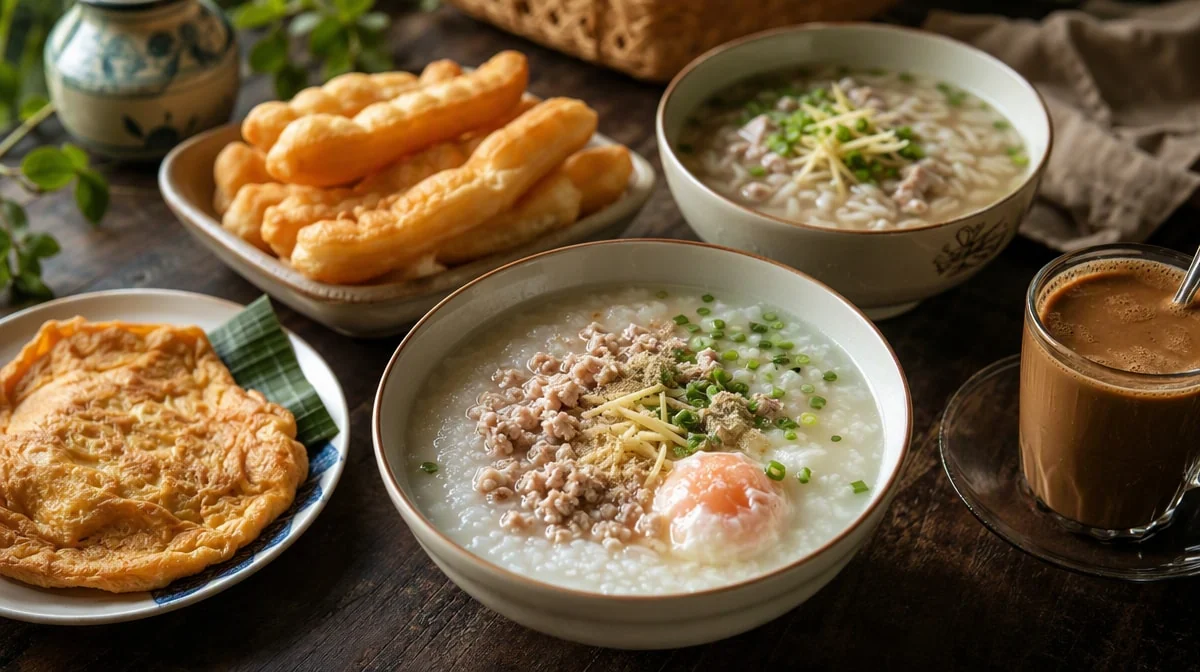
Thai breakfast is not one dish. It is a bowl of rice porridge, a plate of rice soup, an omelette over rice, a bag of sticky rice with grilled pork, or a few fried dough sticks with coffee. The one thing it is not is a fixed menu. Thailand eats the same food at breakfast as it does later in the day, and the morning lane is simply the subset that is quick, warm and easy to eat before work.
If you want the short answer: jok (rice porridge) and khao tom (rice soup) are the two classic bowls. Kai jeow (Thai omelette) with rice is the home fallback. Sticky rice with moo ping (grilled pork) is the street breakfast. Khao yam is the southern one. Patongo and soy milk fill the gaps. Pad thai is not a breakfast dish, even though you can buy it at eight in the morning.
What Do Thai People Eat for Breakfast?
The honest answer is "whatever is closest and fastest", but the recurring dishes are easy to list. Jok is the thick rice porridge, often with pork, egg and ginger. Khao tom is the thinner rice soup, with the grains still visible. Kai jeow is an omelette, usually served over rice. Sticky rice with grilled pork or chicken is the market breakfast, especially in the north and northeast. Khao yam is the southern rice salad. Patongo, soy milk, soft-boiled eggs, steamed buns and dim sum fill in around the edges.
The guidebook's food section puts jok and khao tom in the same breath: "At night and in the early morning, two soup-like rice dishes are favoured by Thais." It describes khao tom as rice in the water it was boiled in, with garlic-fried pork, salted egg or pickled ginger, and joke as the porridge-like relative with minced pork, coriander and fresh ginger. That is the core of the Thai breakfast, and it is savoury rather than sweet.
The other important point is that Thai breakfast is regional. In the south, khao yam is a breakfast. In the northeast and Laos, sticky rice with grilled meat is a breakfast. In Bangkok, jok and khao tom are everywhere, and the Chinese-Thai shops add dim sum and soft-boiled eggs. There is no single national breakfast, only a family of them.
Jok: The Rice Porridge

Jok is the thick one. Rice is cooked with stock until the grains break down into a smooth, almost porridge-like mass. It is the Thai take on Chinese congee, and it is the dish most people mean when they say "Thai rice porridge". The name is also written joke, joak or jôk; the Thai script is โจ๊ก.
The method is simple. Rinse jasmine rice, put it in a pot with chicken stock at roughly one cup of rice to eight cups of stock, and simmer for 45 to 50 minutes, stirring now and then, until the rice has collapsed. While it cooks, mix minced pork with garlic, soy or seasoning sauce, oyster sauce, pepper and spring onion, then form small balls and drop them into the porridge. When the pork is cooked, crack an egg into the pot or poach eggs in the bowl, and finish with crispy garlic, coriander, ginger and white pepper.
That ratio and timing come from a Thai home cook's jok moo recipe, and they are a good starting point. You can make it thinner with more stock, or thicker by cooking it longer. The texture target is not runny soup; it should hold a spoon. If you use a rice cooker, a porridge setting or a long cook on the standard setting will do the same job with less stirring; the rice cooker review on this site covers the appliance if you are buying one.
Toppings are where jok becomes personal. Minced pork balls, a soft-boiled or poached egg, sliced ginger, spring onion, coriander, white pepper, crispy fried garlic and a few drops of soy or Maggi-style seasoning are the classic set. Patongo on the side for dipping is optional but correct. The rice itself is jasmine; our guide to cooking jasmine rice covers the plain version.
Khao Tom Gai: Rice Soup, Not Porridge

Khao tom is the thinner cousin. The rice is cooked first, then added to a hot broth with chicken, pork or fish, so the grains stay visible and the dish eats like soup rather than porridge. Khao tom gai is the chicken version. It is lighter than jok, faster to make from leftover rice, and often eaten with a plate of stir-fry or a few condiments on the side.
The base is chicken stock, cooked jasmine rice, sliced ginger, a little fish sauce and white pepper. Poach or simmer chicken in the stock, add the rice, and let it heat through. Finish with spring onion, coriander and a spoon of garlic oil. If you have leftover rice, this is a ten-minute breakfast. If you are cooking rice from scratch, cook it first and keep it a little firmer than you would for a plate, because it will soften in the broth.
The distinction matters because English recipes use "congee" for both. Jok is the broken-down porridge; khao tom is the soup with whole grains. The guidebook's description is precise: khao tom comes in the water it was boiled in, while joke is porridge-like. If you order khao tom expecting a thick bowl, you will be surprised; if you order jok expecting a clear soup, you will be more surprised.
The site's chicken recipes are the place to go if you want a full meal alongside. Khao tom is a breakfast and a late-night dish, and it is one of the easiest Thai things to make in a British kitchen because it needs no special ingredients beyond rice, stock, ginger and fish sauce.
Kai Jeow: The Thai Omelette
Kai jeow is the Thai omelette, and it is the first dish most Thai cooks learn. Two eggs, a teaspoon of fish sauce, a hot pan with enough oil, and a few minutes. It is served over jasmine rice, usually with sriracha or a chilli sauce, and it is a legitimate breakfast, lunch or dinner.
The texture is different from a French omelette. Thai omelettes are fried hard in hot oil, so the edges go crispy and browned and the middle stays just set. Hot Thai Kitchen gives two methods: a restaurant-style version with half an inch of oil for a crisp, evenly browned omelette, and a home version with just enough oil to coat the pan, pushing the edges in so the raw egg runs to the side. Both work. The restaurant version is prettier; the home version is faster and less oily.
The ratio is two large eggs to one teaspoon of fish sauce. Beat them well, until there are no gooey bits of white left, or the omelette will be streaky. Add minced pork, prawns, crab or chopped vegetables if you want a fuller version; mix them into the egg before frying. Serve with rice and sriracha, or with a clear soup on the side.
For a breakfast, keep it plain and put it on top of rice. For a dinner, add pork and a stir-fry. The dish is forgiving, which is why it is the one Thai children learn first. It is also the fastest way to make a Thai breakfast in a UK kitchen with nothing in the fridge.
Sticky Rice, Moo Ping and Gai Yang
In the north and northeast, and in Laos, breakfast is often sticky rice with something grilled. Moo ping are pork skewers, grilled over coals. Gai yang is grilled chicken. Both are sold in the morning market with a bag of sticky rice, and both are eaten with the fingers.
The cookbook's Laotian section describes the same pattern: for breakfast, glutinous rice is soaked, steamed and eaten with mango, coconut or a fermented fish product, and sometimes with dried meat, fried chicken or chilli paste. In Isaan, the Thai version is sticky rice with grilled chicken or pork, and it is one of the most common street breakfasts in the region.
For a UK kitchen, the sticky rice is the part that needs planning. It has to be soaked and steamed, which takes longer than a bowl of jok. The guide to cooking sticky rice covers the method, and the guide to buying sticky rice tells you which bag to look for. The grilled meat can be done under a grill or on a griddle pan; it will not taste of charcoal, but it will taste of the marinade.
This is the breakfast to make when you want something you can eat with your hands. It is also the one that surprises people who think Thai breakfast is always wet. A bag of sticky rice and a skewer is a complete meal.
Khao Yam: The Southern Breakfast
Khao yam is the southern rice breakfast, and it is the one most English guides miss. The guidebook describes it as "a popular breakfast" of rice topped with sliced herbs, bean sprouts, dried prawns, toasted coconut and powdered red chilli, served with a sour-sweet fish-based sauce. It is a cool, herby, savoury dish, not a porridge, and it is built for the hot southern climate.
The name is also written khao yam, kow yam or kôw yam. The guidebook's phonetic spelling is Kôw yam, which is why
a string search for "khao yam" in the corpus returns nothing. The dish is real, and it is a breakfast, but the
books give the description rather than a recipe. That is why this page describes it and does not pretend to give
a family recipe.
If you want to make it in the UK, the closest approach is cold cooked rice with a lot of fresh herbs, bean sprouts, toasted coconut and a dressing of fish sauce, lime, palm sugar and chilli. It is a salad, not a soup. The southern Thai pages on this site cover the regional pantry; this page's job is to put khao yam on the breakfast map.
Patongo, Coffee and Soy Milk
Patongo are the Thai fried dough sticks, the ones you see in a wok of oil at a morning stall. They are lightly sweet, fluffy inside and crisp outside, and they are sold in bags for breakfast. They are eaten plain with coffee, dipped in a sweet custard called sang kaya, or dunked into jok. The same stalls often sell nam tao hoo, fresh soy milk served warm with sugar and jelly, and soft-boiled eggs.
This is the "grab it on the way to work" breakfast. It is not a recipe you need to make from scratch in a UK kitchen. If you have a Chinese bakery nearby, you can buy the same thing under the name yao tiew. If you have a Thai grocer, frozen patongo is a shortcut.
The coffee is strong, sweet and often served with condensed milk. If you do not want sugar, ask for black coffee;
the guidebook's phrase is gah·faa dam. The soy milk is warm, not cold, and it is a drink and a snack at the
same time. This is the part of Thai breakfast that travels most easily to the UK, because the ingredients are
already in a British supermarket.
Is Pad Thai a Breakfast Food?
No, not traditionally. Pad thai is an anytime dish, and you can find it at a street stall in the morning, but it is not part of the breakfast repertoire. The breakfast dishes are the rice porridges, the soups, the omelette and the sticky-rice-and-grill combination. Pad thai is a lunch, dinner or late-night dish.
The confusion comes from the fact that Thai meal boundaries are loose. A Thai cook will eat rice and curry at breakfast, and a British visitor will eat pad thai whenever it is available. Eating Thai Food makes the point that you can eat the same foods for breakfast as for lunch or dinner, and then lists jok, khao tom, omelette, moo ping, patongo and dim sum as the breakfast regulars. Pad thai is not on that list.
The answer is: you can eat pad thai for breakfast, and nobody will stop you, but it is not what a Thai family means by breakfast. If you want the real thing, make jok or khao tom. If you want pad thai, make the prawn pad thai recipe and eat it whenever you like. Just do not call it a breakfast dish and expect a Thai grandmother to agree.
Making Thai Breakfast in a UK Kitchen
The good news is that most of this is supermarket-friendly. Jasmine rice, eggs, fish sauce, ginger, spring onion, coriander, chicken stock and minced pork are all easy to find. The only specialist items are the Thai seasoning sauce for jok, the crispy fried garlic (make it yourself in five minutes), and the patongo if you want the full street experience.
A rice cooker makes jok almost hands-off. Use the porridge setting if it has one, or the standard setting with a 1:8 rice-to-stock ratio and a long cook. Check it after 45 minutes; if it is not broken down, give it more time. A slow cooker works too, but the texture is better on the stove where you can stir and adjust. The site's rice cooker review is the place to look if you are buying one.
For khao tom, cook the rice the day before and keep it in the fridge. That turns breakfast into a ten-minute dish. For the omelette, use a small pan and enough oil to make the edges crisp; do not be timid with the heat. For sticky rice, soak it overnight and steam it in a basket or a colander over a pan; the sticky rice guide has the timings.
The shopping list is short: jasmine rice, sticky rice, fish sauce, soy sauce, oyster sauce, ginger, garlic, spring onion, coriander, eggs, minced pork, chicken stock and sriracha. The guide to buying Thai ingredients in England covers the shop types. Everything else is a variation.
Frequently asked questions
What do Thai people usually eat for breakfast?
Jok (rice porridge), khao tom (rice soup), kai jeow (omelette) with rice, sticky rice with grilled pork or chicken, and patongo with coffee or soy milk. In the south, khao yam is a breakfast. Thai breakfast is savoury and regional, not a single fixed menu.
Is Thai breakfast healthy?
It can be. Jok and khao tom are light and mostly rice, stock and lean protein. The fried dough, processed meats and sugary coffee are the less healthy parts. If you want a lighter version, use more vegetables, less oil and skip the sweet drinks. It is not a health food by default.
Do Thai people eat eggs for breakfast?
Yes. Eggs turn up in jok, in khao tom and as kai jeow, the omelette served over rice. Soft-boiled eggs are also a street breakfast, often with patongo and coffee. Eggs are cheap, quick and neutral, which is why they fit the morning lane so well.
What is jok made of?
Jok is rice cooked in stock until it breaks down into a thick porridge. It usually has minced pork, ginger, spring onion, coriander, white pepper and a soft-boiled or poached egg. The ratio is about one cup of rice to eight cups of stock, simmered for 45 to 50 minutes.
Can I make jok in a rice cooker?
Yes. Use the porridge setting if your cooker has one, or the standard setting with a 1:8 rice-to-stock ratio and a long cook. Check it after 45 minutes and add stock if it is too thick. A rice cooker is less precise than a pot, but it is much easier on a weekday morning.
Is khao tom the same as congee?
No. Khao tom is rice soup: the rice is cooked first, then added to broth, and the grains stay visible. Congee, and its Thai cousin jok, is cooked until the grains break down into a porridge. The names are often used loosely in English, but the textures are different.
What is khao yam?
Khao yam is a southern Thai breakfast of rice topped with herbs, bean sprouts, dried prawns, toasted coconut and chilli, served with a sour-sweet fish sauce. It is a cool, herby salad rather than a porridge. The guidebook calls it "a popular breakfast".
Is pad thai a breakfast food?
Not traditionally. Pad thai is an anytime dish, but the Thai breakfast lane is jok, khao tom, omelette, sticky rice with grilled meat and patongo. You can eat pad thai in the morning, and some stalls sell it, but it is not what a Thai family means by breakfast.
What is the difference between jok and khao tom?
Jok is thick rice porridge, cooked until the grains break down. Khao tom is rice soup, made with cooked rice and broth, with the grains still visible. Jok is smoother and more filling; khao tom is lighter and faster. Both are savoury, and both are breakfast dishes.
What do Thai people drink for breakfast?
Coffee, often strong and sweet with condensed milk, or black coffee if you ask for gah·faa dam. Soy milk
(nam tao hoo) is common, served warm with sugar and jelly. Tea and fruit juices are also common. The coffee culture
is serious, especially in the south.



Comments