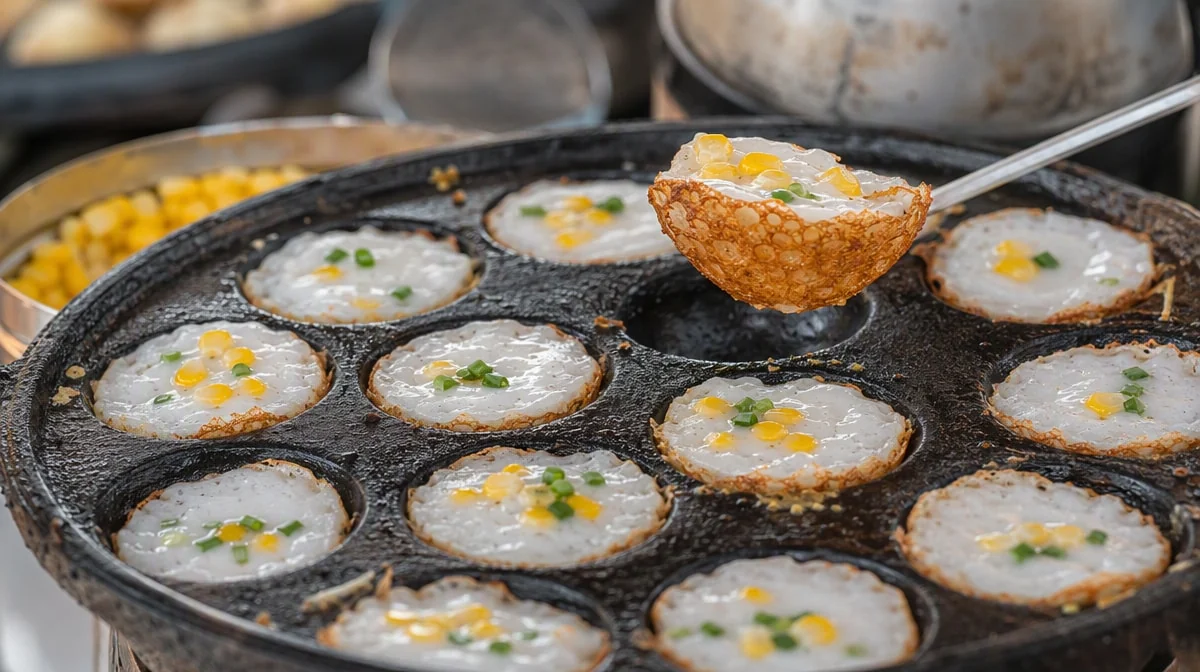
Khanom khrok, usually searched as khanom krok, are Thai coconut pancakes cooked in a dimpled pan. They are crisp and golden on the bottom, soft and custardy in the middle, and small enough to eat in one or two bites. The batter is rice, coconut and sugar; the filling is coconut milk, sugar and a little rice flour; the toppings are usually spring onion, sweetcorn or taro. They are one of the most popular street snacks in Thailand, and they are easy to make at home once you have the right pan.
The texture is the whole point. A good khanom krok has a thin, crunchy shell and a warm, wobbly coconut centre. If it is soggy, the pan was not hot enough, the batter was too wet or the cakes were left to sit. If it is tough, the batter was overworked or the rice flour was the wrong kind.
What Is Khanom Krok?
Khanom krok is a Thai coconut pancake, cooked in a pan with round indentations. It is a street food and a dessert, and it sits somewhere between a pancake, a custard tart and a doughnut hole. The outside is crisp; the inside is soft, sweet and coconutty. The name is sometimes written khanom khrok, kanom krok or khanom krok.
The cooking-school book's recipe makes 24 and calls them "crispy rice pancakes". The batter is jasmine rice, cooked rice, grated coconut, salt, sugar and boiling water, processed until ground. The topping is thick coconut milk, caster sugar, salt and tapioca flour. The pan is compared to "an aebelskiver pan or gem scone iron". That is the whole dish in one paragraph: a rice batter, a coconut topping and a dimpled pan.
The texture comes from two things. The rice batter sets into a thin shell, and the coconut topping sets into a soft custard. If you mix them together before cooking, you get a pancake, not khanom krok. The two-part pour is the technique. It is one of the desserts on the coconut desserts page and the Thai street food list.
Khanom Krok Pan: What Pan to Use

The traditional pan is a large cast-iron griddle with many round hollows. It is made for a street stall, not a home hob, so most UK cooks use a smaller pan with the same shape. The cooking-school book says the pan "could best compared to an aebelskiver pan or gem scone iron". Hot Thai Kitchen says a takoyaki pan works well, and an aebelskiver pan works if you fill it only halfway because the hollows are too big.
The pan matters because of the shell-to-filling ratio. If the hollow is too wide, you get too much custard and too little crisp shell. If it is too shallow, the filling spills. A takoyaki pan, an appam pan or a dedicated khanom krok pan is the right size; a Yorkshire pudding tin is not, because the sides are too straight and the batter will not form the same cup.
In the UK, these pans are sold as takoyaki pans, aebelskiver pans or appam pans. Amazon UK lists cast-iron aebelskiver pans that are also sold for takoyaki and khanom krok, and Karahi Shop sells appam pans. You do not need a Thai-specific pan; you need a pan with round, fairly shallow hollows and a lid.
If you have an electric takoyaki pan, use it on a medium setting and give it time to heat through. If you have a cast-iron pan, season it well or the batter will stick. The cooking-school book brushes the pan with oil; Hot Thai Kitchen brushes the holes with oil and tests the heat with a drop of water.
Khanom Krok Recipe (Crispy Outside, Soft Middle)
This follows the cooking-school recipe, with the topping and the method from the same page. It makes about 24 small pancakes.
For the batter
- 200g jasmine rice
- 4 tablespoons cooked rice
- 60g grated fresh coconut
- ¼ teaspoon salt
- 1 tablespoon sugar
- 750ml boiling water
- Oil, for the pan
For the topping
- 250ml thick coconut milk
- 2 tablespoons caster sugar
- ¼ teaspoon salt
- 1 tablespoon tapioca flour
To serve
- 65g sweetcorn kernels
- 3 spring onions, thinly sliced
- 2 tablespoons pounded dried shrimp (optional)
Method
- Combine both rices, the coconut, salt and sugar in a bowl. Pour in the boiling water and leave it to stand until cold.
- Blend the mixture until ground. It should be a smooth, pourable batter, not a paste. If it is too thick, add a little water.
- Mix the topping ingredients in a bowl and whisk until smooth.
- Heat the pan over a low to medium heat and brush the hollows with oil. Half-fill each hollow with the rice batter.
- Cook for about 10 minutes, or until the base is set and the edges are crisp. Halfway through, add a scant tablespoon of the coconut topping to each cake and sprinkle with corn, spring onion and dried shrimp, if using.
- Cover the pan with a lid for the last minute or two to set the top. The topping should be just set but still wobbly.
- Lift the cakes out with a small spoon or skewer and serve warm.
The cooking-school book gives an oven option: preheat the oven to 220°C (430°F) and cook for 10 minutes. That is useful if you do not have a hob-friendly pan, but the stovetop gives a crisper base.
Why Khanom Krok Goes Wrong
The most common failure is a soggy cake. It usually means the pan was not hot enough, the batter was too wet or the cakes were left sitting after cooking. Hot Thai Kitchen's rule is to eat them straight away; they go mushy and soggy fast. If you are making a batch, keep them warm in a low oven, but do not stack them.
The second failure is a tough or rubbery cake. That is usually over-blending the batter or using the wrong rice flour. The cooking-school recipe uses whole jasmine rice and cooked rice, blended until ground; Hot Thai Kitchen uses Thai rice flour and warns against glutinous rice flour. If you use a flour labelled "glutinous", you will get a chewy texture, not a crisp shell.
The third failure is a filling that will not set. The topping needs tapioca flour and enough heat. If it stays liquid, the pan is too cool or the topping is too thin. Add a little more tapioca flour and give it another minute with the lid on.
The fourth failure is sticking. Cast iron needs seasoning, and non-stick pans need oil in every hollow. Do not skip the oil, even on a non-stick pan.
Khanom Krok Fillings: Corn, Spring Onion and Savoury
The classic toppings are spring onion and sweetcorn. The spring onion is the one that surprises people: it is savoury in a sweet coconut pancake, and it works. Hot Thai Kitchen calls it the most classic topping and her favourite. Sweetcorn is the other common one, and taro is a third.
The cooking-school book serves the cakes with corn, spring onion and pounded dried shrimp. The dried shrimp is optional, but it turns the pancake into a savoury bite and is a good bridge to a party table. If you are serving them as a dessert, skip the shrimp and use corn or taro.
There are also filled versions. The cooking-school book's Khanom Khrok Tom Kha Kai is a crème-brûlée-style rice batter filled with tom kha chicken, galangal, kaffir lime and chilli jam. It is a restaurant interpretation, not a street pancake, and it is a useful reminder that the form can carry savoury fillings. Do not expect it to taste like the street version.
For a party, make a plain batch and a savoury batch. The plain ones with spring onion are the crowd-pleaser; the savoury ones with dried shrimp are the conversation piece.
Khanom Krok Bai Toei: the Pandan Version

Bai toei is pandan leaf, so khanom krok bai toei is the pandan version of the pancake, not a banana-cup version.
The batter is blended with fresh pandan leaves, which gives it a green colour and a sweet, grassy aroma. The
method is the same: rice batter, coconut topping, dimpled pan.
Forkin's recipe blends coconut milk, water and pandan leaves, strains the liquid, then mixes it with rice flour, tapioca starch, sugar and salt. The topping is coconut milk, sugar, salt and rice flour. The result is a green pancake with the same crisp shell and soft centre.
This is the version to make if you want the pancakes to look different on a party table. It is also the version that travels best in the UK, because pandan is sold in Asian grocers and the colour is unmistakable. If you cannot find fresh pandan, use pandan extract, but start with a small amount; it is strong.
The banana-leaf cup is a different form. The Food of Thailand uses banana-leaf cups for steamed fish, not for khanom krok. Do not confuse the two; the pancake is cooked in a pan, and the leaf cup is a steamer.
Khanom Krok in the UK
The ingredients are easy to find. Jasmine rice, rice flour, coconut milk, sugar, salt, corn and spring onions are supermarket staples. Fresh grated coconut is the one item that may need an Asian grocer; desiccated coconut is not a good substitute for the batter, though it is fine as a garnish. The guide to buying Thai ingredients in England covers the shop types.
The pan is the only specialist piece of kit. A takoyaki pan, an aebelskiver pan or an appam pan will do; a dedicated khanom krok pan is nice but not necessary. If you are buying one, check the size of the hollows and whether it fits your hob. A pan that is too big for the burner will heat unevenly and give you pale, soggy cakes.
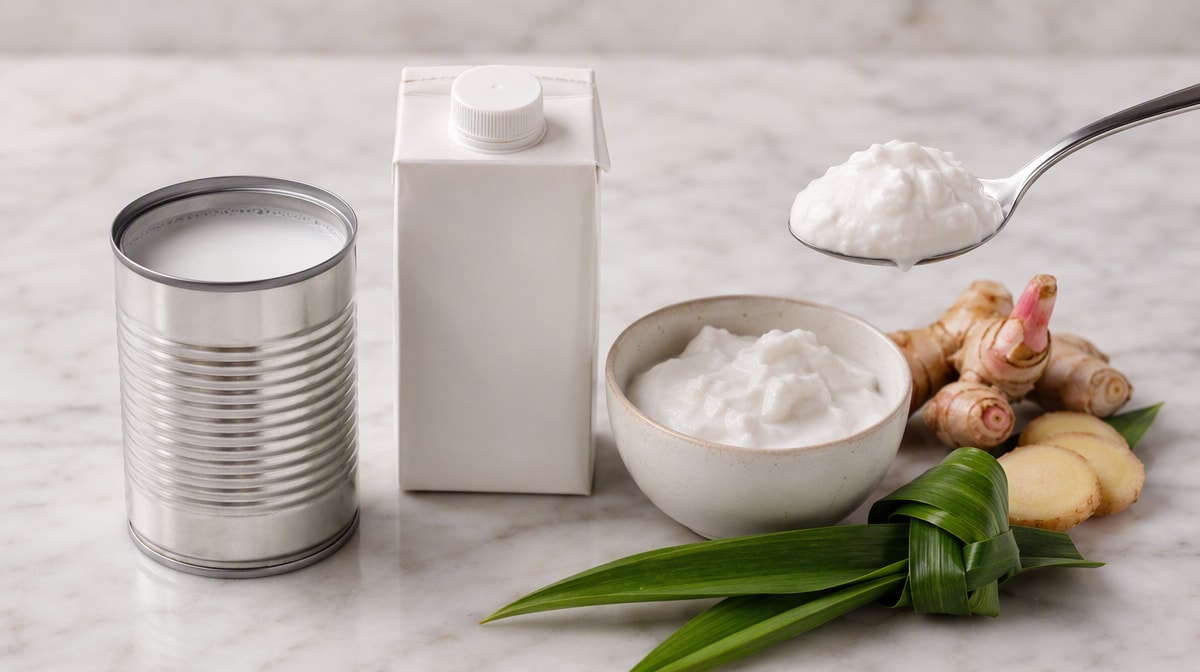
Coconut milk quality matters. Hot Thai Kitchen recommends a good carton of coconut milk, not a low-quality tin, because the flavour of the pancake depends on it. The site's coconut milk vs coconut cream page explains the grades; this recipe uses thick coconut milk for the topping and a thinner batter. If you have opened a tin and have some left, the storage page covers how long it keeps.
Serving and Storage
Serve khanom krok warm, straight from the pan. They are best within a few minutes of cooking, while the shell is still crisp and the centre is still wobbly. If you are making a large batch, keep the finished ones in a single layer in a low oven, not stacked, and bring them to the table as they come off the pan.
They do not keep well. Hot Thai Kitchen says they go mushy and soggy fast, and recommends reheating leftovers back in the pan until they sizzle. That works, but they will be drier than fresh. Freezing is possible; the texture suffers, and a quick reheat in a hot pan or air fryer is better than a microwave.
For a party, cook them in batches and serve them as they come. Do not try to fry 50 in advance and reheat them all at once. The dish is a performance: the pan, the ladle and the topping are part of the appeal.
Khanom Khrok (Thai Coconut Pancakes)
Ingredients
- 200 g jasmine rice
- 4 tbsp cooked rice
- 60 g grated fresh coconut
- ¼ tsp salt
- 1 tbsp sugar
- 750 ml boiling water
- Oil, for the pan
- 250 ml thick coconut milk
- 2 tbsp caster sugar
- ¼ tsp salt
- 1 tbsp tapioca flour
- 65 g sweetcorn kernels
- 3 spring onions, thinly sliced
- 2 tbsp pounded dried shrimp (optional)
Instructions
- Combine both rices, coconut, salt and sugar. Pour in the boiling water and leave until cold.
- Blend until ground into a smooth, pourable batter.
- Mix the topping ingredients and whisk until smooth.
- Heat the pan over low-medium heat and brush the hollows with oil. Half-fill each hollow with batter.
- Cook for about 10 minutes until the base is set and crisp. Halfway through, add a scant tablespoon of topping and the corn, spring onion and dried shrimp.
- Cover the pan for the last 1-2 minutes to set the top. The topping should be just set and wobbly.
- Lift out with a small spoon or skewer and serve warm.
Frequently asked questions
What is khanom krok?
Khanom krok, also written khanom khrok, is a Thai coconut pancake cooked in a dimpled pan. It has a crisp rice shell and a soft coconut custard centre, usually topped with spring onion, sweetcorn or taro. It is a street food and a dessert, and it is eaten warm.
What pan can I use if I don't have a khanom krok pan?
A takoyaki pan works well. An aebelskiver pan works if you fill it only halfway, because the hollows are larger. An appam pan also works. You need round, shallow hollows and a lid. A Yorkshire pudding tin is too deep and straight- sided.
Why are my khanom krok soggy?
The pan was not hot enough, the batter was too wet, or the cakes sat after cooking. They are best eaten straight away. If you are batch-cooking, keep them in a single layer in a low oven, not stacked, and reheat leftovers in a hot pan.
Are khanom krok vegan?
The basic recipe is vegan if you use coconut milk and sugar, because it contains no egg or dairy. Check the coconut milk and the toppings. The cooking-school version with tom kha chicken is not vegan; the plain street version usually is.
Can I make khanom krok ahead?
The batter can be made ahead and kept in the fridge, but bring it to room temperature before cooking. The cooked pancakes do not keep well; they go soggy. Cook them to order if you can, or keep them warm in a single layer in a low oven.
How do I reheat khanom krok?
Put them back in the pan over medium heat until they sizzle and the base crisps again. An air fryer works too. A microwave will make them rubbery and should be avoided. They will be drier after reheating, but the texture comes back.
What toppings go on khanom krok?
Spring onion and sweetcorn are the classics, with taro as a third. The cooking-school book also uses pounded dried shrimp, which makes a savoury version. For a dessert, stick to corn, taro or plain. For a party, make one sweet batch and one savoury batch.
Is khanom krok gluten free?
The rice-based recipe is gluten free if the rice flour and other ingredients are gluten free. Check the packet, because some rice flour is processed in a shared mill. The cooking-school recipe uses whole rice and cooked rice, which is naturally gluten free.
What is khanom krok bai toei?
It is the pandan version of khanom krok. The batter is blended with pandan leaf, which gives it a green colour and
a sweet, grassy aroma. It is not a banana-cup version; bai toei means pandan leaf. The method is the same as the
plain pancake.
Why is my khanom krok tough?
The batter was over-blended, or you used glutinous rice flour instead of regular rice flour. Blend only until the rice is ground, and use Thai rice flour, not glutinous rice flour. Over-cooking also makes the shell hard rather than crisp.


Comments