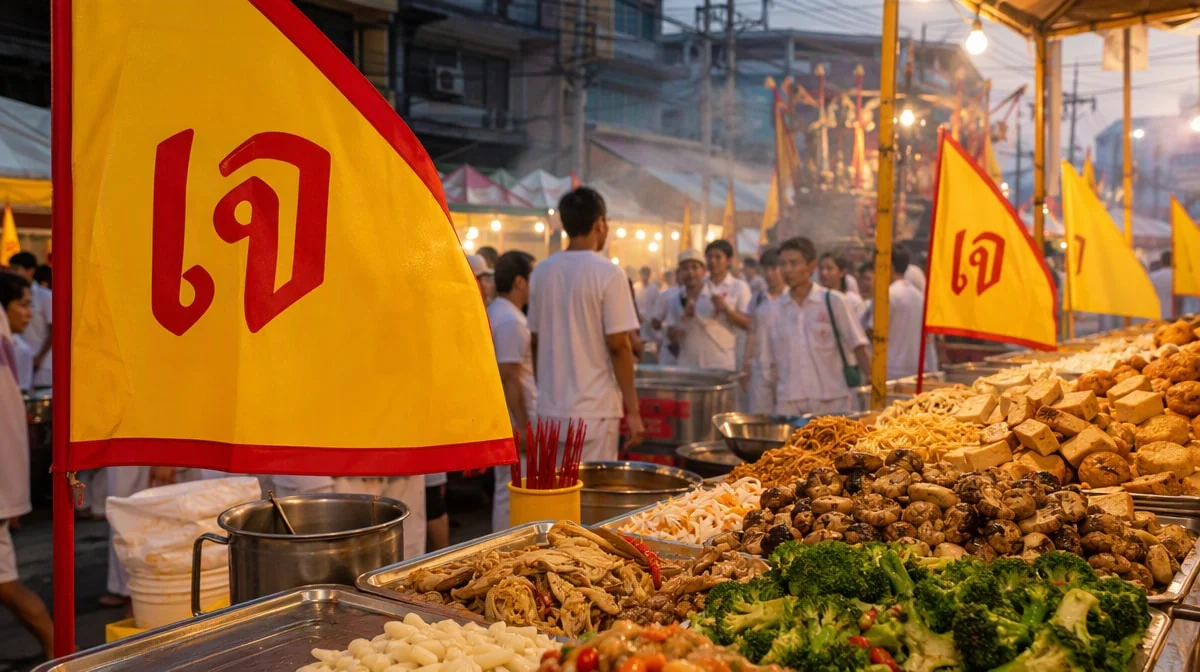
Jay food, ahaan jay or kin jay, is the Chinese-Thai vegan tradition that takes over Thailand's streets for nine
days each autumn. The rules go further than ordinary vegan food: no meat, fish, eggs or dairy, and no garlic,
onions, shallots, chives or other pungent vegetables. The food is marked with a yellow flag printed with the Thai
character เจ in red. If you see the flag, the stall is cooking to the jay rules, not merely leaving the meat out.
The festival is called Tesagan Gin Jay in Thai, and it honours the Nine Emperor Gods. It falls in the ninth month of the Chinese lunar calendar, which is why the dates move each year. In 2026 the main observance runs from 10 to 18 October, with Phuket's ceremonies beginning on 9 October. It is a religious observance as much as a food festival: participants dress in white, visit shrines, and give up animal products, alcohol and other indulgences for the period.
What Is Jay Food?

Jay food is plant-based food cooked to a set of Chinese-Thai religious rules. The core rule is no animal products: no meat, poultry, fish, seafood, eggs or dairy. The second rule is no pungent vegetables: garlic, onions, shallots, chives and related plants are out. Alcohol is also avoided during the observance.
That makes jay stricter than vegan in one direction and different in another. A dish can be vegan and still not be jay if it uses garlic or onion. A dish can be jay and not vegan if it uses honey, though most jay cooks avoid that too. The distinction matters when you are ordering: asking for "vegan" may get you a garlicky stir-fry; asking for "jay" gets you the festival rules.
The guidebook describes the festival as a 10-day Chinese-Buddhist event that "wheels out yellow-bannered streetside vendors serving meatless meals", with the greatest concentration in Bangkok's Chinatown. It also notes that during the festival many restaurants and stalls go meatless for a month, which is longer than the nine-day festival. The rules are religious, but the food is ordinary Thai food adapted: curries, stir-fries, noodles, soups and snacks, made without the fish sauce, shrimp paste, garlic and onion that usually build the flavour.
Why Are There Yellow Flags in Thailand in October?
The yellow flag is the sign of jay food. It is usually a yellow cloth or paper flag with the character เจ in red, and it tells customers that the stall or restaurant is following the jay rules. The guidebook says that during the festival "food shops and stalls all over the city post yellow flags to announce their meat-free status".
The flags are not a certification. They are a signal, and the cook is trusting you to trust them. Duke Language School makes the point directly: the flag tells you the vendor is offering jay food, but it is not an independent food-safety inspection. If you have a serious allergy or a strict requirement, ask about the ingredients and the utensils.
The flags appear outside restaurants, market stalls, supermarkets and even petrol-station food counters. In Chinatown, whole streets turn yellow. The colour is associated with the festival and with the Chinese-Thai shrines, and it is the fastest way to find food you can eat without a conversation.
When Is the Thai Vegetarian Festival?
The festival is held in the ninth month of the Chinese lunar calendar, which usually puts it in September or October. It runs for nine days, with the main observance from the first to the ninth day of the ninth lunar month. The date moves every year because the lunar calendar does not line up with the Gregorian one.
In 2026, the main observance runs from 10 to 18 October, with Phuket's opening ceremonies on 9 October and Bangkok's Yaowarat activities starting on 9 October. In 2027, the dates are 30 September to 8 October, according to news and travel listings. If you are reading this in a later year, check the current dates; the lunar rule is the permanent fact, the dates are not.
The festival is celebrated across Thailand, but the best-known versions are in Phuket, Bangkok's Chinatown, Trang and other towns with large Thai-Chinese communities. Phuket's is the most dramatic, with processions, firecrackers and spirit mediums. Bangkok's is the most food-focused, especially around Yaowarat. The guidebook describes the southern festival as a late September or October event with parades and "fantastic meat-free food".
What Is Kin Jay?
Kin jay means "eat jay" in Thai. The phrase is used as an invitation, a description and a request. The guidebook
gives the phrase for "I'm vegetarian" as pom gin jair (for men) or dichan gin jair (for women), and notes that
it means no eggs and no dairy, which is effectively vegan.
There is a second phrase, mangsawirat, which means vegetarian in the general sense. The difference matters: a
mangsawirat kitchen may use eggs or dairy, while a jay kitchen follows the stricter festival rules. If you want
the full jay rules, say jay; if you are happy with ordinary vegetarian food, mangsawirat is the broader term.
The word is also written je, jee or jay in English. The Thai character is เจ. On a flag or a menu, it is the
one to look for.
What Vegans Can and Can't Order in Thailand
Thai food is not automatically vegan. Fish sauce is in most savoury dishes, oyster sauce is common in stir-fries, shrimp paste is in many curry pastes, and egg turns up in noodles and fried rice. A dish that looks vegetable-based may still have fish sauce in the dressing.
The safest places are jay stalls and restaurants during the festival, because the whole kitchen is cooking to the
rules. Outside the festival, look for mangsawirat restaurants, or ask for jay if you want the stricter version.
Do not assume a restaurant understands "vegan" in the English sense; it is safer to say jay or mangsawirat and
ask about fish sauce, oyster sauce and shrimp paste.
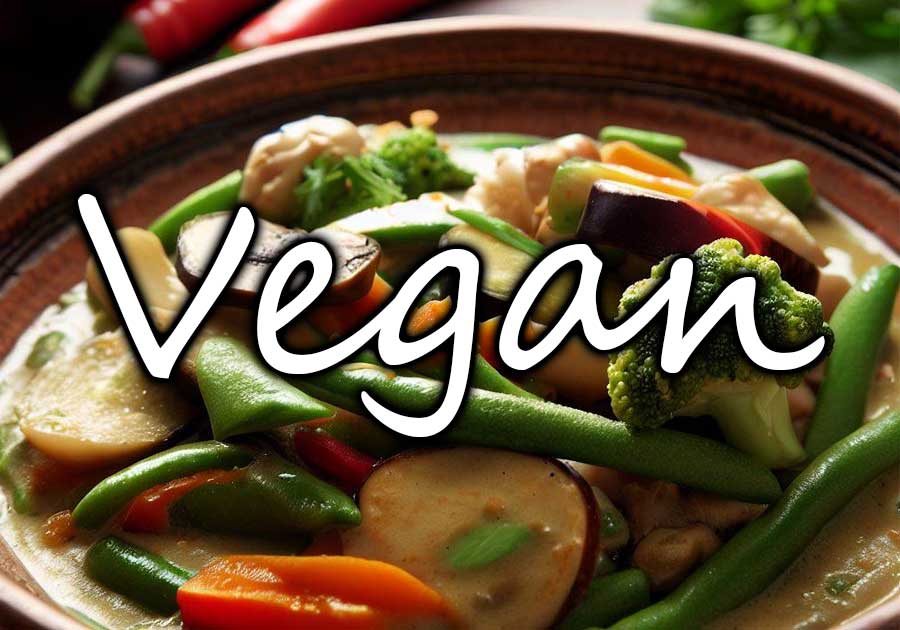
What can you order? Vegetable stir-fries, tofu dishes, mushroom dishes, plain rice, rice noodles with vegetables, som tam without fish sauce, coconut-based curries made with jay paste, and fruit. What should you check? Curry pastes, stir-fry sauces, soups, fried rice, and anything with a "vegetarian" label that may still contain egg or dairy. The vegan green curry is a good home baseline.
Jay food is not necessarily bland. The festival cooks replace the missing garlic and fish sauce with soy, herbs, mushrooms, fermented bean products and slow cooking. The result can be deeply savoury. If you want heat, ask for chilli; jay food can be as spicy as any other Thai food, and the heat guide explains the scale.
What Replaces Fish Sauce in Jay Food?

Fish sauce is the main problem. Jay cooks replace it with light soy sauce, mushroom sauce, fermented bean curd, vegetarian oyster sauce or a commercial vegan fish sauce. Each brings salt and umami, but none tastes exactly like fish sauce. The cook adjusts with sugar, lime, chilli and herbs to rebuild the balance.
The blue-elephant guide to the festival says cooks "rebuild the depth that garlic and fish sauce usually provided with soy, herbs and slow cooking". That is the right way to think about it: the replacement is not one ingredient, it is a combination. Soy gives salt and colour; mushrooms give earthiness; fermented bean products give funk; lime and chilli give the top notes.
At home, use light soy sauce or mushroom soy instead of fish sauce, and add a little sugar to round the salt. Do not use the same amount; soy is saltier and more direct. Taste as you go. If you want a ready-made product, look for "vegetarian fish sauce" or "vegan fish sauce" in an Asian grocer, and check the label for fish or shrimp.
Red and Yellow Signs: How to Read a Jay Stall
The yellow flag with red เจ is the main sign. A red and yellow sign may also appear; the combination is the festival colouring, and it usually means the same thing. Some stalls use a printed banner, some a hand-painted flag, some a small sticker on the cart. The character is the thing to look for, not the exact shade of yellow.
A jay stall usually sells a limited menu: noodles, curries, stir-fries, fried rice, dumplings, sweets. The food is often served from large trays or cooked to order. The prices are street-food prices, and the portions are small. The stall may also sell jay snacks and desserts, which are worth trying.
The flag is not a guarantee of allergy safety. If you have a nut allergy, a gluten intolerance or a serious shellfish allergy, ask. A jay kitchen avoids fish and shellfish by rule, but cross-contact is possible in a shared market. The same caution applies to any street food.
Jay Food in the UK
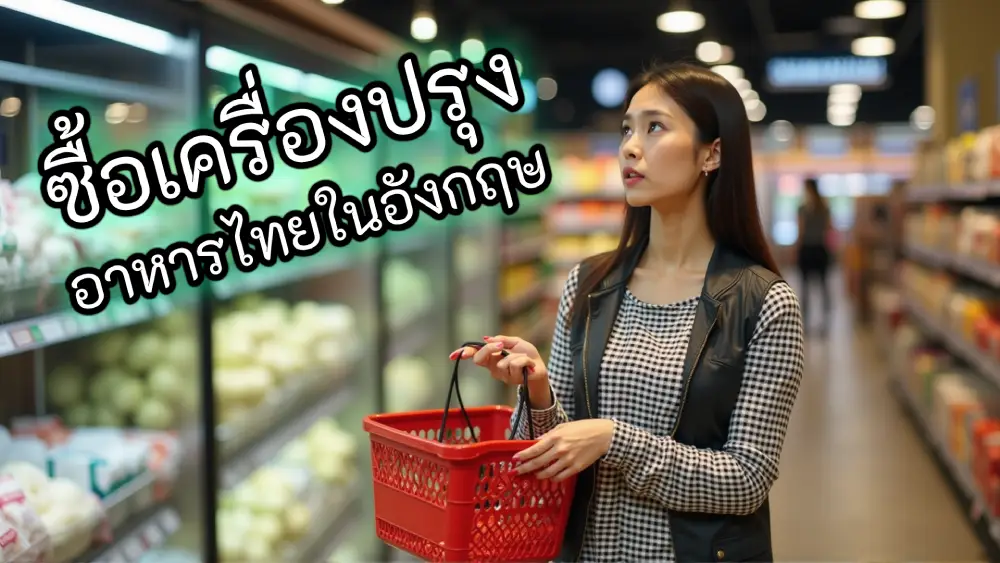
You will not find a yellow-flagged street in most UK towns, but you can cook jay food at home and you can find the ingredients. Asian grocers sell vegetarian oyster sauce, mushroom soy, fermented bean curd and vegan fish sauce. The guide to buying Thai ingredients in England covers the shop types.
The easiest jay meal at home is a coconut curry with tofu and vegetables, made with a jay-friendly paste. Check the paste for shrimp paste and fish sauce; many Thai curry pastes contain one or both. The vegan green curry is a good starting point, and the jay rules are easy to apply: leave out the garlic and onion, use soy or mushroom sauce instead of fish sauce, and check the paste.
Some UK Thai restaurants offer vegan menus, especially in cities with a Thai community. Ask for jay or
mangsawirat, and ask whether the curry paste is fish-free. The answer is not always yes, so a conversation is
worth having.
Frequently asked questions
Is jay food vegan?
Mostly, but the rules are stricter than vegan in one direction and different in another. Jay excludes all animal products, including eggs and dairy, and also excludes garlic, onions, shallots and chives. A vegan dish with garlic is not jay; a jay dish is usually vegan.
Is jay food gluten free?
Not automatically. Soy sauce, vegetarian oyster sauce and some curry pastes contain wheat. Rice, rice noodles, coconut milk and vegetables are naturally gluten free. Check the labels if you are coeliac, and ask about soy sauce at a stall. Rice noodles are the safer choice.
Can I eat jay food all year?
Yes. Some restaurants serve jay food throughout the year, especially in areas with Chinese-Thai communities. The festival is when it becomes widespread, but the food and the yellow flags are not limited to the nine days. The festival is the peak, not the only time.
What is the difference between jay and vegetarian?
Mangsawirat is the general Thai word for vegetarian and may include eggs or dairy. Jay is the stricter
Chinese-Thai tradition: no animal products and no garlic, onions, shallots or chives. If you want the full rules,
ask for jay. The two words are not interchangeable.
What is the Nine Emperor Gods festival?
It is the Chinese festival behind Thailand's Vegetarian Festival. It honours the Nine Emperor Gods, who are associated with healing and purification. The Thai version is celebrated in the ninth Chinese lunar month with processions, shrine visits, white clothing and a strict plant-based diet.
Where is the festival in Thailand?
The best-known celebrations are in Phuket, Bangkok's Chinatown (Yaowarat), Trang and other towns with large Thai-Chinese communities. Phuket is the most dramatic; Bangkok is the most food-focused. The festival is not a single venue; it is a nationwide observance. Phuket's is the most famous.
What should I order at a jay stall?
Noodles, fried rice, curries, stir-fries, dumplings, tofu and mushroom dishes, and the jay sweets. The menu is usually small and the food is cooked fresh. Ask what is in the dish if you have an allergy, and look for the yellow flag with the red เจ.
Is jay food spicy?
It can be. Jay food is Thai food without the animal products and the pungent vegetables, not without the chilli. Some dishes are mild, some are hot. Ask for less chilli if you need to, and remember that the heat guide is about Thai food generally, not a jay-specific scale.
Can I buy jay food in the UK?
You can buy the ingredients in Asian grocers and cook it at home. Some UK Thai restaurants offer vegan menus, and some sell jay dishes during the festival. Look for vegetarian oyster sauce, mushroom soy and vegan fish sauce, and check the curry paste.
When is the festival in 2027?
The 2027 dates are 30 September to 8 October, according to news and travel listings. The date moves with the ninth Chinese lunar month, so check again closer to the time. The page gives the lunar rule so the answer stays useful even when the dates change.


Comments