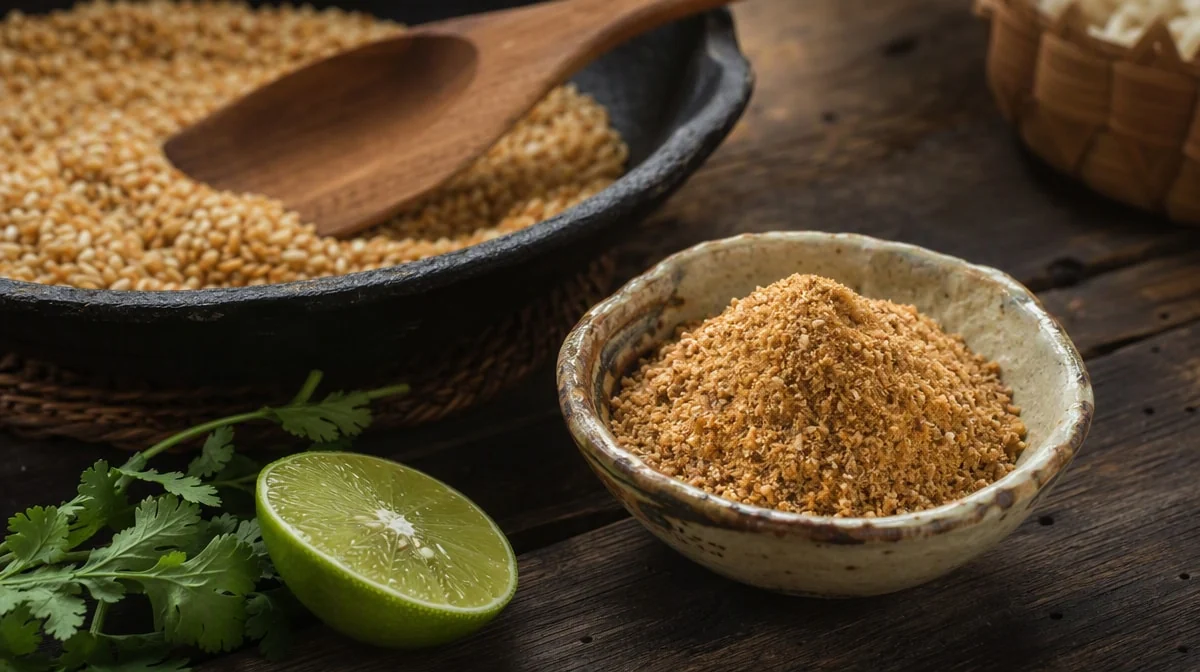
Roasted rice powder and toasted rice powder are the same ingredient. Raw rice goes into a dry pan, gets stirred until the grains turn golden or deep brown, then gets ground to a coarse powder. In Thai it is khao khua (ข้าวคั่ว), from khao, rice, and khua, to toast in a dry pan. It tastes nutty and smells like popcorn, and it is the reason larb has an earthy depth and a faint crunch rather than tasting only of lime and fish sauce.
You can make it in about fifteen minutes with a quarter cup of sticky rice and a frying pan, or buy a 250g bag from a Thai or Chinese grocer. Homemade is stronger. The aroma fades quickly once the rice is ground, which is the one argument for doing it yourself.
What Is Roasted Rice Powder?
Khao khua is rice, not a spice mix and not a flour. The cooking-school booklet prints it as "Roasted Rice Powder, Kao Pun", with a quarter cup of long-grain rice and nothing else. Its own note then calls the same thing "ground toasted rice", which is the clearest evidence that the two English names are not two products. The guidebooks use the same phrase when they describe larb: minced meat seasoned with "roasted rice powder, lime, fish sauce and fresh herbs" (Lonely Planet Thailand).
The texture is the part that matters. The cooking-school method grinds the toasted grains until they resemble coarse cornmeal. Hot Thai Kitchen aims for fine sand, and the Curry Guy for sand or fine breadcrumbs. None of them wants flour. A powder that fine loses the grit that makes the ingredient useful.
What it does in a dish is easy to miss if you have only seen it listed as an optional extra. It absorbs the juices that meat and lime throw off, so the salad does not pool at the bottom of the bowl. It carries salt and chilli through every bite. It adds a toasted aroma that no fresh herb can replace. Our own larb recipe puts it plainly: khao khua is structural, not a garnish.
Its home is Isaan, the northeast, and Laos. The guidebook puts larb itself in the northeast, and Hot Thai Kitchen calls toasted rice powder an iconic flavour of Isaan cooking. It turns up in nam tok, nam jim jaew and jungle curry, and it is used as a coating for fried chicken as well as a seasoning for salads. In an Isaan kitchen it is a pantry ingredient, not a one-dish trick.
How to Make Roasted Rice Powder at Home

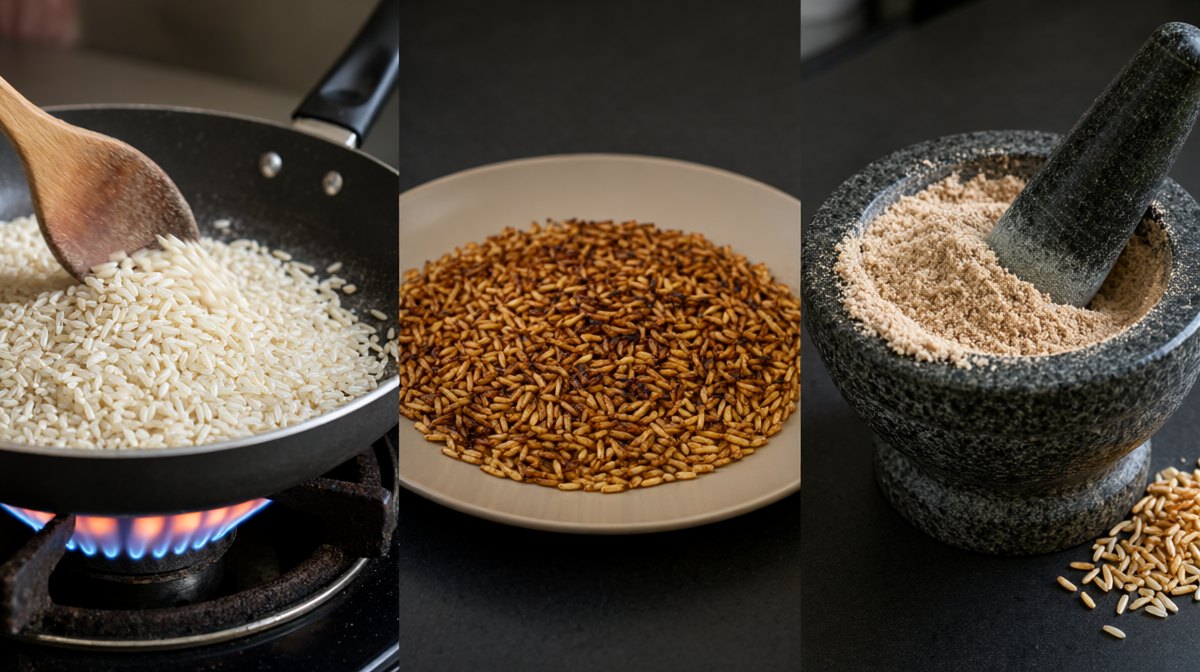
Put raw rice in a dry pan over medium to medium-high heat and stir it constantly until the grains are evenly golden brown and smell nutty. Tip them out, let them cool completely, then grind to coarse sand. That is the whole method.
The rice matters less than the technique. Sticky rice, sold as glutinous or sweet rice, is the traditional choice and gives the best thickening texture. Jasmine rice is more aromatic and toasts just as well, which is why Hot Thai Kitchen uses it at home. If you are not sure which bag you have, our guide to the main types of rice in Thailand sorts them out. If you keep both, use sticky rice for larb and jasmine when you want a more aromatic powder.
Use a quarter cup of rice to start. The cooking-school recipe says that makes about half a cup of powder, which is several batches of larb. A little goes a long way, and stale powder is worse than no powder.
Timing depends on the pan, the heat and the amount of rice. The books give anything from six to fifteen minutes. The Food of Thailand dry-fries jasmine rice for six to eight minutes; the cooking-school method gives ten to fifteen; Hot Thai Kitchen says five to eight minutes for a few tablespoons over high heat. Do not cook to the clock. Cook to the colour and the smell.
Keep the rice moving the whole time. A grain that sits still scorches on one face and stays pale on the other. Do not add oil. The pan is dry, and the toast comes from the rice itself.
Some Thai cooks add aromatics to the pan. Hot Thai Kitchen toasts whole makrut lime leaves with the rice, and gives lemongrass and galangal as further options. A lime leaf or two is a good first experiment. It is not required, and plain rice is the version most recipes assume.
Let the rice cool completely before grinding. Warm rice gums up under a pestle or blade, and you end up with clumps instead of grains. Spread it on a plate if you are in a hurry.
How to Make Toasted Rice Powder Without a Mortar and Pestle
Use a clean coffee grinder or spice grinder. Put in a couple of tablespoons of cooled toasted rice at a time and pulse in short bursts until the grains break down to coarse sand. Stop before the powder turns to flour. The cooking-school note specifies a clean coffee grinder for a reason: rice powder leaves a flavour in the burr that will turn up in your next coffee.
A blender works if you pulse and scrape down the sides. Do not let it run. The blades will take the rice from sand to dust in a second or two, and dust is the one texture you do not want.
A mortar and pestle is the traditional tool and gives the most control. It also takes longer, and there is no need to buy one for a single batch. The cooking-school method uses a pestle in a continuous circular motion, pressing the grains against the side of the mortar, which is a good description of what you are trying to do with a machine as well: crush, do not purée.
Work in small batches even with a machine. Small batches give you more control over the texture.
What Does Roasted Rice Powder Taste Like?
It tastes nutty, toasted and faintly smoky. The smell is closer to popcorn or toasted bread than to any spice. There is no salt, sweetness or heat in it. The flavour lives in the aroma, which is why a fresh batch tastes stronger than a bag that has been open for months.
On the tongue it is gritty rather than smooth. That grit is the point. It gives larb and nam tok a texture that lime juice, fish sauce and herbs cannot supply on their own.
It also thickens slightly. Cooking with Nart describes it as a thickener in soups and sauces, and the Curry Guy says it helps thicken a dressing a little. Do not expect it to behave like cornflour. It is there for aroma and texture first, and body second.
The amount is small. The cooking-school laab gai uses two tablespoons in a pound of chicken, about 450g. The Food of Thailand toasts one tablespoon of jasmine rice for 280g of duck, which makes a smaller quantity of powder. Start with one tablespoon for 450g of meat, taste, and add more if the salad looks wet.
Too much turns the dish pasty. Too little and it tastes flat, which is exactly the problem our why does my larb taste bland page puts at the top of its list. The powder is not a chilli heat, so adding more will not make the dish spicier. It will only make it earthier and drier.
Roasted or Toasted? Is It the Same as Rice Flour?
Roasted and toasted are the same word for the same process. British packets tend to say roasted, American recipes tend to say toasted, and the cooking-school book uses both on one page. If a recipe says either, it means raw rice toasted in a dry pan and ground coarse.
Rice flour is a different ingredient. It is raw rice milled fine. Charmaine Solomon's glossary separates ground rice from rice flour, noting that ground rice is more granular and gives a crisper texture in batters. Khao khua goes further than either: the rice is toasted whole first, then ground coarse.
You cannot swap rice flour for khao khua and get the same dish. Rice flour will not bring the toasted aroma, and its texture is too fine to do the job of coarse grains. It is also raw, so it thickens like starch rather than behaving like toasted rice.
Ground rice is closer in texture than rice flour, but it is still raw and untoasted. If a recipe says ground rice, it usually means raw rice ground coarsely, not khao khua. The two are not interchangeable.
The short version: roasted rice powder and toasted rice powder are the same. Rice flour and ground rice are not.
Roasted Rice Powder Substitute
The best substitute is rice. Any plain white rice will toast and grind. Jasmine is the closest if you do not keep sticky rice, and it is what Hot Thai Kitchen uses at home. Sticky rice gives a slightly better thickening texture, so use it if you have it.
If you have no rice at all, there is no supermarket stand-in that does the same job. Rice flour is not it. The honest substitute is to toast and grind whatever plain rice is in the cupboard, even if it is not the traditional variety.
If you are buying a bag and the label says "seasoned", or lists herbs, salt or sugar, it is a different product. Plain khao khua should list rice and nothing else. Seasoned roasted rice powder is a real thing, and it is not what a larb recipe is asking for.
If you are out of powder and cannot make more, put it on the shopping list rather than replacing it with flour. Larb without it is wetter and flatter. The larb troubleshooting page says the same thing in more detail.
Roasted Rice Powder for Larb (UK)
For larb, use about one to two tablespoons of powder for 450g of minced meat, added off the heat just before serving. In the UK, buy a bag from a Thai or Chinese grocer or make it from sticky rice. Either works, and the homemade version will smell stronger.
The cooking-school laab gai uses two tablespoons for a pound of chicken. The Food of Thailand toasts one tablespoon of jasmine rice for 280g of duck, which makes a smaller amount of powder. Start with one tablespoon, taste, and add more if the salad looks wet.
Add it after the meat has come off the heat. Cooking with Nart warns that adding powder to a hot pan cooks it, kills the crunch and dries the dish. The same warning applies to the dressing: toss the powder through at the end, not at the start.
It is not a garnish. It absorbs the lime and fish sauce that would otherwise pool, and it carries the chilli through every bite. That is why the larb recipe treats it as a component rather than a finishing touch.
Sticky rice for making your own is sold as glutinous or sweet rice in Thai and Chinese grocers. A bag lasts a long time. If you would rather not make it, the buying section below covers the packets.
Where to Buy Roasted Rice Powder in the UK
Look in a Thai or Chinese grocer, a cash-and-carry, or a larger supermarket with a good Asian food section. It is an Asian-grocer line rather than a British supermarket staple, so do not count on finding it in every Tesco or Sainsbury's. Our guide to buying Thai ingredients in England covers the shop types if you are starting from scratch.
Online, Amazon UK sells Khun Shine Ground Roasted Rice in 250g bags. The listing describes it as 100% sticky rice, slow-toasted and ground to a coarse powder. BoroPantry, a UK Asian grocery, also lists the Khun Shine line.
Read the label before you buy. Some bags are seasoned with herbs, salt or sugar. Khun Pensri sells a seasoned roasted rice powder, which is a different product from the plain powder a larb recipe expects. For larb you want rice and nothing else.
If you cannot find a bag, buy glutinous rice and make your own. It is a few minutes' work, it keeps longer in whole-grain form, and it tastes better. The method above takes about fifteen minutes.
Do not buy rice flour by mistake. The bags look similar, and the names are close enough to catch you out. Rice flour will not make larb taste right.
How Long Does Khao Khua Keep?

Two to three months in an airtight jar in a cool, dark cupboard. The aroma fades before the powder becomes unsafe, so the real limit is flavour rather than food safety. Serious Eats gives two months; the Curry Guy gives three; Cooking with Nart says the smoky flavour is best within two weeks.
That range is the honest answer. A tightly sealed jar in a cool kitchen will get you to three months. A bag left open next to the hob will taste flat in a fortnight. Make small batches and the question stops mattering.
Fridge or cupboard is a genuine disagreement. The Curry Guy says avoid the fridge because it introduces moisture. Hot Thai Kitchen keeps hers in the fridge to stop it going rancid or mouldy, especially in a warm, humid place. Both are trying to solve the same problem. If your kitchen is humid, seal the jar tightly, keep it in the fridge, and let it come to room temperature before opening.
For longer storage, freeze it in a sealed bag for up to six months. The aroma fades a little, so frozen powder is better for cooking than for a raw salad garnish.
Whole toasted rice keeps its aroma longer than powder. Hot Thai Kitchen toasts a batch and grinds only what she needs. That is the best compromise if you make khao khua often.
If it smells musty or shows mould, throw it out. Moisture is the enemy, and a jar that has taken in damp will not be fixed by toasting it again.
Frequently asked questions
Is roasted rice powder the same as toasted rice powder?
Yes. Both names describe raw rice dry-toasted and ground. British packs tend to say roasted, American recipes tend to say toasted, and the cooking-school book uses both on one page. The Thai name is khao khua, and both English names are in common use.
Can I use jasmine rice instead of sticky rice?
Yes. Jasmine toasts well and is more aromatic, which is why Hot Thai Kitchen uses it. Sticky rice is traditional and thickens better, so it is the safer choice for larb. Use what you have and adjust the amount by texture.
Can I make it in a blender or food processor?
A clean spice or coffee grinder is easiest. A blender works if you pulse in short bursts and scrape down the sides. Stop at coarse sand. Do not grind a large batch at once. Over-blitzing turns it to flour and loses the texture that makes it useful.
What can I use if I don't have roasted rice powder?
Toast and grind plain white rice. Jasmine is the nearest if you have no sticky rice. Rice flour is not a substitute: it is raw, finely milled and will not give the toasted flavour or coarse crunch. If you have no rice, leave it out.
Is roasted rice powder gluten free?
Plain rice powder is gluten free. Check the packet if you are coeliac, because some brands add herbs, salt or other ingredients, and cross-contamination is possible in a shared mill. Plain khao khua should list rice only. Rice itself contains no gluten, so the grain is not the problem.
How much roasted rice powder do I put in larb?
About one to two tablespoons for 450g of meat. The cooking-school laab gai uses two tablespoons for a pound of chicken; the Food of Thailand uses one tablespoon of rice for 280g of duck. Start low and add more if the salad looks wet.
Does roasted rice powder go bad?
It does not spoil quickly because it is dry. The bigger risk is moisture, which makes it mouldy, and time, which fades the aroma. Keep it airtight, discard it if it smells musty or shows mould, and make small batches.
Can you freeze toasted rice powder?
Yes. Seal it well and freeze for up to six months. The aroma fades a little, so it is better for cooking than for a raw salad garnish. Let it come to room temperature before opening the bag to avoid condensation.
Is khao khua the same as rice flour?
No. Khao khua is whole rice toasted then ground coarse. Rice flour is raw rice milled fine. They behave differently: khao khua adds toasted flavour and crunch, while rice flour is used for batters and thickening. Do not swap one for the other.
What is khao khua used for besides larb?
Nam tok, nam jim jaew, jungle curry and some soups. It also works as a coating for fried chicken and a topping for salads. In Isaan cooking it is a pantry ingredient, not a one-dish garnish. A jar in the cupboard makes larb a weeknight dish.



Comments