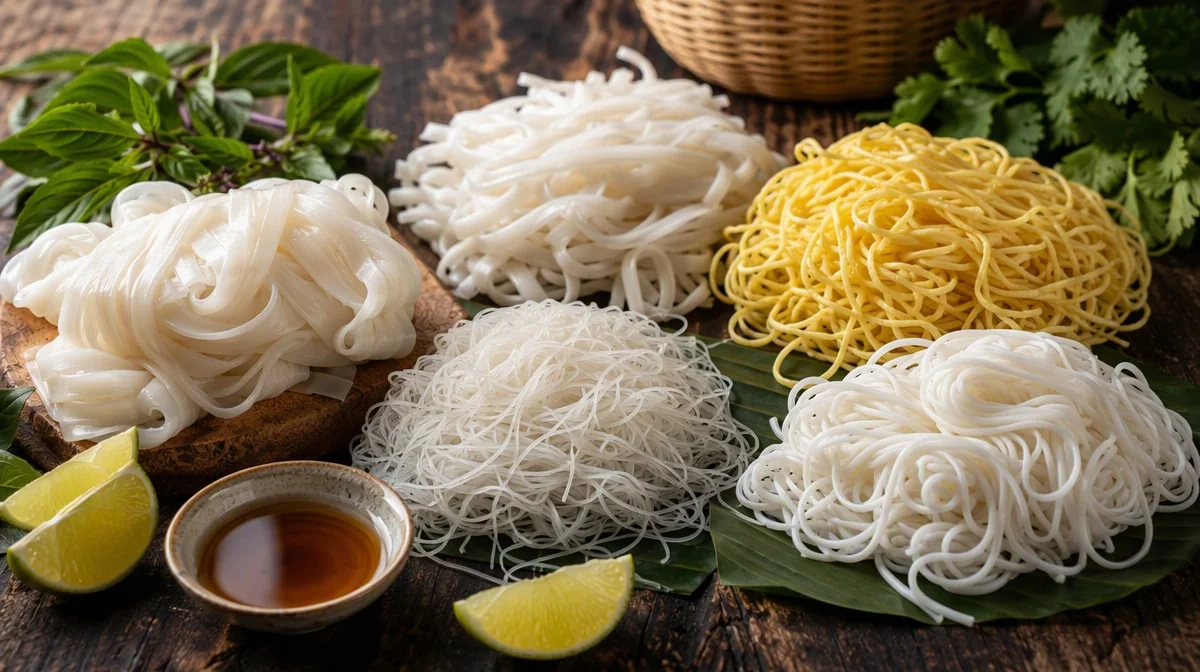
Thai noodles are not one ingredient. They are a family of rice, wheat and starch noodles, and the name on the packet usually tells you the grain and the width rather than the dish. The four you need first are sen yai (wide rice), sen lek (narrow rice), sen mee (very thin rice) and bamee (wheat and egg). Add khanom chin, the fresh fermented rice noodle, and wun sen, the glass noodle, and you can order almost anything in the country.
The useful question is not "what is a Thai noodle" but "which width and which grain". A 5mm rice stick is pad thai. A 10mm rice ribbon is pad see ew. A handful of sen mee is a salad or a quick soup. Bamee is the yellow wheat noodle in a bowl of wonton soup or khao soi. Once you can read those cues, the wall of packets in a Thai grocer stops being a wall.
What Are Thai Noodles?
The guidebook's crash course is still the clearest short answer. It names four main kinds: bamee, khanom jeen, sen gooay dee-o and wun sen. Bamee is wheat flour and egg, yellow, and sold fresh in bundles. Khanom jeen is a fine round rice noodle made by pushing a rice dough through a sieve into boiling water. Sen gooay dee-o is the common rice noodle, made from rice flour and water, steamed into wide sheets, folded and cut into widths from sen lek (thin) to sen yai (wide). Wun sen is almost clear, made from mung-bean starch, and turns up occasionally in soups.
The same book gives the sentence that explains half the confusion in UK shops: when ordering, "it's generally necessary to specify which noodle you want". Thai menus do not assume. You say the width, the grain and often the broth style in one breath.
Insight Guides adds the everyday shorthand. It divides the field into kuay tiaw, made from rice flour, and ba mee, from wheat flour, and says the rice noodles can be ordered broad (sen yai), narrow (sen lek) or very narrow (sen mee). That is the vocabulary to carry into a Thai restaurant, even if the English menu only says "rice noodles".
The names are worth learning because they are more precise than the English. Sen means noodle or strand; yai means big, lek means small. Bamee is the odd one out: wheat and egg, not rice. Khanom chin is fresher and sourer than a dried rice stick. Wun sen is not rice at all.
Rice Noodles vs Wheat Noodles (and Where Vermicelli Fits)

Rice noodles are made from rice flour and water, sometimes with tapioca or corn starch. They are soft, slippery and slightly chewy, and they take on the flavour of the sauce or broth around them. Wheat noodles are made from wheat flour, often with egg, and they are springier and more resistant. The difference is texture and gluten, which is why rice noodles are the safer choice for a gluten-free Thai meal, provided the packet lists only rice and water.
The practical rule is the one Thai cooks use. Rice noodles for stir-fries and salads, wheat noodles for soups and curries where you want chew. Pad thai, pad see ew, drunken noodles and the Isaan noodle salads are rice. Khao soi, bamee wonton noodles and most Chinese-style bowls are wheat and egg. The khao soi page has the northern curry version. The site's guide to cooking wheat noodles covers the wheat side; this page is about choosing.
Vermicelli is not a separate grain. It is a very thin rice noodle, roughly 1mm, sold in brittle nests or straight bundles. In Thai it is sen mee; in Vietnamese, bun; in Chinese, mai fun. It behaves like a rice noodle but cooks in minutes and soaks up dressing fast, which makes it good for salads and spring rolls and bad for a long simmer. If a recipe says "rice vermicelli" and you have sen mee, you have the right thing.
Glass noodles are the other clear noodle, and they are not rice. Wun sen is made from mung-bean starch, sometimes sweet-potato starch, and cooks up transparent and springy. It is not a substitute for rice vermicelli in a salad, though it works in soups and stir-fries. The guidebook lists it separately for a reason.
How to Prepare Rice Vermicelli for Stir Fry
Soak it in warm water, not boiling, for about 5 to 10 minutes, until it is pliable but still firm. Drain it well. It finishes cooking in the wok, where it absorbs the sauce instead of water. If you boil it first, it goes soft before it hits the pan and turns to mush.
That is the short answer. The longer one is about what "pliable" feels like. Pick up a strand and bend it. It should flex without snapping, but still have a little resistance in the middle. If it is fully soft and limp, it has gone too far. If it snaps, give it another minute.
For soups, follow the packet. Rice vermicelli usually needs only 2 to 3 minutes in boiling water, and it keeps softening in the hot broth at the table. For a crisp garnish, drop a small bundle straight from the packet into hot oil for a few seconds; it puffs and turns white almost immediately. That trick is in the cookbook, and it is the reason a handful of dry vermicelli belongs in the cupboard even if you never soak it.
Do not soak a large batch and leave it sitting wet. Rinse it in cold water if you are not cooking immediately, and drain it thoroughly. Wet vermicelli clumps, and clumped vermicelli will not separate in the wok.
Which Noodles for Pad Thai

Use a flat rice noodle about 5mm wide, the width sold as rice stick or sen lek. The site's prawn pad thai recipe says the same: flat rice noodles around 5mm, soaked in cold water for about 30 minutes until pliable but still resistant. That is the noodle that gives pad thai its chew without turning to paste.
UK packets make this easier than they used to. Tiger Tiger sells a 5mm rice stick; Thai Dragon sells a 5mm rice stick; Sous Chef lists a Thai rice stick at 5mm. The number is the useful part of the label, not the brand. If a packet says "rice stick" with no width, look at the strands: 5mm is roughly the width of a matchstick, maybe a little wider.
The Thai name for the best-known pad thai noodle is a place name, not a width. Hot Thai Kitchen explains that sen chan means "noodles from Chanthaburi", a province famous for making rice noodles for stir-fries. Chanthaburi noodles are prized for a slightly chewier bite. You will see sen chan pad thai on menus; it is pad thai made with that noodle, not a different dish.
If you only have 3mm rice sticks, you can still make pad thai. It will be lighter and a little less chewy, but it will work. If you have 10mm ribbons, save them for pad see ew. If you have spaghetti, put it back in the cupboard. The site's troubleshooting page deals with what happens when the soak or the wok goes wrong.
Which Noodles for Pad See Ew
Use a wide rice noodle, about 10mm, or fresh ho fun if your Asian grocer has it. The wide ribbon is what makes pad see ew feel like pad see ew: it picks up the dark soy and the egg, and it stays separate in the wok instead of clumping into a nest of thin strands.
The same width is sold under several names. In Thai it is sen yai. In Chinese shops it is ho fun or sha he fen. On a UK packet it may simply say "wide rice noodle" or "10mm rice stick". Fresh ho fun is sold chilled in folded sheets; separate the strands gently before cooking, or they will tear. Dried wide noodles need a longer soak than the thin ones, and they are less forgiving.
Drunken noodles, pad kee mao, traditionally use the same wide rice noodle. The site's drunken noodles recipe uses wheat noodles as a practical UK swap, and it works, but it is not the traditional choice. If you want the version you get in Bangkok, use sen yai.
Do not use vermicelli for pad see ew. It is too thin to carry the sauce, and it will collapse. Do not use bamee either; the wheat chew fights the sweet-soy glaze. The wide rice noodle is the one.
The Thick Rice Noodle Name: Sen Yai
Sen yai is the Thai name for the wide rice noodle. Sen means noodle, yai means big. It is the noodle in pad see ew, in rad na and in many Chinese-Thai stir-fries. In a restaurant, if you want it, say "sen yai"; pointing at the wide ribbon on the menu also works.
It comes fresh or dried. Fresh sen yai is soft, folded and lightly oiled; it needs only a rinse and a minute in the wok. Dried sen yai needs soaking, and it is easy to oversoak because the strands are thick. Aim for pliable but still opaque in the centre. If the centre is chalky, it needs longer; if it is translucent all the way through, it is ready.
The width is not standardised across brands. One company's 10mm is another's "wide". That is why the Thai name and the millimetre number are both worth knowing. "Thick rice noodles" in English could mean 5mm or 10mm, depending on who is writing the menu.
Why Rice Noodles Are Labelled by Width, Not Brand
Because the width is what changes the dish. The same rice flour and water can be steamed into a thin sheet or a thick one, cut into hairlike strands or broad ribbons, and the result behaves differently in the wok. A brand name tells you who packed it; a width tells you what it will do.
The guidebook says it directly: when ordering, you have to specify which noodle you want. Insight Guides uses broad, narrow and very narrow. UK packets increasingly use millimetres, which is the most useful label of all. Tiger Tiger's 5mm rice stick and Thai Dragon's 5mm rice stick are the same width under different brands; a 10mm packet is a different ingredient for a different dish.
This is also why "rice noodles" on a UK supermarket shelf is not a useful recipe instruction. A 1mm vermicelli and a 10mm ribbon are both rice noodles, and they are not interchangeable. If a recipe only says "rice noodles", look at the dish: thin and slippery for salads and soups, medium for pad thai, wide for pad see ew and rad na.
The old habit of buying by brand comes from packet familiarity, not cooking logic. Once you know the width, the brand is a quality choice, not a recipe choice.
Khanom Chin: Thailand's Fresh Fermented Noodle
Khanom chin is the fresh, thin, round rice noodle that does not fit the dried-stick shelf. It is made from rice that is soaked and fermented, then pushed through a sieve into boiling water, which gives it a soft, slightly sour tang and a springy bite. It is sold fresh, often in plastic bags, and it does not keep like a dried noodle.
The guidebook describes it as a fine, round noodle produced by pushing a rice-based dough through a sieve into boiling water. The cooking-school recipe for nam ya sauce serves it with "rice noodle (kanam jeen)", which is the same noodle under a phonetic spelling. In the south, khanom chin nam ya is a curry noodle dish with a tray of fresh vegetables and herbs; in the north, it turns up with nam ngiao.
Do not confuse it with rice vermicelli. Both are thin and rice-based, but khanom chin is fresh, round and fermented; sen mee is dried, straight and neutral. If you cannot find khanom chin in the UK, rice vermicelli is the closest dried stand-in, but the sour tang and the softness will be different. Say so in the dish rather than pretending they are the same.
A UK Shopping List for Thai Noodles
For a basic Thai noodle cupboard, buy three packets: a 5mm rice stick for pad thai, a 10mm wide rice noodle for pad see ew and rad na, and a pack of rice vermicelli for salads and spring rolls. That covers most of the everyday dishes. Add a pack of dried egg noodles if you cook khao soi or want a wheat option, and a pack of glass noodles if you like soups.
The 5mm rice stick is now a supermarket line as well as a specialist one. Tesco lists Tiger Tiger 5mm Rice Stick Noodles, and Thai Dragon sells the same width. For the wider noodles and fresh ho fun, a Thai or Chinese grocer is more reliable; the guide to buying Thai ingredients in England covers the shop types. Online, Tuk Tuk Mart and Sous Chef both list rice sticks by width.
Read the ingredients if gluten matters. Plain rice noodles should list rice flour and water, sometimes tapioca or corn starch. Some brands blend in wheat, and "rice noodle" on the front is not a guarantee. The same warning applies to "glass noodles": they are usually mung bean, but check the packet.
Do not buy a "stir-fry noodle" mix without looking at the width. A mixed pack is fine for a general stir-fry, but it will not tell you whether you are cooking pad thai or pad see ew. Buy the width the dish wants.
Frequently asked questions
What are the main types of Thai noodles?
Rice noodles in four widths (sen mee, sen lek, sen yai and the fresh khanom chin), wheat-and-egg bamee, and mung-bean glass noodles (wun sen). The width and the grain matter more than the brand. A 5mm rice stick, a 10mm rice ribbon and a pack of vermicelli cover most home cooking.
Are rice noodles gluten free?
Plain rice noodles made from rice flour and water are gluten free. Some brands add wheat starch or wheat flour, and cross-contamination is possible in a shared mill. Check the ingredient list if you are coeliac. Bamee and most egg noodles contain wheat, so they are not a substitute.
What are glass noodles?
Glass noodles, or wun sen, are made from mung-bean starch, sometimes sweet-potato starch. They cook up clear and springy. They are not rice noodles and not a direct swap for vermicelli, though they work in soups and stir-fries. Check the packet, because "glass noodle" is used loosely.
Can I use spaghetti for pad thai?
No. Spaghetti is wheat and too thick and firm for pad thai. It will not absorb the tamarind sauce the same way, and the texture is wrong. Use a 5mm flat rice noodle. If you have no rice stick, a thin rice vermicelli is a closer emergency swap than spaghetti, though still not ideal.
What noodle is pad see ew?
Wide rice noodles, about 10mm, sold as sen yai or fresh ho fun. The width is what carries the dark soy and egg without clumping. Drunken noodles traditionally use the same noodle. The site's drunken noodles recipe uses wheat noodles as a UK swap, but wide rice is the traditional choice.
Is khanom chin the same as rice vermicelli?
No. Khanom chin is fresh, round and fermented, with a slight sour tang. Rice vermicelli is dried, straight and neutral. They are both thin rice noodles, but they behave differently. If you cannot find khanom chin, vermicelli is the closest dried stand-in, not an exact one.
Why are Thai noodles sold by width?
Because width changes how the noodle behaves in the wok. A 1mm vermicelli and a 10mm ribbon are both rice noodles, but one is for salads and one is for pad see ew. Thai menus ask you to specify the noodle for the same reason. The millimetre number on a UK packet is the most useful guide.
What is sen chan?
Sen chan means "noodles from Chanthaburi", a Thai province known for rice noodles for stir-fries. It is a style and a place name, not a width. You will see sen chan pad thai on menus; it is pad thai made with that noodle. A 5mm rice stick is the everyday UK equivalent.
Do I need to boil rice noodles before stir-frying?
No. Soak them in warm water until pliable but still firm, drain, then finish them in the wok. Boiling first is how they turn mushy. For soups, follow the packet and cook them briefly; they keep softening in the hot broth. For a crisp garnish, deep-fry dry vermicelli straight from the packet.
What is the difference between sen lek and sen mee?
Sen lek is the narrow flat rice noodle, about 3-5mm, used for pad thai and many soups. Sen mee is the very thin rice vermicelli, around 1mm, used for salads and spring rolls. Both are rice, but the width changes the dish. Do not use sen mee where a recipe asks for sen lek.


Comments