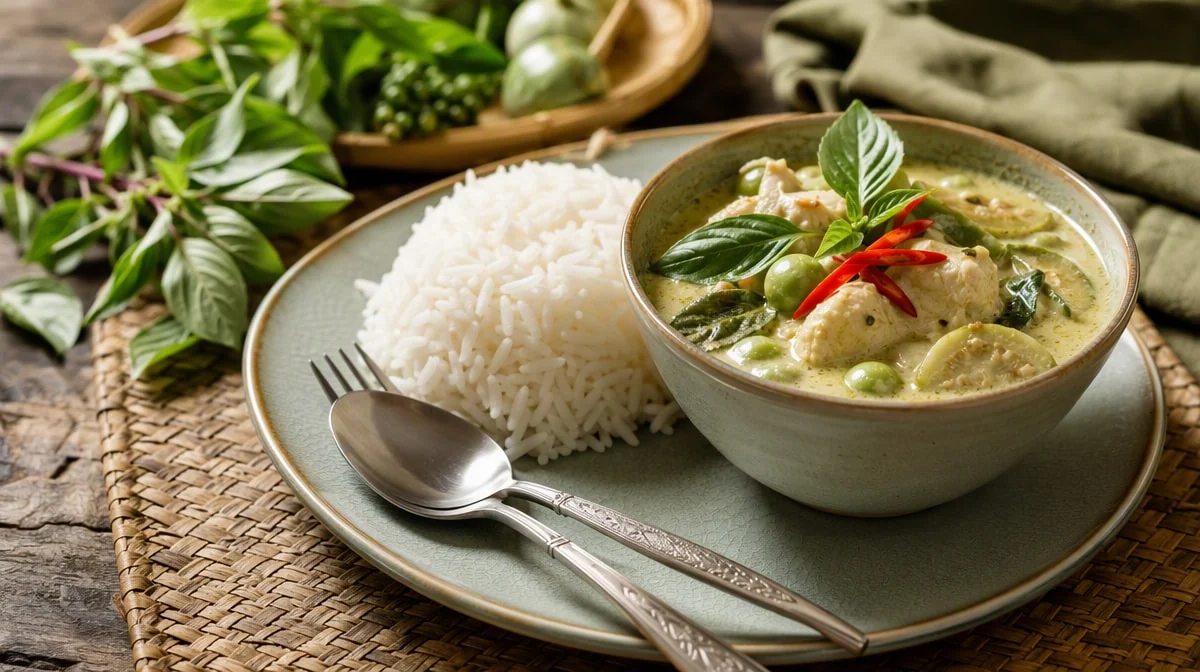
The spoon does the work. It goes in your right hand and carries the food to your mouth, and in Thailand it is the only thing that does. The fork stays in your left and spends the meal pushing rice and curry onto the spoon. It very rarely reaches your mouth.
Chopsticks are a separate question. They come to the table with noodle soup and Chinese food, and even then the noodles are usually parked on a spoon before they reach anyone's lips. Everything else, from green curry to pad krapow to pad thai, is eaten with a fork and a spoon.
Most English-language advice gets the technique roughly right and the history wrong. The history is a Siamese court trying to look civilised to its creditors, a 1930s government that made table manners national policy, and a way of serving a meal that outlived both of them.
Contents
- How do Thai people eat with fork and spoon?
- Why do Thai people eat with spoon and fork?
- How to hold a fork and spoon (which hand)
- How to eat rice with a spoon and fork
- Do Thai people eat with their hands?
- Do Thai people use chopsticks or fork and spoon?
- Thai table manners at a shared plate
- How a Thai meal is balanced
- A note on the sources
- Frequently asked questions
How do Thai people eat with fork and spoon?
Three movements, and the middle one is where visitors lose the plot.
- Take food from the shared dish with the spoon that came in it, or your own if there isn't one. One mouthful, onto the rice already on your plate.
- Use the fork to push that food and some rice onto your spoon.
- Bring the spoon to your mouth. The fork stays where it is.
Lonely Planet puts it exactly: use a serving spoon "to take a single mouthful of food from a central dish and ladle it over a portion of your rice", then the fork pushes that rice back onto the spoon before it goes to your mouth. The hands matter more than the grip, and the Insight guide says it in as many words: the fork stays in the left, and the fork does the pushing.
No knife comes, and nothing is missing. Thai cooking cuts food to size before it reaches the wok, and the Culinary Institute of America's Thai module writes it as an instruction: cut the chicken into "fork and spoon size pieces". A piece of steamed fish that resists is cut with the edge of the spoon. A knife at a Thai table means the kitchen left a job unfinished, which is why you get one in Britain and would never have asked for one in Thailand.
You will hear the words all evening: ช้อน (chon) spoon, ส้อม (som) fork, ไม้ตะเกียบ (mai dar-geap) chopsticks.
Why do Thai people eat with spoon and fork?
Eating with the fingers is the older practice, and it never properly left. A Thai-published cookbook describes the world it came from: no cutlery apart from serving utensils, sticky rice pressed into balls with the fingers and dipped into the other dishes, plain rice eaten by hand. European spoons and forks, that book says, appeared during the 19th century, "first among royalty and later adopted by the general population".
The court end is better documented. Western dining reached Siamese elite tables through trade in the reign of Rama III, and a study in the Journal of Arts and Thai Studies finds the adoption was a mixture of Thai and Western customs right up until Rama V. After Chulalongkorn's travels, to Singapore first and then to Europe in 1897, it became a deliberate programme. A Chulalongkorn University doctoral study on that court states the motive plainly: the king and his elites changed how they ate in order to be accepted as civilised by Western observers. Their banquets served French food beside Thai dishes, laid Western place settings over Thai flower work, and ordered cutlery in Western shapes with Thai patterns.
That is where the guidebook line comes from, that Thais began laying their tables with fork and spoon in the early 1900s "to affect a 'royal' setting". One memoir written from inside the country lists the "required use of spoons and forks at the table instead of fingers" among the changes of the Rama VI and Rama VII years, alongside surnames, chairs and schooling.
Then the state made it policy. In 1939 the government of Plaek Phibunsongkhram issued seven ratthaniyom, twelve within four years. Baker and Phaiboon Chaiyong's history is careful with the wording: they are "often translated as 'cultural mandates'", they write, "but better rendered as 'state edicts'". One theme was progress. Dress and public conduct were prescribed so that outsiders would have no excuse for treating Thailand as uncivilised, and in Baker's sentence: "Some western habits were advised, including using forks and spoons". Another edict set a timetable for the day, meals included. The same campaign judged eating with the hands to be unclean, and told people who insisted on it to wash them first.
None of that made a Thai meal Western. The court took the cutlery and kept the service: every source behind this page agrees a proper Thai meal still arrives all at once, in the middle, with rice doing the plain work.
What does the fork and spoon symbolise?
Respectability, mostly in the past tense. It is not a royal emblem and never a religious object. For the court that adopted it, Western cutlery was evidence of being civilised; for the government that encouraged it in 1939, evidence of being modern. Neither project is running now, so the symbolism has dropped quietly out of the utensil. Ask a Thai diner what a fork and a spoon mean and you will be told how to hold them.
How to hold a fork and spoon (which hand)
The spoon is a table spoon, not a teaspoon; Thai tables use a soup-sized one. If a smaller spoon appears, soup is coming in its own bowl, and a Chinese-style ceramic spoon in front of you means exactly that.
If you are left-handed, Thai etiquette guidance says to hold the spoon in your dominant hand and the fork in the other.
Some habits read as foreign at a glance. Eating straight off the fork is considered crude, and the etiquette sites say so flatly. Sawing at a chicken thigh with the spoon looks wrong and is the correct workaround. Talk with a full spoon in mid-air and people notice.
How to eat rice with a spoon and fork
Rice is the base rather than a side. It arrives on your own plate while everything else sits in the middle of the table, and every mouthful gets assembled on that rice. That is also how to eat rice and curry with spoon and fork: the curry never travels to your mouth on its own.
Two facts about it explain the mechanics. Thai rice is cooked with no salt at all, deliberately, because the dishes eaten against it are salty enough to make salted rice unworkable. And it is the only part of the meal that has to reach the table hot: curries, stir-fries and chilli pastes are routinely cooked hours ahead and served at room temperature. Charmaine Solomon's point: the meal is built so you can taste each dish separately against a plain background, or combine them on your spoon. Both are correct.
Rice onto your plate first, from the shared bowl in the middle, then one spoonful of one dish onto the edge of it, tasted on its own before you try the next. Push food and rice onto the spoon with the fork. Go back for a second spoonful of whatever you liked, since going back twice reads as appreciation rather than greed.
Do Thai people eat with their hands?

Yes, where it works better, and that means sticky rice.
A ball of steamed sticky rice (khao niao; also written khao niew or khao neow) is pressed between the fingers and used to scoop, or dipped into a chilli paste (nam prik) or a gravy. Lonely Planet describes the same reflex in a Bangkok eatery: meat taken off fried chicken with a fork, or with fingers and a pinch of sticky rice. Hand-eating survives hardest in the north and in Isaan, which are where steamed sticky rice is the everyday starch; the grains are compared in the main types of rice in Thailand, and the style belongs to the region described in Isaan food.
Charmaine Solomon concedes the point: modern Thais eat with a spoon and fork, "though for those who can manage the old-fashioned way, with the fingers, the food does seem to taste even better".
The 1939 edicts tried to end it. They didn't take, and in villages where rice is steamed in a bamboo basket, a spoon would be absurd.
Is it rude to eat with your hands in Thailand?
Not for sticky rice, and not at a som tam stall where half the table is doing it. Two things are rude: using your hands at a table where everyone else has cutlery, and using the left hand alone, cutlery or bare, which Thai etiquette guidance treats as taboo. Curry and jasmine rice are eaten with a spoon and fork.
Do Thai people use chopsticks or fork and spoon?
Both, and the rule fits on one line: chopsticks for soup noodles and Chinese food, fork and spoon for everything eaten with rice.
Lonely Planet's advice to a visitor is blunt. "If you're not offered chopsticks, don't ask for them." They are for Chinese-style food eaten from a bowl, and Thai restaurateurs do not assume you can't use them. Chopsticks also sit in Thai-Chinese homes, and several of the country's most ordinary noodle dishes are Thai-Chinese rather than Thai.
At a noodle stall the spoon comes back into it. Chopsticks in the right hand, ceramic soup spoon in the left. The chopsticks gather noodles, meat and greens and hand them to the spoon, and the broth is drunk from the spoon. Stir-fried noodles are a different case: pad thai, pad see ew and khao pad arrive on a plate and are eaten with a fork and spoon in Thailand, which is why they reach you that way in a British Thai restaurant.
When you have finished, lay the chopsticks across the bowl or on the table. Standing upright in the bowl means you are still eating.
Thai table manners at a shared plate

Thai eating manners are few, informal, and mostly about other people getting their share.
Use the spoon that came in the dish. Thai etiquette guidance treats taking food from a communal plate with your own spoon as rude. With no serving spoon in sight, tip the dish onto yours rather than dipping into it.
Take one spoonful at a time. Lonely Planet's phrasing is "put no more than one spoonful onto your plate at a time", because piling your portions out at once looks greedy to Thai eyes. The Insight guide puts it more mildly, and Thai etiquette sites list it as the mistake foreigners make most often.
When you have finished, put the fork and the spoon down together on the plate, side by side. There is no British clock position to it. Bones and shells go onto your spoon first and then to the edge of the plate, never back on the shared dish.
Leave a little rice. This one pulls two ways. Thai etiquette guidance says a clean rice plate can imply the host did not provide enough, while rice carries a weight in Thai culture that bread has never carried in Britain. Leaving it in the serving bowl, or tipping your own plate back into the shared dishes, is the part that reads badly. In someone's home, leave the last mouthful; in a restaurant, leave a few grains and lay the cutlery together, which says it more clearly.
Expect to be fed more than you planned. A host who has refilled your rice plate twice thinks the evening is going well.
How a Thai meal is balanced
A Thai meal is not whatever happened to be cooked. It is a set designed to taste unlike each other, and the design is the point.
The template in the sources is consistent enough to be called a formula. Lonely Planet: traditionally the party orders "a curry, a steamed or fried fish, a stir-fried vegetable dish and a soup", with real care taken on both sides of each pairing, hot against cool, sour against sweet, salty against plain. A Thai cookbook gives the same set with the roles named: a large bowl of rice in the middle, a soup, a curry, a steamed or fried dish, and sauces at the side so each person can finish their own plate. Solomon's version is a soup, two or more curries, and as many accompaniments as the cook has time for.
Three consequences, and they change how you order in Britain.
The rice is the "plain". It is the deliberate blank in the set, which is also why it is cooked without salt and why the mild dishes are not an afterthought. Thai meals include quietly flavoured food on purpose, garlic and mild herbs rather than chilli, and Thailand's reputation for unbroken heat is a menu-board invention, which is Thai food spicy? takes apart properly.
Bitter and hot are supporting flavours. The balance a Thai cook aims for runs sweet, salty and sour, with bitter and spicy-hot used as accents. A single dish can lead with one of those; a meal shouldn't.
Seasoning is the diner's job. At a noodle stall the counter carries chilli in vinegar, fish sauce, dried chilli flakes and sugar, and the bowl arrives slightly under-seasoned so you finish it yourself. Lonely Planet notes what that set adds up to: three ways to make a bowl hotter, and one way to make it sweet.
In a UK restaurant, ordering the roles instead of the people is the whole trick. For four: one curry, one fish dish, one stir-fried green vegetable, one soup, rice to go round, plus whatever you chose because you like it, with the shortlist in the 10 most popular Thai dishes. Ordering one plate each, the British habit, leaves nobody at that table tasting the contrast the meal was built for.
At home, everything but the rice can be cooked hours ahead. Get the rice right first in how to cook jasmine rice and the rest is assembly.
A note on the sources
This page carries more history than the rest of the site, and the dates in it disagree, which is worth saying before anyone writes in.
One Thai cookbook puts it in the 19th century, at court first. A journal study has Western dining entering elite Siamese life through trade under Rama III, with the deliberate programme following Chulalongkorn's travels. Lonely Planet puts fork-and-spoon dining in Bangkok by the early 1900s, and a memoir written from inside the country calls it required practice in the 1920s and 1930s. What they agree on is direction: court, then cities, then the state from 1939. The technique itself was settled long before anybody wrote it down.
Frequently asked questions
Do I need a knife at a Thai table?
No. Thai food is cut to bite size before cooking, so nothing at the table needs cutting. If a piece of fish or chicken resists, press the edge of your spoon through it. A knife at a Thai table means the kitchen left a job unfinished; you only get one in Britain because we set one at every place.
Which hand holds the fork and which holds the spoon?
Spoon in the right, fork in the left, and the fork only pushes. If you are left-handed, put the spoon in your dominant hand and the fork in the other. Using the left hand alone for anything, cutlery or bare fingers, is what Thai tables object to.
What do I do with the fork and spoon when I have finished?
Take them off the food and lay them side by side on the plate. That is the signal in Thailand, and in a Thai restaurant the staff will usually check with you before clearing. Do not leave them crossed mid-meal, do not stand the spoon upright in your rice, and lay chopsticks across the bowl rather than in it.
Is it rude to leave food in Thailand?
Yes, on rice. A clean rice plate tells a Thai host you are still hungry and invites another helping, so leave a mouthful and put your fork and spoon together. Never tip your own plate back into the shared dishes, and leave the serving bowl alone; rice carries a weight there that bread has never carried in Britain.
Do Thai people use chopsticks for pad thai?
No. Pad thai, pad see ew and khao pad are stir-fried dishes served on a plate, and in Thailand they are eaten with a fork and spoon. Chopsticks belong to noodle soups and Chinese food. Order a bowl of noodle soup and you get chopsticks and a ceramic spoon; the chopsticks move food onto the spoon, not to the mouth.
Is Thai food under-seasoned on purpose?
Often, yes, and noodle dishes above all. The condiment set on the counter, chilli in vinegar, fish sauce, dried chilli flakes and sugar, exists so the diner finishes the bowl. In a UK restaurant, taste before you add anything, and remember that fish sauce and a pinch of sugar between them fix most flat dishes.
Can I eat sticky rice with my hands in a Thai restaurant?
Yes, if it was served to you as sticky rice. Pinch a small ball of it in your right hand and use it to scoop meat or dip it in a chilli paste. If you were served jasmine rice and curry, use the spoon and fork. At a table where everyone else is using cutlery, follow the table.
What is the small ceramic spoon for?
Soup. Thai soup comes in its own small bowl rather than being poured over your rice, and the Chinese-style ceramic spoon is the correct tool for it. Use it between mouthfuls rather than finishing the bowl in one go, and leave the spoon resting in the bowl when you are done.
Is it rude to take the last piece from a shared dish?
Take it, but offer it around first. The real breach is leaving the last mouthful on the serving plate while someone at the table has had nothing, or scraping the dish out with your own spoon. Lift the last piece with the serving spoon, ask whether anyone wants it, and if nobody does, it is yours.
Should I wait to start until everyone else has been served?
Wait if you can. Thai etiquette guidance has the host or the eldest person at the table begin, and elders and respected guests are seated and served first. Nobody in a UK restaurant minds your food going cold, but waiting one beat and inviting the table in is the version that reads well, and it costs you nothing.

Comments