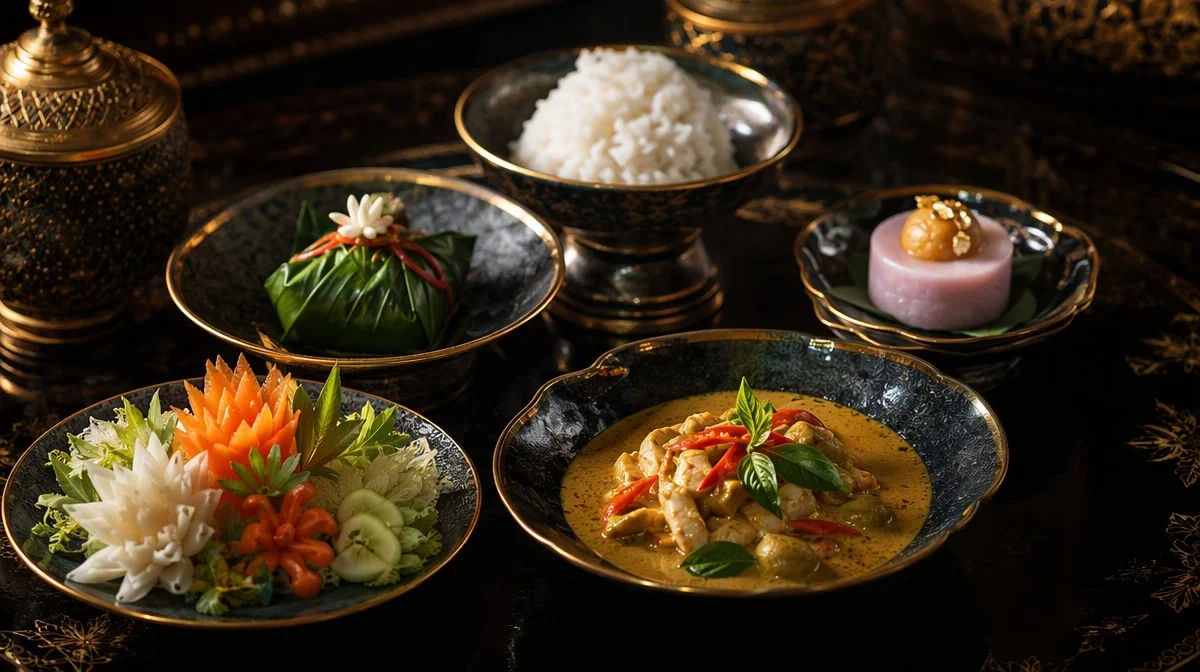
Royal Thai cuisine is the refined cooking of the Thai palace and the noble households around it. It is not a separate set of ingredients so much as a different standard of sourcing, labour and presentation: the best produce from named provinces, cooking that takes time and several pairs of hands, flavours balanced rather than blasted with heat, and plating treated as part of the dish. The Thai royal-cookery book puts it in one sentence: royal cuisine requires skill in both "food for the palate and food for the eyes".
It is also not the same as "royal Thai" on a restaurant menu. The term is used loosely in the UK to mean Thai food with a nicer plate. The historical cuisine is narrower, and more interesting, than that.
What Is Royal Thai Cuisine?
The royal-cookery book defines it as food "created, combined, and crafted with great refinement by palace cooks", including cooks from noble families, women and skilled cooks from the palace. It was not limited to the Grand Palace. It also belonged to the palaces of nobles and the homes of high-ranking officials with connections to the court. The point was to serve the royal family and the highest nobility at the highest level.
That is a social definition, not a recipe list. Royal cuisine is what happens when the cook has the best ingredients, the time to prepare them and an audience that notices the difference. The book says it uses the finest ingredients from various provinces, complex methods that require "time, effort, and many people", and a standard of presentation that is part of the cooking rather than an afterthought.
The flavours are balanced, not hot. That is the line that surprises people who equate Thai food with chilli. The book says royal cuisine has "balanced flavors that are not overly spicy but smoothly harmonious". Heat is allowed; it is not the point. The point is harmony, and the visual finish.
The book also describes the "Noble's Set", a meal of at least seven types of food, including rice for the king, savoury dishes, side dishes for curry, and side dishes for foreigners. That is a court banquet, not a weeknight dinner. It tells you the scale the cuisine was built for.
What Is Royal Thai Food Called?
In English, it is usually called royal Thai cuisine or palace cuisine. The royal-cookery book also uses the term "noble cuisine", because the cooking was not confined to the royal family; it belonged to the aristocratic households around the court as well.
In Thai, you will see the term chao wang, meaning "palace people" or "court", used in the names of old
cookbooks and in restaurant branding. The page does not push a Thai phrase it cannot source properly, because the
English term is the one the book uses and the one the search query asks for.
"What is royal Thai food called" has a simple answer: royal Thai cuisine. The more useful question is what makes it royal. That is the next section.
How Royal Thai Cuisine Differs from Everyday Thai Food
The book gives four differences, and they are a good checklist.
Sourcing. Royal cuisine uses the finest ingredients from named provinces. The book gives two examples: Bang Chang chillies from Samut Songkhram and white sugar from Nakhon Chai Si. Everyday cooking uses what the market has; royal cooking asks where it came from.
Labour. Royal dishes require time, effort and many people. A curry paste pounded by one cook is everyday food; a paste pounded by a team, with ingredients prepared separately and assembled at the end, is palace work. The book's phrase is "complex, refined cooking methods that require time, effort, and many people".
Balance. The flavours are balanced and not overly spicy. Everyday Thai food can be loud; royal food is harmonious. The book says the flavours are "smoothly harmonious", which is a different target from "as hot as you can take".
Presentation. The book says royal cuisine requires "food for the palate and food for the eyes". The plate is part of the dish. That is why royal dishes are often small, neat and visually composed rather than piled.
The everyday contrast is not a value judgement. A village curry can be better than a palace curry. The difference is the standard the cooking is aiming at, not a ranking of the people who eat it.
Where the Ingredients Came From

The book is specific. Royal cuisine used "the finest ingredients from various provinces, such as Bang Chang chilies from Samut Songkhram, white sugar from Nakhon Chai Si". Those two names are the evidence that royal cooking was a supply chain as much as a technique: the palace knew which province produced the best chilli and the best sugar, and it bought accordingly.
That is the answer to the "where the ingredients come from" question, and it is also the reason royal cuisine is expensive. You are not paying for a different species of chilli. You are paying for a named source, a standard of selection and the labour to prepare it.
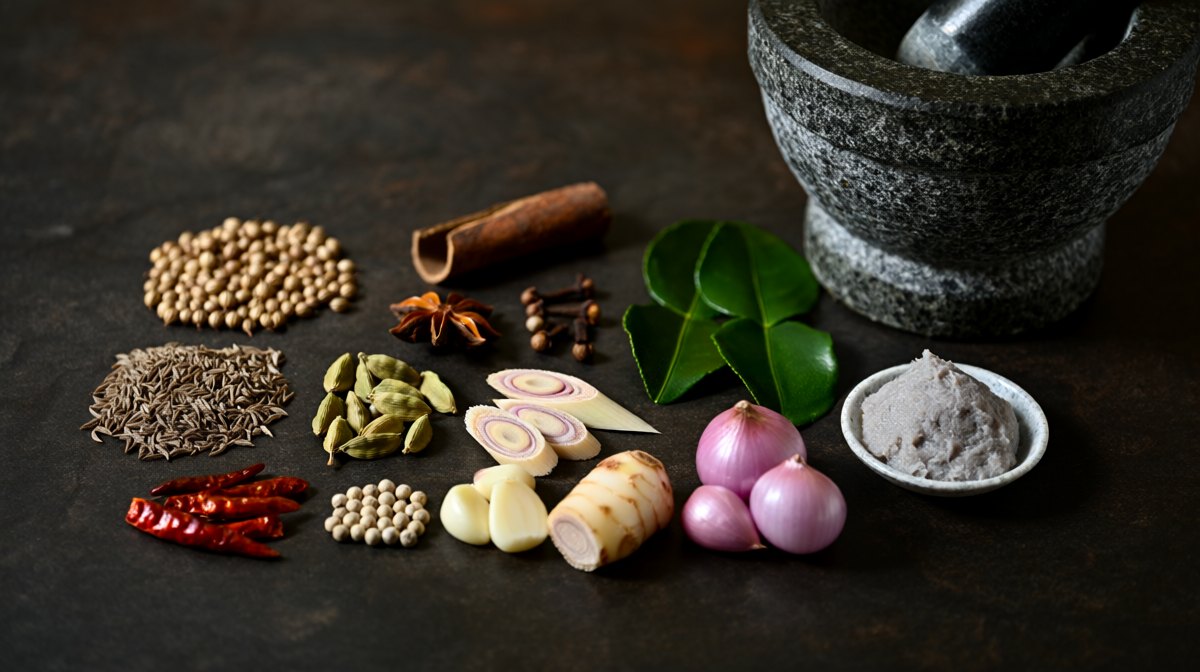
The book's pantry is recognisably Thai: shrimp paste, fish sauce, palm sugar, coconut, galangal, lemongrass, kaffir lime, chillies, garlic, shallots. The difference is not the list. It is the grade and the handling. The site's common Thai ingredients page covers the everyday pantry; this page is about the court standard applied to it.
Royal Thai Cuisine Recipes
The royal-cookery book is a collection of recipes from several palace households, not a single restaurant menu. The dishes that recur in its table of contents give a fair picture of the cuisine:
- Khao chae: cold rice served with aromatic water and a set of small accompaniments. It is a hot-season dish and one of the most distinctly royal things in the repertoire.
- Mueng kam: the one-bite leaf wrap with toasted coconut, dried shrimp, ginger, peanuts, shallots, lime, chilli and shrimp paste sauce.
- Nam prik: chilli pastes, including nam prik kapi and nam prik makham, served with rice and vegetables.
- Gaeng ranua: a curry from the palace repertoire, built on the same paste-and-balance logic as other Thai curries but with its own ingredient set.
- Khao ping: grilled rice wrapped in banana leaf, a portable, savoury rice dish.
- Pla ra nai kala: fermented fish cooked in a coconut shell, a dish that shows how far the palace kitchen was willing to go with a humble ingredient.
- Luk kapi: shrimp-paste balls, a small savoury bite.
- Khanom: the sweet side of the repertoire, including egg-yolk sweets and coconut-based cakes.
It is a list of forms rather than a menu to cook in one night: a cold rice dish, a one-bite wrap, a chilli paste, a curry, a grilled rice, a coconut-shell dish and a sweet. If you want to cook one, start with mueng kam or khao chae, because they are the most immediately understandable to a UK table.
Why Royal Food Is Served One Bite at a Time

The book's mueng kam recipe ends with the instruction: "take a leaf portion, add about ½ teaspoon of shrimp paste, wrap, and eat in one bite." That is the clearest statement of the form. The dish is built to be a single mouthful, not a plate to be cut up.
Why? The practical answer is that a one-bite wrap is a complete flavour package. The leaf gives freshness, the coconut gives richness, the shrimp gives salt and umami, the ginger and lime give sharpness, the chilli gives heat and the sauce ties it together. If you take two bites, the balance changes. The first bite gets the sauce; the second gets the leaf.
The social answer is that small, neat portions are easier to serve at a court table and easier to eat without making a mess. The book does not give a theory of etiquette; it gives a recipe that says "eat in one bite". That is enough. The form is the point.
The same logic runs through the other one-bite dishes: khanom khrok, luk kapi, the small fried eggs. They are not miniature versions of a main course. They are complete in themselves.
Is Royal Thai Food Healthy?
The honest answer is that "healthy" is the wrong question. Royal cuisine is balanced in flavour, not in calories. The book's "balanced, not hot" line is about taste, not nutrition. The food is rich: coconut milk, pork fat, egg yolks, sugar, shrimp paste. It is not a diet.
That said, the royal style has some genuinely healthy habits. It uses a lot of vegetables, herbs and aromatics. It serves small portions. It balances strong flavours with plain rice and cool accompaniments. If you eat a palace meal in the palace way, with rice at the centre and small amounts of the rich dishes, it can be a balanced meal.
If you are looking for a low-calorie Thai dish, this is not the page. The site's health pages cover that ground. This page is about a historical cuisine, not a wellness plan.
Royal Cuisine Today
Royal cuisine survives in three places: the old cookbooks, the palace households that still cook the dishes, and the restaurant menus that borrow the name. The first two are the real thing. The third is a mixed bag.
A UK restaurant that calls itself "royal Thai" is usually signalling presentation and a higher price, not a palace kitchen. That is fine as marketing, but it is not the historical cuisine. The historical cuisine is defined by sourcing, labour, balance and presentation, and you can often find more of those qualities in a small family restaurant than in a "royal" one.
The useful way to use the term is as a standard, not a brand. If a dish is made with named ingredients, cooked with care, balanced rather than hot and presented with attention, it is closer to the royal idea than a menu that simply uses the word. The central Thai food page is the regional parent; this page is the court layer on top of it.
Frequently asked questions
Is royal Thai cuisine the same as Bangkok cuisine?
No. Bangkok is the capital and the home of the Grand Palace, but royal cuisine also belonged to noble households across the old court network. Central Thai cuisine is the regional style; royal cuisine is the court standard applied to it. The two overlap, but they are not the same thing.
What is a royal Thai dessert?
The royal repertoire includes egg-yolk sweets, coconut cakes and small, labour-intensive sweets served in small portions. The book's sweet section is part of the same palace collection. The Portuguese and Maria Guyomar story that often accompanies Thai egg-yolk desserts is not in the corpus, so this page does not tell it.
Is royal Thai food spicy?
Not usually. The royal-cookery book says the flavours are balanced and "not overly spicy but smoothly harmonious". Heat is present, but it is not the point. If you want the full chilli experience, everyday Thai food is the place to look. Royal food is about balance and presentation.
Can I cook royal Thai food at home?
Yes, but start with the simple forms. Mueng kam is a one-bite wrap you can assemble at the table. Khao chae is a cold rice dish with accompaniments. The full palace recipes are long, multi-stage dishes that assume a team. Pick one dish and treat it as a project, not a weeknight dinner.
What is khao chae?
Khao chae is cold rice served with aromatic water and a set of small accompaniments, traditionally eaten in the hot season. It is one of the most distinctly royal dishes in the repertoire. The central Thai page covers it; this page lists it as part of the royal set.
Why is royal Thai food expensive?
Because of the sourcing and the labour. The book names specific provinces for specific ingredients and describes methods that require time, effort and many people. You are paying for the standard as well as the ingredients. A restaurant that uses the word "royal" without that standard is using it as marketing.
Is royal Thai cuisine vegetarian?
Not as a cuisine. It uses fish sauce, shrimp paste and meat. Individual dishes can be adapted, but the historical repertoire is not vegetarian. If you need a vegetarian version, ask for the dish to be made without fish sauce and shrimp paste, and check the curry paste.
What is the difference between royal Thai and everyday Thai food?
Sourcing, labour, balance and presentation. Royal cuisine uses named provincial ingredients, complex methods and many hands; it balances flavours rather than pushing heat; and it treats presentation as part of the dish. Everyday Thai food can be just as delicious, but it is not aiming at the same standard.
Did royal Thai cuisine influence everyday Thai food?
Yes, in both directions. Palace cooks came from noble and common households, and dishes moved between the court and the market. The book treats royal cuisine as a refined branch of Thai cooking, not a separate species. The traffic between the two is part of the story.
What should I order to try royal Thai food?
Look for khao chae in season, mueng kam, nam prik with vegetables, and a palace-style curry. Avoid menus that use "royal" only as a price signal. A good Thai restaurant with a short menu and a careful kitchen is a better bet than a "royal" menu with fifty dishes.



Comments